Criticism of Rights Offering to Defend Chairman Yoonbeom Choi's Management Control
"Joint Venture Ownership Structure Lacks Transparency... U.S. Government Support Also Unclear"
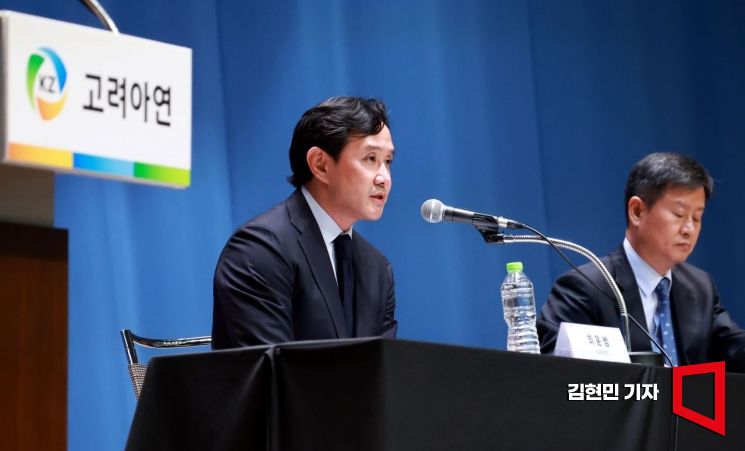 Yoonbeom Choi, Chairman of Korea Zinc, is speaking at a Korea Zinc press conference held at the Korea Chamber of Commerce and Industry in Jung-gu, Seoul, on November 13 last year. On the right is CEO Kideok Park. Chairman Choi stated on that day, "I will step down as chairman of the board as soon as possible, and an outside director will take over as chairman of the Korea Zinc board." Photo by Hyunmin Kim
Yoonbeom Choi, Chairman of Korea Zinc, is currently in a management dispute with Young Poong and MBK Partners. Both Young Poong and MBK Partners have reiterated that they have never opposed either the construction of the U.S. smelter being pursued by Korea Zinc or the Korea-U.S. cooperation itself. They argue that the real issue lies in the rights offering, which is being used as a pretext to defend Chairman Choi's management control. In particular, they pointed out that the funding structure and financial burden for this project could undermine the value for general shareholders.
On December 22, Young Poong and MBK Partners, the largest shareholders of Korea Zinc, released a statement to this effect. They claimed that Chairman Choi's side has misrepresented the funding structure and financial burden, and that their concerns are being distorted as "opposition to the construction of the U.S. smelter" or "denial of Korea-U.S. cooperation."
Describing 'Borrowing' with 8.4 Trillion Won Debt Guarantee as 'U.S. Investment'
Previously, Chairman Choi's side asserted that the United States would cover 91% of the smelter construction costs, and that the project was an example of joint investment by the U.S. government, strategic investors (SI), and global financial institutions. However, Young Poong and MBK Partners argue that this is not accurate.
Young Poong and MBK Partners stated, "Under the joint venture (JV) structure, the total amount invested by the U.S. Department of Defense and strategic investors is about 600 million dollars, while Korea Zinc will also contribute about 90 million dollars." In contrast, they criticized that "the 1.25 billion dollars provided by the U.S. government is a loan that must be repaid."
They further explained, "The long-term syndicated loan of 4.698 billion dollars to be raised by the local U.S. operating company established by Korea Zinc is also a loan provided by the U.S. Department of Defense and global financial institutions," adding, "Korea Zinc is providing a debt guarantee of up to 8.39 trillion won until 2040."
Borrowing that is fully guaranteed by the company carries essentially the same accounting and financial risk as if the guarantor itself had borrowed the funds directly. In the end, they explained, Korea Zinc is effectively taking on most of the responsibility for the debt.
Young Poong and MBK Partners emphasized, "Describing this as 'U.S. investment' is a distorted explanation intended to obscure the real issue, which is the controversy over defending management control through a third-party rights offering."
Disguising Borrowing Costs 2-3 Percentage Points Higher Than Corporate Bonds as 'Low-Interest Funding'
They also criticized the funding interest rates. Previously, Chairman Choi's side described the syndicated loan rate as "low-interest funding, calculated as the 10-year U.S. Treasury yield plus 175 basis points (bp; 1bp=0.01%)."
However, Korea Zinc recently issued three-year and five-year corporate bonds in the domestic market at rates of 3.05% and 3.287%, respectively. Even before this, the company had been able to raise large amounts of capital at stable rates in the low 3% range.
In comparison, the U.S. syndicated loan carries an average interest rate close to 6%, nearly double. If all of this borrowing is executed, the annual interest expense alone is estimated to reach about 480 billion won. This means that significantly higher costs will be incurred compared to raising the same amount of capital in the domestic market.
Young Poong and MBK Partners believe that the structure of this joint venture is excessively favorable to the U.S. side. Previously, Chairman Choi's side explained that the U.S. government would provide various forms of support, such as permits and policy coordination, during the construction and operation of the smelter.
Young Poong and MBK Partners pointed out, "There has been insufficient disclosure or explanation regarding the specific legal basis for this support, who will bear the costs, how profits will be distributed, and the contractual structure." They added, "Although Korea Zinc will secure a 10% stake in the joint venture, the JV's ownership structure, cost-sharing, and profit distribution relationships are not clearly disclosed." They further noted, "Key contractual terms between the U.S. Department of Defense, the local smelter operating company, and the JV have also not been specifically explained."
Young Poong and MBK Partners argued that the essence of the issue is not the construction of the U.S. smelter or Korea-U.S. cooperation, but rather the third-party rights offering designed to defend Chairman Choi's management control. A representative of Young Poong and MBK Partners emphasized, "Most of the financial burden for the construction of the U.S. smelter will ultimately fall on Korea Zinc," and added, "Any attempt to obscure the company's financial reality in order to justify a rights offering for the purpose of defending management control must never be tolerated."
© The Asia Business Daily(www.asiae.co.kr). All rights reserved.

















