"Annual Losses of 3.6 Trillion Won, 14,000 Jobs at Risk"
"Japan's Drug Shortage Crisis Could Be Repeated"
The pharmaceutical industry has defined the government's drug pricing system reform plan as a "declaration of abandoning the industry," warning that its implementation would devastate the sector and urging a complete reconsideration.
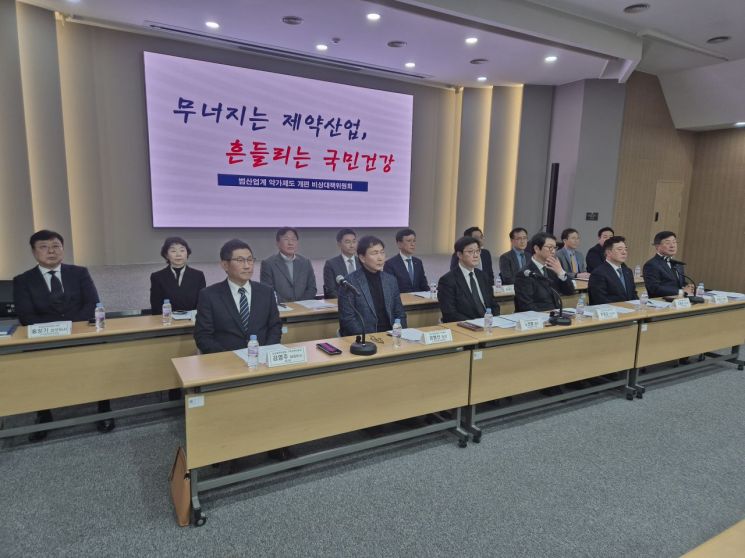 The Emergency Committee for Reforming the Drug Pricing System for the Development of the Pharmaceutical and Bio Industry, consisting of five organizations including the Korea Pharmaceutical and Bio-Pharma Manufacturers Association, Korea Bio-Pharmaceuticals Association, Korea Pharmaceutical Importers and Exporters Association, Korea New Drug Development Association, and Korea Pharmaceutical Cooperative, held an urgent press conference on the 22nd at the association hall in Seocho-gu, Seoul, urging a full reconsideration of the government's drug pricing system reform plan. Photo by Choi Taewon
The Emergency Committee for Reforming the Drug Pricing System for the Development of the Pharmaceutical and Bio Industry, consisting of five organizations including the Korea Pharmaceutical and Bio-Pharma Manufacturers Association, Korea Bio-Pharmaceuticals Association, Korea Pharmaceutical Importers and Exporters Association, Korea New Drug Development Association, and Korea Pharmaceutical Cooperative, held an urgent press conference at the association hall in Seocho-gu, Seoul, on the 22nd and made this statement.
The revised calculation rate could be implemented as early as July next year after gathering feedback. At the press conference, Noh Yeonhong, President of the Korea Pharmaceutical and Bio-Pharma Manufacturers Association, stated, "Since the introduction of the actual transaction price system in 1999, drug prices have been reduced more than ten times, but a comprehensive and multidimensional assessment of the system's effects, side effects, and impact on the industry has never been properly conducted." He added, "We must thoroughly analyze, together with the industry, how both the existing drug pricing policies and the current reform plan will affect public health."
Previously, last month, the Ministry of Health and Welfare reported to the Health Insurance Policy Review Committee a plan to improve the drug pricing system, which includes lowering the calculation rate for generic and patent-expired drugs from the current 53.55% of the original drug price to the 40% range.
The pharmaceutical industry believes that if the drug pricing reform plan is implemented, annual losses could reach the trillion-won level, leading to a contraction in research and development (R&D) investment. Applying the proposed 40% price cap compared to original drugs to the domestic generic market size, the industry estimates annual losses could reach up to 3.6 trillion won. Citing research that shows a 1% decrease in company profits leads to a 1.5% decrease in R&D activities, they argued that the growth engine of the Korean pharmaceutical industry would be completely undermined.
They further predicted that the damage would be concentrated among small and medium-sized pharmaceutical companies, as their average operating profit margin is less than 5%. The prevailing view in the industry is that these companies would inevitably face deficits if the reform plan is implemented.
Concerns were also raised about a public health security crisis due to potential disruptions or suspensions in the supply of pharmaceuticals. According to a study by the Korea Trade-Investment Promotion Agency (KOTRA) last year, after Japan implemented drug price reduction policies, 4,064 generic drug items-32.1% of the total-experienced supply shortages and production suspensions.
Additionally, the Emergency Committee projected that up to 14,800 job losses could occur as a result of this reform plan. The employment inducement coefficient for the pharmaceutical industry is 4.11 people per 1 billion won in sales, higher than semiconductors (1.6) or displays (3.2). Applying this coefficient to the maximum estimated sales decrease calculated by the industry, up to 14,800 jobs could be lost. They particularly emphasized that high-quality jobs in regional areas would decline, as 653 pharmaceutical production facilities and around 200 research facilities are predominantly located outside the capital region.
The pharmaceutical industry stressed the need for a governance-based decision-making system, rather than unilateral government notifications. They insisted on the necessity of an official consultation mechanism to systematically reflect industry opinions in the drug pricing policy decision process. They also called for a grace period and a complete reconsideration of the government's reform plan, as well as a prior comprehensive and quantitative evaluation of existing drug pricing policies.
© The Asia Business Daily(www.asiae.co.kr). All rights reserved.

















