State-Owned Power Companies to Establish Regional SPCs
Promoting a Public-Led Solar Project Model
Factory Rooftop Solar Potential Reaches 22.6 GW
Only 3.7 GW Deployed So Far
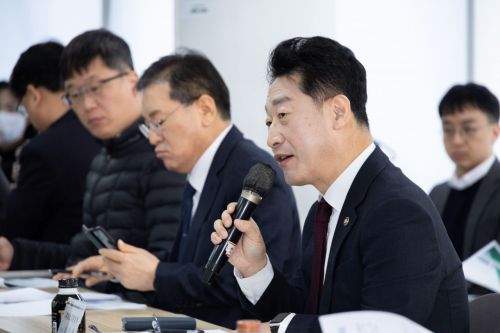 Lee Hohyun, Deputy Minister of the Ministry of Climate, Energy and Environment, is speaking at a meeting to promote rooftop solar power at factories held on the 22nd at SpaceShare Seoul Station Center 2 in Yongsan, Seoul. 2025.12.22 Ministry of Climate, Energy and Environment
The government has announced plans to expand solar power generation to 20 gigawatts (GW) by utilizing factory rooftops and idle land owned by companies located in industrial complexes nationwide. To achieve this, the government will actively promote a public-led rooftop solar project through state-owned power generation companies. The government expects that the rooftop solar project will enable small and medium-sized enterprises to reduce their electricity bills by up to 30%.
On the morning of December 22, the Ministry of Climate, Energy and Environment held a meeting at SpaceShare Seoul Station Center 2 in Yongsan, Seoul, chaired by Deputy Minister Lee Hohyun, to discuss measures to promote rooftop solar power at factories.
Deputy Minister Lee stated, "The potential for solar power generation using factory rooftops across the country is 22.6 GW, but only 3.7 GW has been deployed so far," adding, "We need to accelerate solar power deployment with the goal of reaching 20 GW."
He further explained, "One of the most effective ways to lower industrial electricity rates is to install solar panels on factory rooftops. If we install solar panels that can operate for more than 20 years and link them with on-site power purchase agreements (PPAs), we can supply solar electricity at a significantly lower cost."
Factory rooftops are considered optimal sites for renewable energy deployment because they do not require separate land development and minimize landscape disruption. They also offer advantages in terms of grid connection compared to other locations. If companies use the solar power generated on their own factory rooftops, they can further reduce their electricity costs.
On this day, the Ministry announced plans to expand the rooftop solar project at factories by establishing a system for preliminary diagnosis, consulting, and support; reducing the initial installation burden through financial and deployment support; and promoting the spread of zero-initial-investment PPA models.
The zero-initial-investment PPA model refers to a business model in which the solar power operator is fully responsible for the initial investment and operation, while the factory owner benefits solely from reduced electricity bills or rental income. The government plans to hold regional business briefings, led by the Korea Industrial Complex Corporation, Korea Energy Agency, and industry associations, to match factory owners with interested companies.
In particular, the Ministry plans to expand the "public-led solar project" nationwide, in which state-owned power generation companies and the Korea Industrial Complex Corporation establish special purpose companies (SPCs) to install solar facilities on idle land identified in each region.
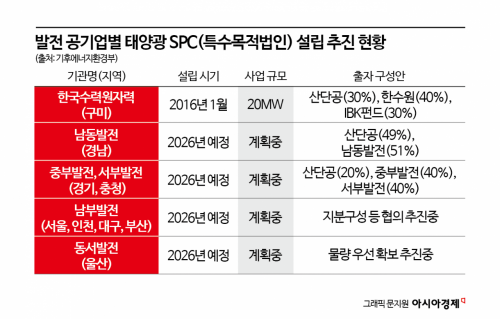
For example, Korea Hydro & Nuclear Power will establish an SPC in Gumi, North Gyeongsang Province; Korea South-East Power will do so in South Gyeongsang Province; Korea Midland Power and Korea Western Power in Gyeonggi and Chungcheong Provinces; Korea Southern Power in Seoul, Incheon, Daegu, and Busan; and Korea East-West Power in Ulsan. Each SPC will promote public-led solar projects in its respective region.
Initially, Korea Hydro & Nuclear Power (with a 40% stake) plans to establish an SPC in January next year together with the Korea Industrial Complex Corporation (30%) and Shinhan Asset Management (IBK Fund, 30%), and then pursue a 20 MW solar project at the Gumi Industrial Complex in North Gyeongsang Province.
Korea Hydro & Nuclear Power will oversee project development and management, the Korea Industrial Complex Corporation will support site identification, civil complaints, and permits, and Shinhan Asset Management will handle SPC establishment, fund management, equity investment, and project financing loans.
Other state-owned power generation companies are also discussing share composition with the goal of establishing SPCs by 2026. Korea South-East Power plans to set up an SPC with the Korea Industrial Complex Corporation to deploy solar power in industrial complexes in South Gyeongsang Province.
The SPCs will use domestically produced solar modules and inverters, select EPC (engineering, procurement, and construction) contractors through public bidding, and return minimum profits to factory owners. With participation from highly creditworthy public institutions and financial institutions, financing costs are also expected to decrease.
A Korea Hydro & Nuclear Power official stated, "Through on-site PPAs and other measures, we plan to supply electricity at prices about 20-30% lower than standard industrial electricity rates."
A Ministry of Climate, Energy and Environment official said, "We plan to operate a consultative body involving the government, local governments, and public institutions by utilizing the currently operating public renewable energy transition policy council," adding, "For leading projects, we will provide support to ensure that permits for power generation projects and construction plans are reviewed quickly."
Meanwhile, in a survey conducted by the government in November targeting companies in ten specialized root industry complexes in the Seoul metropolitan area, southeastern region, and Honam region, 54% expressed demand for solar facilities.
The main reason for wanting renewable energy was electricity cost reduction (80%), followed by carbon reduction and RE100 compliance (20%). The main obstacles to adopting renewable energy were the initial investment burden (70%) and lack of installation space (30%).
© The Asia Business Daily(www.asiae.co.kr). All rights reserved.
![Clutching a Stolen Dior Bag, Saying "I Hate Being Poor but Real"... The Grotesque Con of a "Human Knockoff" [Slate]](https://cwcontent.asiae.co.kr/asiaresize/183/2026021902243444107_1771435474.jpg)

















