Seoul Museum of Art, Through April 5 Next Year
Choi Jaeun has continuously explored the relationship between life and nature through a variety of media, including sculpture, video, installation, and architecture. Her practice of collecting wildflowers and wild plants encountered in daily life, searching for their names, and recording them is part of this ongoing inquiry.
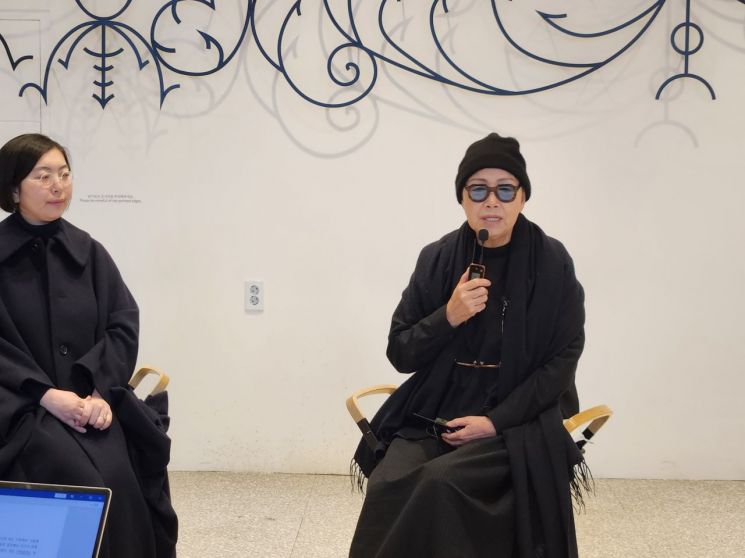 On the morning of the 22nd, artist Choi Jaeun is speaking at a press conference held at the Seosomun Main Building of the Seoul Museum of Art in Jung-gu, Seoul. Photo by Seo Mideum
The artwork "When We First Met" is a result of this process, pressing and naming over 560 collected life forms whose identities were previously unknown. As she took two walks each day to gather wildflowers, one might wonder why and how the artist found and assembled the names of 560 living beings. Meeting with reporters on the 22nd at the Seosomun Main Building of the Seoul Museum of Art, where her solo exhibition "Choi Jaeun: Promise" is being held, Choi explained, "I wanted to restore their sovereignty by recognizing their names and existence," adding, "I thought that if we pay attention to the fact that they coexist with us but are disappearing, there is a possibility for their survival." The wildflowers and wild plants pressed onto lacquered wooden panels seem to each contain their own origins, the cultures they have formed with humans, and stories about the crises they face. The exhibition hall is filled with the gentle sounds of "Calling Names," a sound installation created in collaboration with music director Jang Younggyu, in which the names of representative species that have gone extinct since the Industrial Revolution are called out.
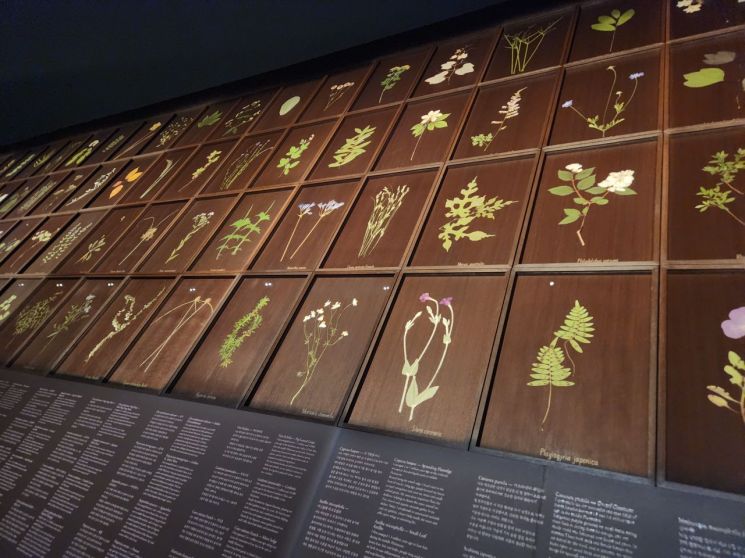 The artwork "When We First Met," which captures the images and names of over 560 wildflowers and wild plants. Photo by Seomideum.
The artist’s affection for nature naturally extends to a special sentiment for the Demilitarized Zone (DMZ), a symbol of division. The steel stepping stones placed in one corner of the exhibition are made from plates produced by melting DMZ barbed wire. This sculpture visually condenses the artist's awareness of the opposition between human-imposed boundaries and the boundlessness of nature. By stepping on these platforms, made from the melted symbol of separation filled with thorny hatred, we experience crossing boundaries and moving toward a new dimension of life. Choi first encountered the DMZ by chance, where she experienced the irony of the severance of humanity and the persistence of nature. She later released the documentary "On the Road" (2000) and continued research on seed balls (bundles of plant seeds for ecosystem restoration), among other projects. Her artistic activities are also part of this ongoing effort. This exhibition presents a concentrated overview of such activities. For her, art possesses a dynamic value beyond mere aesthetics. "I plan to expand my activities in the DMZ. I am encouraging seed ball donations." During the exhibition period, visitors can participate in a hands-on program where they make sunflower seed balls with soil.
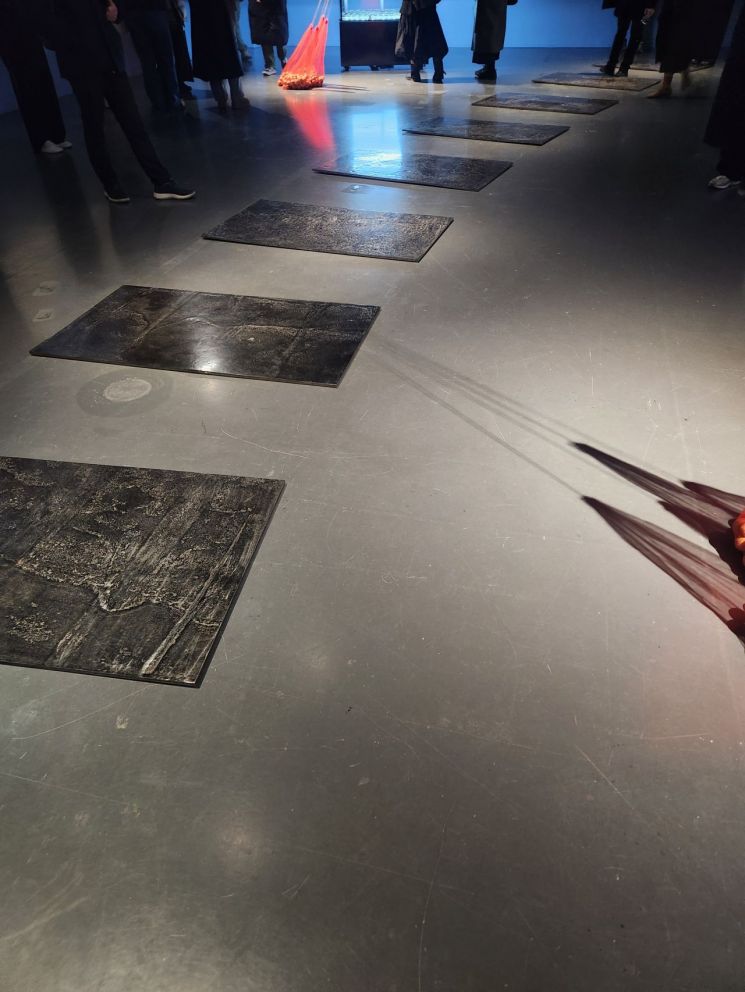 A steel plate made by melting DMZ barbed wire is laid out like stepping stones on the exhibition floor. Photo by Seomideum.
Choi’s works serve as a wake-up call for humanity. Her video series "Unanswered Horizon," which combines real-time sea surface temperature data with ocean imagery, visualizes the realities of the climate crisis and ecological destruction. The bleached coral displayed in the center of the exhibition hall acts as a warning from nature, urging visitors to listen not only from a human-centered perspective but also to the alarms sounded by the sea and the land. Choi stated, "Temperatures from different regions are transmitted every ten seconds. I noticed that sea surface temperatures have risen significantly over the past year," and added, "I hope this exhibition serves as a wake-up call for visitors."
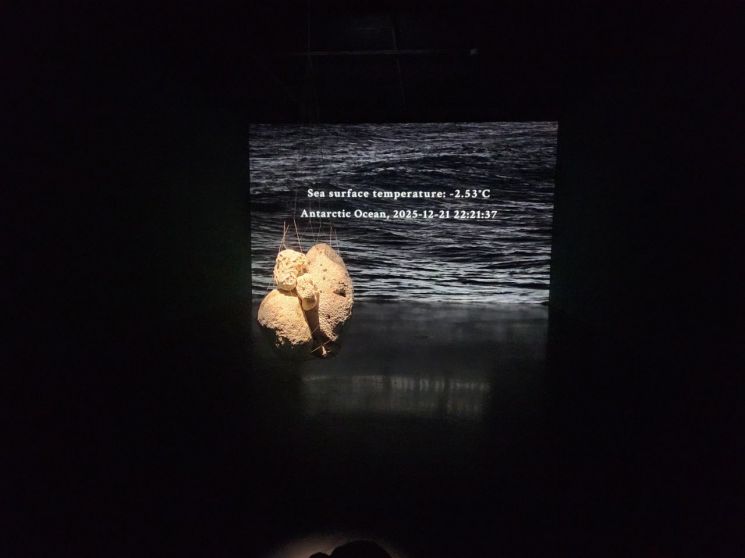 Sea surface temperatures from around the world are being transmitted to the exhibition hall in real time. Photo by Seomideum
This exhibition is Choi Jaeun’s first solo show at a national or public art museum in Korea, offering an overview of her artistic world through both representative and recent works for the first time in about ten years. The exhibition runs until April 5 of next year.
Choi Jaeun (71) moved to Japan in 1975, where she immersed herself in Sogetsu Ikebana, the traditional Japanese art of flower arrangement, and established her own unique artistic world. She has been active internationally, serving as the representative artist for the Japan Pavilion at the Venice Biennale (1995), participating in the S?o Paulo Biennale (1991), and being invited to the main exhibition of the Venice Architecture Biennale (2016). In Korea, she has carried out public projects such as "Simultaneity" at Kyungdong Church in Seoul (1990), "Space of Zen" at the Saritap of Monk Seongcheol at Haeinsa Temple (1995-1998), and "Direction of Time" at Samsung Medical Center (1994).
© The Asia Business Daily(www.asiae.co.kr). All rights reserved.



















