City Branch Approves Female Special Districts for Some Council Seats
Nam-gu 2, Seo-gu 3, Buk-gu 3, and Gwangsan 5 Among Those Mentioned
Lee Myungno: "Retaliatory Cutoff Without Principles"
Agenda Returned Without Supreme Council Approval, Responsibility Back to Gwangju City Branch
The Gwangju City Branch of the Democratic Party of Korea is facing internal backlash after designating certain city council electoral districts as female competitive strategic electoral districts (female special districts). The related agenda item, which was submitted to the Supreme Council of the central party, was sent back without a decision, returning the responsibility for judgment to the city branch.
According to a compilation of reports by The Asia Business Daily on December 22, the Gwangju City Branch of the Democratic Party held an operations committee meeting on December 20 and passed an agenda to designate some of the 20 city council electoral districts in Gwangju as female special districts. The female special district is one of the strategic nomination methods used to achieve the party's constitutional principle of recommending at least 30% female candidates.
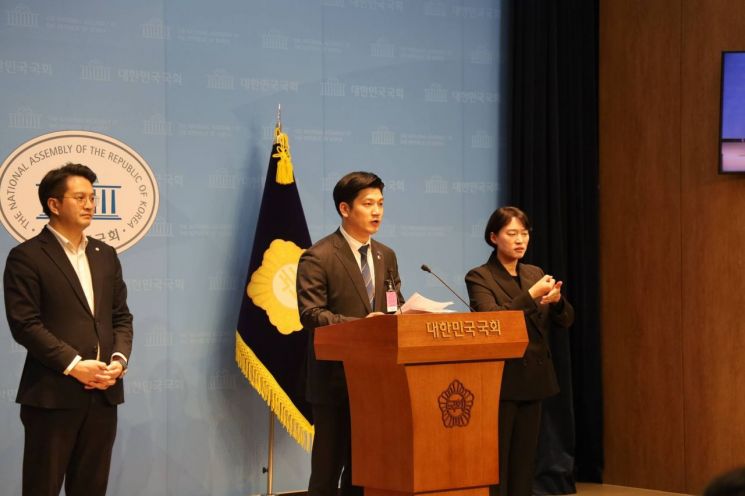 Lee Myungno, a member of the Gwangju City Council, is expressing his position on the designation of the female competitive strategic electoral district (female special district) by the Democratic Party of Korea Gwangju City Party at the National Assembly Communication Office on the morning of the 22nd.
The Gwangju City Branch has not officially released which specific districts have been designated, citing the need for approval from the Supreme Council of the central party. However, in political circles, districts such as Nam-gu District 2 (currently represented by Lim Miran), Seo-gu District 3 (currently represented by Lee Myungno), Buk-gu District 3 (currently represented by Shin Sujeong), and Gwangsan-gu District 5 (currently represented by Park Sugi) are being discussed as possible female special districts.
There was immediate backlash following the city branch's decision. Lee Myungno, a member of the Gwangju City Council, held an emergency press conference, stating, "The female special districts were designated without principles or standards, even though the evaluation of elected officials has not been completed." He argued, "Designating my district as a female special district simply because I did not offer support during the last election is essentially a retaliatory cutoff." He added, "Since Party Leader Jeong Cheongrae has pledged to eliminate unfair cutoffs, the Supreme Council of the Democratic Party must correct the city branch's decision."
Meanwhile, the agenda regarding the designation of female special districts was submitted to the Supreme Council of the central party on the morning of December 22. However, the Supreme Council did not make a decision on the matter, citing unclear responsibility and lack of clarity on who should make the judgment, and the agenda was returned without being processed. As a result, the responsibility for deciding whether to designate female special districts has reverted to the Gwangju City Branch.
Although the designation of female special districts is a task delegated to city and provincial branches under the party's constitution and regulations, it is not a mandatory rule. Given that matters related to female nominations have typically been executed by city and provincial branches after receiving guidelines from the central party, there are criticisms that this decision was pushed forward preemptively by the Gwangju City Branch without prior instructions from the central party.
In a phone interview with The Asia Business Daily, Assemblyman Lee Myungno said, "I agree with the intention to expand women's political participation, but it is problematic for the city branch to decide on special district designation without central party guidelines." He added, "There were concerns within the Gwangju City Branch that pushing ahead in this manner was risky, and I understand there was an opinion to seek a decision through the Supreme Council." On this day, Assemblyman Lee visited Seoul to meet with Supreme Council members of the central party and stated, "With the agenda item returned by the Supreme Council, the responsibility and judgment have reverted to the city branch."
Internal criticism continues. Yang Bunam, the head of the Gwangju City Branch, and former Assemblyman Kim Gwangjin, who competed against him in last year's general election primary, have publicly raised issues with the city branch's decision. Former Assemblyman Kim stated on social media, "Designating specific districts as female special districts before the evaluation of incumbents is completed is no different from carrying out political cutoffs under the name of special districts."
The composition of the Gwangju City Council is also cited as a background to the controversy. Currently, out of a total of 23 seats on the Gwangju City Council, the Democratic Party holds 22, with 10 female members (eight representing districts and two proportional representatives). The proportion of female members is about 43%, already exceeding the party's constitutional principle of recommending at least 30% female candidates.
A Democratic Party official stated, "We are comprehensively reviewing the current situation, including the results of the Supreme Council's discussion," and added, "The city branch's final position regarding the designation of female special districts will be determined within today."
In local political circles, there are also voices raising procedural concerns. One local political figure said, "There is little disagreement within political circles about the direction of expanding women's political participation," but added, "The opinions of candidates who have been preparing to run should have been heard and a sufficient deliberation process should have taken place. The omission of such procedures has led to increased backlash." The source continued, "The Supreme Council members also respect local opinions, but since this issue has been controversial from the beginning, it must have been burdensome. The return of the agenda seems to be intended to postpone the conclusion and encourage further consideration."
© The Asia Business Daily(www.asiae.co.kr). All rights reserved.
![Clutching a Stolen Dior Bag, Saying "I Hate Being Poor but Real"... The Grotesque Con of a "Human Knockoff" [Slate]](https://cwcontent.asiae.co.kr/asiaresize/183/2026021902243444107_1771435474.jpg)

















