Advancing Network Infrastructure... 290 Billion Won Investment Planned for Next Year
Collaboration with Nvidia, but Guarding Against Overdependence Through Localization
The government has announced plans to build intelligent base stations equipped with AI (AI-RAN) to lead the era of physical artificial intelligence (AI) services in the 6G era. In this process, the government aims to maintain its partnership with Nvidia while taking the lead in the ecosystem through the localization of solutions.
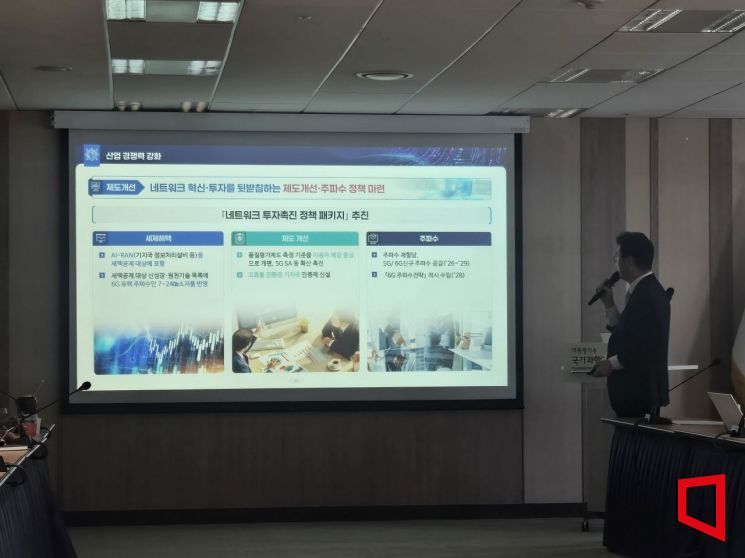 Younggil Jung, Director of Network Policy at the Ministry of Science and ICT, is presenting at the 'Hyper AI Network Strategy' press briefing held on the 19th. Photo by Gyeongjo Noh
At the "Hyper AI Network Strategy" press briefing held on the 19th, Younggil Jung, Director of Network Policy at the Ministry of Science and ICT, stated, "While network evolution up to 5G has focused on communication performance, from 6G onward, base stations will be equipped with computing and sensing capabilities, accelerating the spread of physical AI."
The AI ecosystem is evolving from generative AI to AI agents and physical AI. Physical AI, which directly operates robots and objects, requires large-scale AI computation and real-time communication. Accordingly, the network must also evolve into a computing infrastructure (edge AI) that enables simultaneous AI computation and control at nearby base stations.
Jung explained, "In the case of the cloud, passing through AI data centers causes latency, making it impossible to meet real-time requirements. For Korea to become the global leader in physical AI, it is essential for the unfamiliar fields of telecommunications and physical AI to be seamlessly integrated."
He added, "The government plans to invest approximately 290 billion won next year in the advancement of networks, including AI base stations. We will create a platform where not only equipment manufacturers but also operators and software companies can participate." He further noted that mid- to long-term investment resources will be discussed in consultation with the Ministry of Economy and Finance and the Ministry of SMEs and Startups.
AI base stations will be built with graphics processing units (GPUs). Seongho Choi, Program Manager at the Institute for Information & Communications Technology Planning & Evaluation (IITP), said, "Base stations with GPUs are inevitably more expensive, but in Korea, it is cost-effective because GPUs only need to be installed in about 200 central offices where optical cables are concentrated."
However, there are concerns that a GPU-based structure could increase supply chain dependence on Nvidia and lead to ecosystem lock-in. Regarding this, Choi explained, "Once the market expands with Nvidia's unique GPU solutions, there is a risk of lock-in. However, just as Samsung Electronics grew based on Qualcomm's CDMA technology in the past, we will also consider strategies for localization."
The government plans to expand standalone 5G (SA) and 6G across all commercial networks while also pursuing specialized networks in parallel. The allocation of 6G frequencies is scheduled to take place around 2029. The Ministry of Science and ICT is focusing more on securing leadership in the ecosystem than on being the first in the world to commercialize 6G.
Jung stated, "Just as the advent of smartphones drove the development of 4G, network evolution requires killer services that satisfy consumer needs. In the 6G era, physical AI will play that role."
© The Asia Business Daily(www.asiae.co.kr). All rights reserved.

















