Six IBs Expect Two Rate Cuts; Two Project One Cut, Two See Three Cuts
Inflation to Peak in First Half, Expected at 2.7% by Year-End
Limited Job Growth Anticipated; Unemployment Rate to Remain at 4.4%
Six out of ten major investment banks (IBs) on Wall Street expect the United States Federal Reserve (Fed) to cut its benchmark interest rate twice next year. This outlook is somewhat more dovish than the Fed's recent dot plot, which suggested only one rate cut. The consensus among major IBs is that, with the policy rate now close to the neutral rate, the monetary easing cycle will likely conclude after around two rate cuts in 2025.
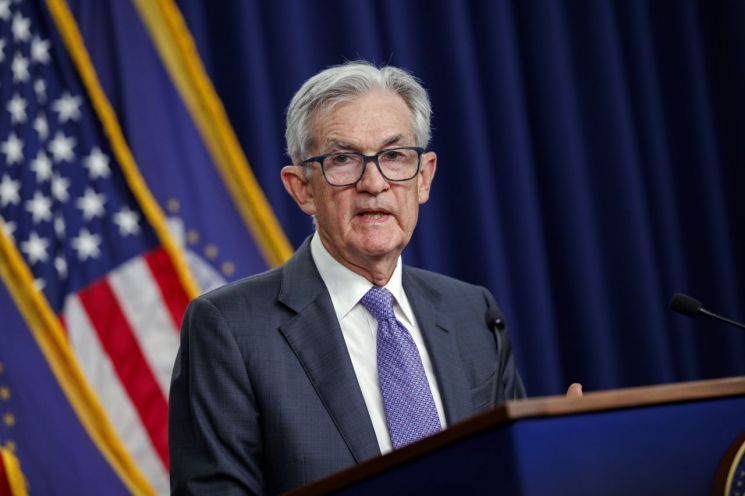
According to the "2026 U.S. Economic Outlook and Key Issues" report released by the Bank of Korea's New York office on December 20 (local time), six out of ten Wall Street IBs-Goldman Sachs, Morgan Stanley, Wells Fargo, Barclays, Bank of America (BoA), and Nomura Securities-forecast that the Fed will cut its benchmark rate, currently at 3.5-3.75% per annum, by 0.25 percentage points twice next year.
J.P. Morgan and Deutsche Bank expect the Fed to cut the benchmark rate once by 0.25 percentage points next year, in line with the Fed's dot plot projection. In December of last year, the Fed indicated in its dot plot, released immediately after the regular Federal Open Market Committee (FOMC) meeting, a median year-end policy rate of 3.4%, suggesting the possibility of one rate cut in 2025.
In contrast, Citibank and TD Securities anticipate that the Fed will cut the benchmark rate three times by 0.25 percentage points each next year.
The Bank of Korea's New York office explained, "The similar outlook for Fed policy rate cuts among major IBs in 2026 is due to the policy rate approaching the neutral rate as rate cuts continue in the second half of this year, and because forecasts for the U.S. economy, employment, and inflation next year are generally similar." The office added, "Most IBs expect the current rate-cutting cycle to end in the second or third quarter of next year, as policy uncertainty under the Donald Trump administration eases, tax cuts are implemented, and continued corporate investment supports solid economic growth."
Fifty-six IBs project that inflation next year will remain under upward pressure, especially in the goods sector, peaking in the first half of the year and gradually slowing to reach around 2.7% by the end of 2025. This is because companies that have not been able to fully pass on tariff costs to consumer prices so far are likely to raise goods prices to secure margins going forward. The current tariff pass-through rate reflected in prices is estimated at 20-40%. However, as price pass-through is completed in the first half and base effects come into play, inflation is expected to slow in the second half. Inflation for this year is projected to rise by 2.6% year-on-year.
The labor market is expected to recover only gradually, due to limited labor supply and the negative impact of tariff hikes on employment. The number of employed persons is projected to increase by an average of 72,000 per month next year, slightly higher than this year's estimate of 62,000. The unemployment rate forecast for next year, as presented by 44 IBs, is 4.4%, the same as this year's estimate.
Despite a slowdown in consumption caused by weak employment, the U.S. economy is expected to maintain a growth rate similar to this year, supported by increased investment and the effects of tax cuts. Sixty-six IBs forecast the U.S. growth rate for 2026 at 2.0%, unchanged from this year's projection. In particular, continued corporate investment, especially in artificial intelligence (AI), along with tax cuts providing incentives for investment in tangible assets, is expected to underpin solid growth.
The Bank of Korea's New York office stated, "The reduction in the tax burden on households and companies due to the One Big Beautiful Bill (OBBA), along with lower interest expenses from policy rate cuts, will partially offset the slowdown in consumption and support investment." The office added, "In particular, corporate investment is expected to show robust growth even outside the AI sector, based on increased investment capacity secured through tax cuts."
© The Asia Business Daily(www.asiae.co.kr). All rights reserved.

















