President Lee Briefs Financial Services Commission and Financial Supervisory Service
"Flood of Anonymous Reports... Many Claims Are Quite Valid"
"Finance Seems to Be the Cutting Edge of Capitalism, Devoid of Blood or Tears"
Repeated Criticism of Business Practices Centered on Collateral Loan Interest
Emphasis on Transition to Inclusive Finance
"Due to concerns over government-led financial control, the government has instructed us not to intervene directly, so we have refrained. However, when left alone, a corrupt 'inner circle' forms, and a small group rotates control as they please."
"Looking at the business practices of financial companies, their main activity is to lend money using land or houses as collateral and profit from the interest, which is essentially an easy and risk-free approach."
On December 19, President Lee Jaemyung mentioned the 'Task Force for Improving Governance Structure' during a briefing by the Financial Services Commission and the Financial Supervisory Service, stating that changes are needed in the process of appointing CEOs in the financial sector. He instructed the supervisory authorities to appropriately exercise their powers in response. President Lee also directly criticized the business practices centered on collateralized lending. Since taking office, he has repeatedly emphasized at Cabinet meetings and other occasions the need to shift toward 'productive finance,' which increases the proportion of funds flowing in through corporate activities.
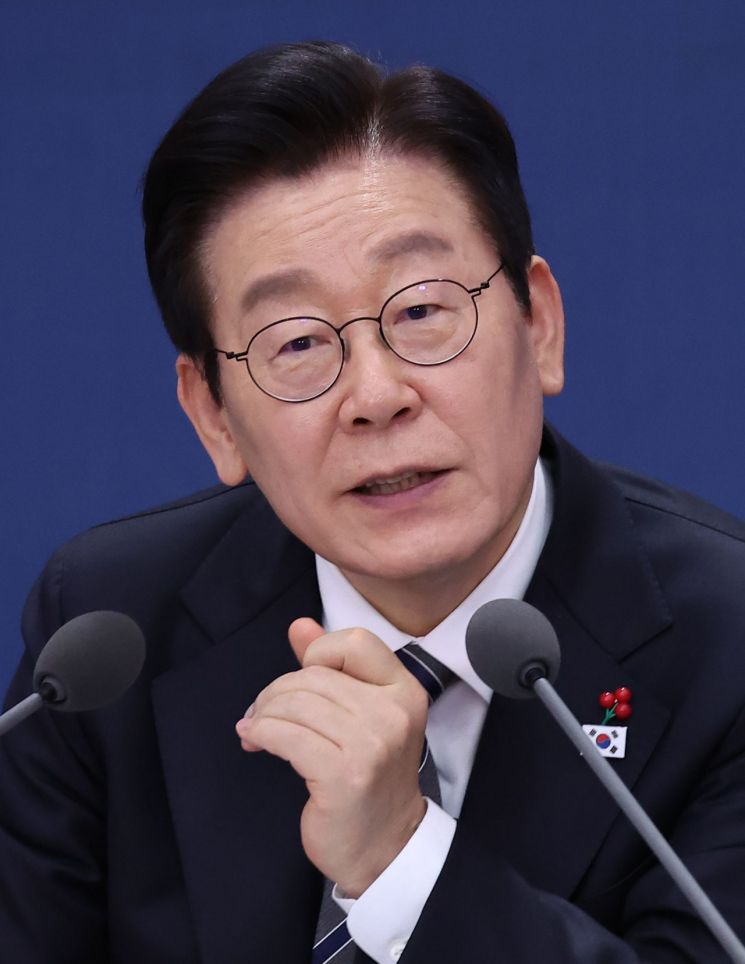
President Lee began by saying, "These days, I receive a flood of anonymous reports. There are a huge number of complaints about issues in the selection process." He then raised concerns with Lee Chanjin, Governor of the Financial Supervisory Service, about the backward personnel structure where a small group wields control, asking, "Is it really something we can just leave unattended?" During the discussion, he also asked Chief of Staff Kang Hoonshik and Policy Chief Kim Yongbeom if they had received similar reports; when both answered that they had, President Lee remarked, "The claims in these reports are not just slander arising from competition; there is considerable validity to them. The same group forms an inner circle and continues to take turns controlling things," he criticized.
President Lee continued, "If the inner circle were ethical and competent and managed the financial groups well, there would be nothing to say. But that does not seem to be the case. They keep rotating, serving as chairman, then bank president, going back and forth for 10 or even 20 years," he continued to criticize.
In response to President Lee's remarks, Governor Lee stated that he would present related legislative reform measures by January. He said, "I have previously referred to this as a 'trench,' and the problem is particularly acute in financial holding companies. The board is structured mainly around people connected to the chairman, which is a structural issue that needs to be improved. We will launch a task force and produce legislative reform measures by January to submit a bill," he replied.
President Lee also said it is necessary to appropriately utilize the powers held by the Financial Supervisory Service. He emphasized, "While amending laws and systems is important, it is also crucial to exercise the authority of the Financial Supervisory Service, at least to the extent of preventing highly abnormal cases from occurring." Governor Lee responded, "We are preparing to initiate inspections of individual financial institutions under the financial holding companies in question, and I will provide a detailed report in January."
"Household collateral loan interest is the main pillar... The cutting edge of capitalism, devoid of blood or tears" - Criticism
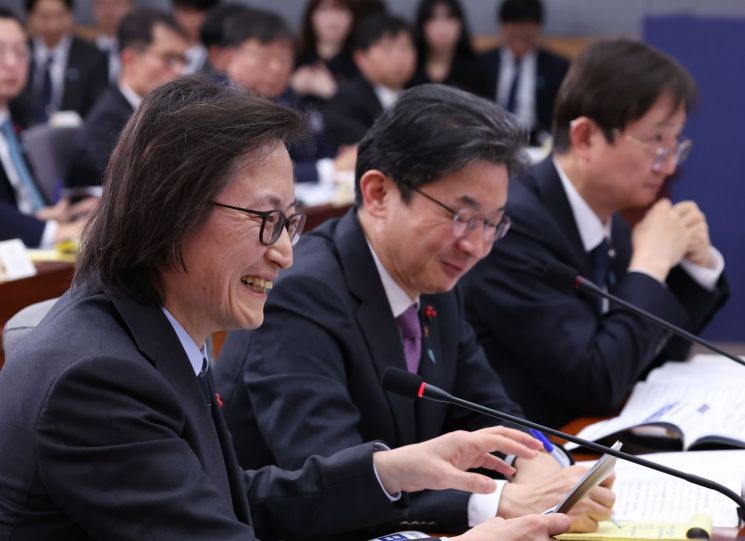
President Lee continued his criticism of the business practices in the financial sector. During the Financial Services Commission's briefing, he stated, "We need to strengthen the transition to inclusive and productive finance," and pointed out, "The main business model is essentially lending money using land or houses as collateral and profiting from the interest, which is an easy and risk-free approach." He emphasized the need for correction, saying, "Funds should flow into the corporate or productive sectors, but they are all concentrated in the private consumption sector."
In response, Financial Services Commission Chairman Lee Eogwon said he would pursue institutional reform. He explained, "Seventy percent of household loans in the banking sector are mortgage loans because it is the easiest and least risky, so lending is concentrated there. It is questionable how much this actually benefits the Korean economy as a whole." President Lee reiterated, "Even if you change things with determination, at some point things just snap back. The power of money is formidable. It would be best to fix this in the form of law as much as possible," he urged.
He also called for a transition to an inclusive financial environment. President Lee said, "The people who really need money are ordinary citizens, but those with plenty of assets, strong collateral, and high credit use finance to make even more money." He diagnosed that in a low-interest environment, this leads to widening asset gaps. President Lee added, "This is a kind of natural phenomenon, but since only the government and policy can correct it, the roles of the Financial Services Commission and the Financial Supervisory Service are important."
President Lee again emphasized the need to strengthen the public function of financial companies. He believes that while financial companies hold a privileged position by utilizing the state's currency-issuing power, they lack sufficient awareness of their public responsibility. President Lee said, "It is good to work hard, but as a result, the financial sector seems to be the most liberal, the cutting edge of capitalism, completely devoid of blood or tears. Since they are acting on behalf of state affairs, they must bear corresponding responsibility," he said.
President Lee went on to point out the issue with the structure that allows financial companies to easily pursue debt-related lawsuits due to relatively low litigation fees, stating, "It is problematic to create a system by law that unfairly favors financial institutions. It feels like a violation of the constitutional right to equality. Should the disadvantaged be put at an even greater disadvantage?" he criticized.
© The Asia Business Daily(www.asiae.co.kr). All rights reserved.


















