Ministry of Justice Briefs President on Key Initiatives
"Supporting Prosecutorial Reform Including Separation of Investigation and Prosecution"
Strengthening Investigation Capabilities for Voice Phishing and Drug Crimes
On December 19, Justice Minister Jung Sung-ho announced his commitment to "steadily advancing prosecutorial reform that meets public expectations," stating that he would support the establishment of the Office of Public Prosecution and the Serious Crimes Investigation Agency (SCIA) in accordance with the principle of separating investigation and prosecution.
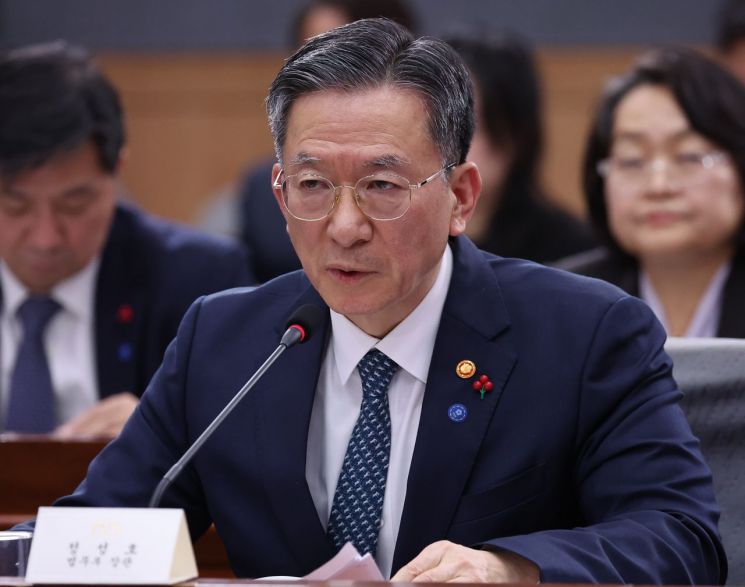 Jung Sung-ho, Minister of Justice, is reporting on work to President Lee Jae-myung at the Government Seoul Office Annex on the 19th. Photo by Yonhap News
At a work briefing held that day in the international conference room of the Government Seoul Office, Justice Minister Jung reported on the "Major Work Implementation Plan of the Ministry of Justice" and presented four key directions and twelve priority tasks.
Regarding prosecutorial reform, Minister Jung stated that "investigation and prosecution will be separated, but the national capacity to respond to crime will be maintained." He pledged to support the activities of the Prosecutorial Reform Task Force under the Prime Minister's Office, and to strengthen the public interest representation role of prosecutors, including the recovery of criminal proceeds, international cooperation, and public interest litigation.
In addition, to respond to crimes that harm people's livelihoods, the joint investigation unit for voice phishing crimes will be formally institutionalized. Through the "Government-Wide Task Force for Overseas Voice Phishing Offenders," international cooperation will be used to pursue the arrest and extradition of overseas base organizations. Financial crime investigations will be strengthened, centered on the Task Force for Strengthening Responses to Unfair Transactions in the Capital Market. The ministry also plans to introduce an "independent confiscation system," which will allow the confiscation and collection of criminal proceeds without indictment or conviction, and to amend relevant laws to facilitate the return of assets to victims.
Regarding drug crimes, the government will concentrate investigative and administrative resources through the Government Joint Investigation Headquarters to block supply, and expand rehabilitation and treatment programs, including conditional non-prosecution for participation in the "Judicial-Treatment-Rehabilitation Linkage Model." Sixty-one dedicated probation officers will be deployed to strengthen supervision of high-risk repeat offenders, and efforts will be made to prevent recidivism through the operation of dedicated juvenile institutions and the expansion of juvenile facility capacity.
In the economic sector, the ministry will promote regional economic revitalization and social integration through immigration policies such as expanding region-specific visas and institutionalizing metropolitan visas, and will support improvements to commercial and civil law systems. In addition, it will pursue "rationalization of the penal system" to reduce the burden on businesses by revising economic criminal regulations and converting minor violations of obligations to fines.
In the area of human rights, the ministry will seek to introduce provisional measures such as restraining orders and electronic monitoring devices to protect victims of dating violence, establish an integrated support system for online crime victims, and expand support for court-appointed lawyers for victims of serious crimes. The ministry also announced that it would complete follow-up legislation to amend the Attorney-at-Law Act to introduce the Attorney-Client Privilege (ACP).
Minister Jung stated, "We will make 2026 the first year of innovation in legal administration and lead changes that the public can truly feel."
© The Asia Business Daily(www.asiae.co.kr). All rights reserved.

















