Ecological Sensory Experiences of Children Aged 3 to 5
Production of "Green Sensory" Cards
The Korea Forest Welfare Institute under the Korea Forest Service, National Chilgok Forest Center, announced that it has piloted the production of “Green Sensory” cards, a forest culture content based on regular forest play education programs conducted throughout 2025 for children aged 3 to 5. These cards capture the sensory experiences and expressions of young children in the forest.
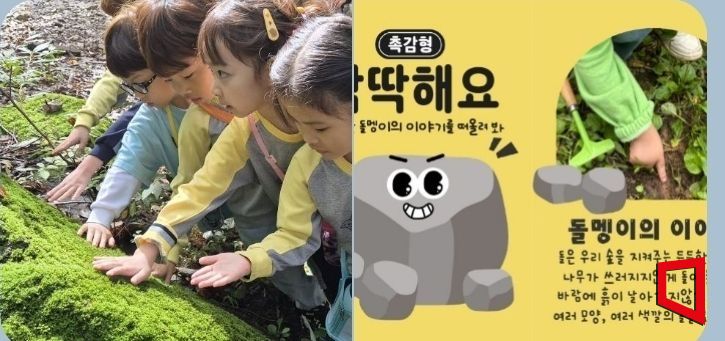 Children aged 3 to 5 participating in regular forest play education touching moss growing on rocks in the forest to feel the texture with their hands / Photo by Lee Ihwan
While operating the regular forest play education program in partnership with Emil Daycare Center in Chilgok County, the National Chilgok Forest Center observed that children were experiencing the forest not merely as a space for activities, but as a place for learning where they perceive and create meaning through their bodies and senses.
In particular, it was noted that the way children perceive and express their sensory experiences in the forest varies by age, from 3 to 5 years old. As a result, the need for educational tools that support sensory experiences at each stage of development and help naturally expand these experiences through play was discussed.
The “Green Sensory” cards were developed in a total of 25 types, based on the diverse sensory experiences children felt and expressed in the forest. These cards feature young children's language expressions focused on touch, texture, and feelings.
Expressions such as “soft,” “pointy,” and “hard” were included to naturally support the process of children recognizing and expressing their senses during actual forest play.
Each card also includes activity suggestions to help extend sensory experiences into play, making them useful as resources for sensory play and play support in the field. Through these cards, teachers and forest instructors can observe children's sensory expressions and adjust or expand play according to age and individual differences.
This pilot production serves as a foundational step for future use. The National Chilgok Forest Center plans to develop and operate forest sensory programs for infants and young children using the “Green Sensory” cards starting in 2026. Additionally, the center intends to distribute these materials as educational resources that can be practically used in early childhood education institutions and forest welfare settings.
The director of the National Chilgok Forest Center stated, “The creation of this forest culture content was an effort to respect the diverse sensory experiences that children feel and express in the forest, and to connect these experiences to education and culture.” The director added, “We will continue to develop forest education content based on children’s developmental stages and real experiences, so that it can be widely used in early childhood education institutions and forest welfare fields.”
© The Asia Business Daily(www.asiae.co.kr). All rights reserved.

















