Susegyo Intersection to Sagimakgol Samgeori: 12.9 km Designated as 'Kim Yunhu Commander Road'
1.1 km in Agok-ri Designated as 'Cheoin Bugokmin-gil'
Yongin City in Gyeonggi Province has designated an honorary road to commemorate Commander Kim Yunhu, who achieved victory in the Battle of Cheoinseong against the Mongol army, and the patriotic spirit of the people of Cheoin Bugok.
On the 18th, Yongin City held an unveiling ceremony for the honorary street nameplate, 'Kim Yunhu Commander Road,' at the Cheoinseong History Education Center in Namsa-eup, Cheoin-gu, with over 50 attendees, including Mayor Lee Sangil and Monk Jeongho of the Yongin Buddhist Temple Association.
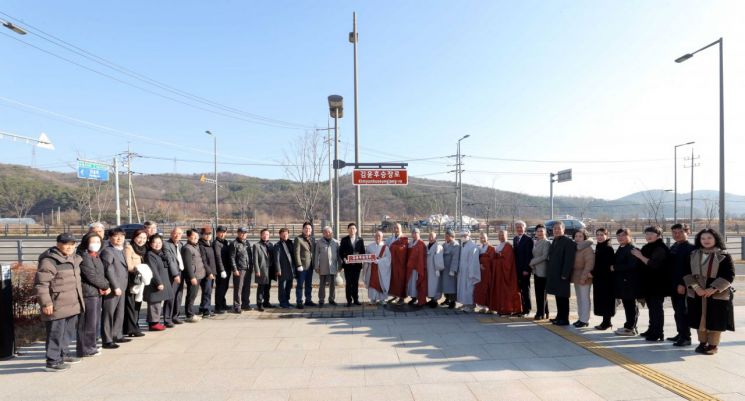 On the 18th, attendees are taking a commemorative photo at the unveiling ceremony of the honorary street nameplate for Elder Kim Yunhu at the Cheoinseong History Education Center in Yongin. Provided by Yongin City
This event was held to honor Commander Kim Yunhu, who killed the Mongol general Salitai and achieved a great victory during the Mongol invasion in 1232, as well as the people of Cheoin Bugok. In November last year, the city designated honorary roads named 'Kim Yunhu Commander Road' and 'Cheoin Bugokmin-gil' around Cheoinseong, where the battle took place.
'Kim Yunhu Commander Road' was designated for approximately 12.9 kilometers, stretching from Susegyo Intersection on Local Road 321 (Bongmyeong-ri, Namsa-eup) to Sagimakgol Samgeori (Seori, Idong-eup). 'Cheoin Bugokmin-gil' was designated for about 1.1 kilometers, from 59-2 to 667 in Agok-ri. The city installed eight honorary street nameplates along the roads that received the honorary designations.
Honorary road names are not included in legal addresses, but are given to commemorate individuals or historical events.
The 'Battle of Cheoinseong' in 1232 was a fierce fight in which General Kim Yunhu and the people of Cheoin Bugok achieved a decisive victory against the Mongol army, which had marched south to Yongin, threatening King Gojong of Goryeo after he moved the capital to Ganghwa Island. Historical records such as 'Goryeosa,' 'Goryeosa Jeolyo,' and 'Dongsa Gangmok' note that Kim Yunhu turned the tide of battle by killing Salitai, the Mongol commander, during the attack on Cheoinseong. There is also a well-known story that he declined rewards for his achievements after the battle.
The city expects that the honorary road naming will help people recognize the significance of the proud history of the 'Battle of Cheoinseong' in Yongin, and that these symbolic structures will allow visitors to reflect on the historical meaning of the anti-Mongol resistance.
Cheoinseong and Cheoin-hyeon are the origins of present-day Cheoin-gu in Yongin City. Records show that during the reign of King Taejong of Joseon in 1413, Yongin was created by merging Yonggu-hyeon and Cheoin-hyeon.
Mayor Lee stated, "The victory of Commander Kim Yunhu and the people of Cheoin Bugok is a proud part of the history and record of both Yongin and Korea. I hope that the triumph at Cheoinseong, where the Mongol invasion was repelled, will serve as a pillar of our generation's patriotic spirit, ensuring that we never again allow foreign invasions."
© The Asia Business Daily(www.asiae.co.kr). All rights reserved.
![Clutching a Stolen Dior Bag, Saying "I Hate Being Poor but Real"... The Grotesque Con of a "Human Knockoff" [Slate]](https://cwcontent.asiae.co.kr/asiaresize/183/2026021902243444107_1771435474.jpg)
















