"Ruling Fails to Reflect Procedural Legitimacy, Difficult to Accept
Gondola Project to Continue Through Park and Green Space Act Revision"
The Seoul Metropolitan Government announced its intention to immediately appeal after losing a lawsuit on December 19 regarding the Namsan Gondola project, which was filed by the cable car operator.
On the afternoon of the same day, in response to the Seoul Administrative Court’s ruling to cancel the decision to amend the Namsan Gondola urban management plan, the city stated, "This is a ruling that disregards public interest," and declared it would file an immediate appeal.
The city further emphasized, "This ruling is an incomprehensible decision that fails to fully reflect the procedural legitimacy and legal requirements that Seoul followed in the urban management plan decision process," adding, "The administrative action to amend the urban management plan met the requirements for changing the urban natural park zone."
The city continued, "The Namsan Gondola is a core policy of Seoul aimed at ensuring accessibility for people with mobility challenges and the elderly, who have found it difficult to access Namsan, and correcting the structure that has been operated primarily by a specific private entity. In the appellate trial, we will clearly demonstrate the legality, policy necessity, and public interest of the urban management plan amendment."
Previously, Mayor Oh Sehoon of Seoul had promoted the Namsan Gondola project to break up the monopoly structure of the Namsan cable car, which had lasted for over 60 years, and to revitalize the area.
However, the project was suspended indefinitely due to a lawsuit filed by Korea Cable Car Industry, the cable car operator. Korea Cable Car Industry argued that Seoul's decision to change the zoning in order to install gondola-related facilities was flawed and filed a lawsuit with the Seoul Administrative Court seeking its cancellation. Following their request for a stay of execution, the court suspended the effect of the urban management plan decision.
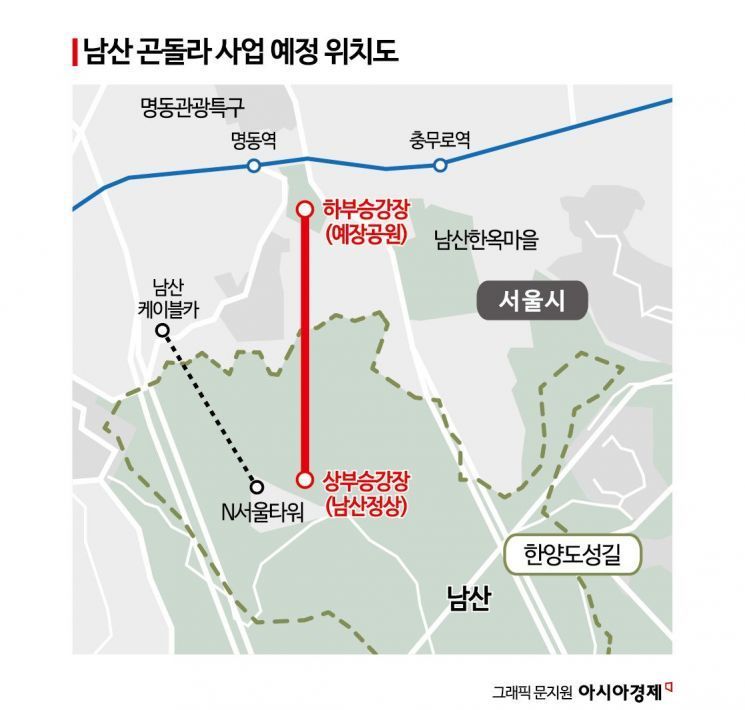
The core issue of the lawsuit is whether it was lawful for the city to change the existing urban natural park zone to an "urban planning facility (park)" in order to install the gondola. The city changed the zoning of the gondola project site to install intermediate supports (reinforced concrete pillars) over 30 meters high on Namsan. Korea Cable Car Industry maintains that the city's action was illegal because it did not comply with the standards for lifting the urban natural park zone as stipulated in the Park and Green Space Act.
The court ruled in favor of Korea Cable Car Industry, deciding that the city had failed to comply with the standards for lifting or changing the urban natural park zone under the Park and Green Space Act, and thus canceled the city's urban management plan decision.
Separately from this lawsuit, the city plans to continue pursuing the gondola project by revising the enforcement decree of the Park and Green Space Act. The city also intends to actively gather public opinion through the public-private consultative body, the "Namsan Development Committee," and to push ahead with the "Better Namsan Activation Plan" announced earlier this month.
Kim Changgyu, Director-General for Balanced Development at the Seoul Metropolitan Government, stated, "This first-instance ruling by the court is a decision that fails to sufficiently reflect the policy judgment pursued under the principle of 'restoring the public character of Namsan.' We will immediately appeal to correct the legal and policy legitimacy and steadfastly pursue policies to restore accessibility to Namsan and return it as 'Namsan for All.'"
© The Asia Business Daily(www.asiae.co.kr). All rights reserved.

















