"Difficult to Regard as a Simple Technical Act"
Kim Doyun, a well-known tattoo artist who was fined in the first trial for performing tattoo procedures on celebrities without a medical license, received a suspended sentence for the fine in his appeal trial.
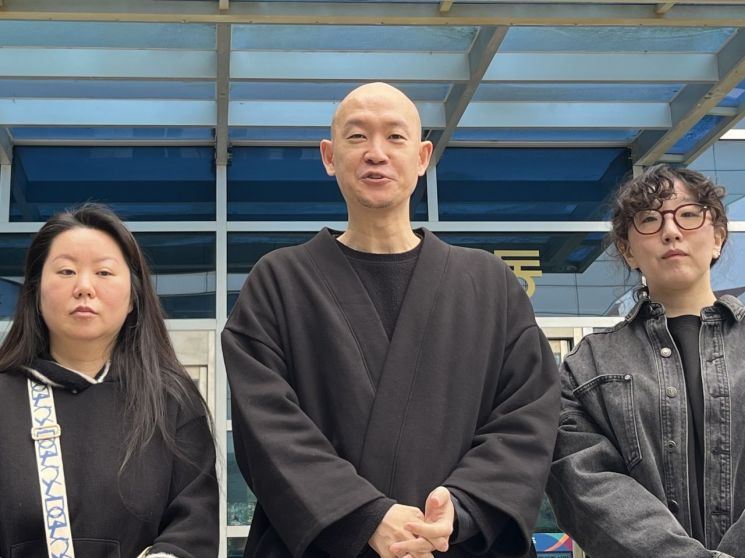 Tattoo artist Kim Doyun, head of the Tattoo Union branch (center), who was fined in the first trial for performing tattoo procedures without medical qualifications, is speaking after the appeal trial held at the Seoul Northern District Court on October 31. Photo by Yonhap News.
On December 19, the Criminal Appellate Division 2 of the Seoul Northern District Court (Presiding Judge Kang Younghoon) suspended the imposition of a 1 million won fine for Kim, the head of the Tattoo Union branch, who was indicted for violating the Medical Service Act.
Kim was initially fined 5 million won in the first trial held in December 2021, but he appealed the decision.
The court stated, "Tattooing is performed on the human body and can involve areas that are structurally risky, such as the neck or face," adding, "It is difficult to regard this as a simple technical act." The court thus recognized tattooing as a medical practice.
The court further explained, "Given the current level of medical technology, it is practically difficult to restore or remove full-body tattoos, and for adolescents, the possibility of recovery is even more limited," emphasizing, "It cannot be left entirely to individual discretion or autonomy."
Regarding the Tattooist Act, which has passed the National Assembly and is set to take effect soon, the court noted, "The law stipulates restrictions on location, criminal penalties, and safety management obligations, indicating the state's intent to specially regulate tattoo procedures, distinct from ordinary occupations," and added, "It is difficult to interpret the National Assembly's legislation as a comprehensive judgment that tattooing is not a medical practice."
After the sentencing, Kim told reporters that he plans to appeal to the Supreme Court. He said, "I believe this is a very short-sighted ruling," and emphasized, "It disregards legislative and social consensus, fails to recognize research and effort, and yet again delivers a guilty verdict."
Meanwhile, the Tattooist Act, which allows non-medical professionals with proper qualifications to legally perform tattoo procedures, passed the National Assembly on September 25 and was subsequently reviewed and approved by the Cabinet before being promulgated. The law will go into effect in 2027 after a two-year grace period following its promulgation.
© The Asia Business Daily(www.asiae.co.kr). All rights reserved.
![User Who Sold Erroneously Deposited Bitcoins to Repay Debt and Fund Entertainment... What Did the Supreme Court Decide in 2021? [Legal Issue Check]](https://cwcontent.asiae.co.kr/asiaresize/183/2026020910431234020_1770601391.png)