All-Sky Infrared Spectroscopic Map Completed in Six Months
Korean Researchers Play a Key Role in the Project
The appearance of the universe has been broken down into "colors" for the first time. With the release of humanity's first all-sky spectroscopic map, recorded in 102 infrared wavelengths, a new benchmark has been established for decoding the structure and evolution of the universe.
The Korea Aerospace Administration announced on December 19 that it has released the first all-sky map image observed by the space telescope SPHEREx, which was jointly developed by the Korea Astronomy and Space Science Institute and the National Aeronautics and Space Administration (NASA). This result marks the first-ever space map completed by spectroscopically mapping the entire sky in 102 infrared wavelengths.
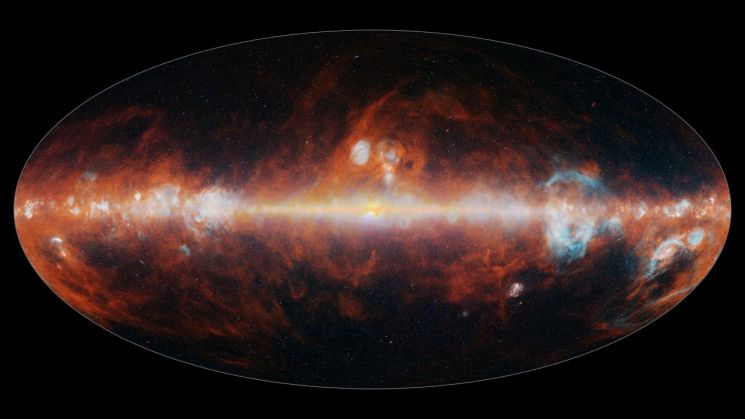 Image of the SpearX all-sky map. SpearX has mapped the entire sky using 102 infrared colors that reveal various characteristics of the universe, and this image shows some of those colors. It represents infrared light emitted from stars (blue, green, white), hot hydrogen gas (blue), and cosmic dust (red). Photo by NASA/JPL-Caltech
After its launch on March 12, SPHEREx began full-scale observations in May and scanned the entire sky over approximately six months. It converted the infrared spectrum, invisible to the human eye, into visible colors, allowing the physical properties of celestial components such as stars, gas, and cosmic dust to be distinguished by color. The released image visualizes some of these wavelengths.
SPHEREx orbits the Earth about 14.5 times a day, following a trajectory that crosses both the North and South Poles. Each day, it captures around 3,600 images along a circular band of the sky, and as Earth's orbit shifts its field of view, it covers the entire sky without gaps over six months. The research team digitally synthesized this vast amount of observational data to create a 360-degree all-sky mosaic map.
The key to making this possible lies in six detectors and a specially designed linear spectroscopic filter. SPHEREx simultaneously observes 102 wavelength bands, obtaining unique spectroscopic information on galaxies, stars, star-forming regions, and interstellar dust. By comparing the characteristics of celestial bodies that appear bright only at certain wavelengths, it becomes possible to measure the distances to hundreds of millions of galaxies and create three-dimensional distribution maps.
This all-sky observational data will be used to reveal the history of the universe, the formation and evolution of galaxies, and the distribution of water and ice-the origins of life. The mission is overseen by NASA's Jet Propulsion Laboratory (JPL), and the data analysis involves 10 institutions in the United States, as well as a domestic research team led by Dr. Jung Woongseop at the Korea Astronomy and Space Science Institute. The Korean research team plays a crucial role in data processing and key scientific mission analysis.
The international joint research team plans to conduct three additional all-sky observations during the main two-year mission period. Through this, they aim to complete a three-dimensional integrated map of the universe with enhanced sensitivity. All data will be made freely available to the global community through the Infrared Science Archive (IRSA) at the California Institute of Technology’s IPAC.
Shawn Domagal-Goldman, Acting Director of NASA's Astrophysics Division, said, "It's thrilling that we've completed 102 new maps of the universe in just six months. This vast dataset will be a treasure trove for astronomers around the world."
Kang Kyungin, Director of Space Science Exploration at the Korea Aerospace Administration, emphasized, "Through SPHEREx's observational data, Korean scientists will be able to play a key role not only in the study of cosmic ice, but also in research on active galactic nuclei and small solar system bodies."
© The Asia Business Daily(www.asiae.co.kr). All rights reserved.
![Clutching a Stolen Dior Bag, Saying "I Hate Being Poor but Real"... The Grotesque Con of a "Human Knockoff" [Slate]](https://cwcontent.asiae.co.kr/asiaresize/183/2026021902243444107_1771435474.jpg)
















