80th Anniversary of Poet Yoon Dongju's Death
The progressive Japanese weekly magazine, The Weekly Friday, has published a special feature on the life and literature of Yoon Dongju, a poet who resisted Japanese colonial rule, in commemoration of the 80th anniversary of his death.
In its recently published Issue No. 1549, The Weekly Friday featured a photo of Yoon Dongju on its cover and ran a variety of special articles. The publication noted, "It has been 80 years since Yoon Dongju died in Fukuoka Prison on February 16, 1945," adding, "He left behind 127 poems during his short life of just 27 years." The magazine continued, "His beautiful and accessible poetry continues to be read today, moving the hearts of many," and added, "We followed in Yoon Dongju's footsteps, visiting places connected to his life."
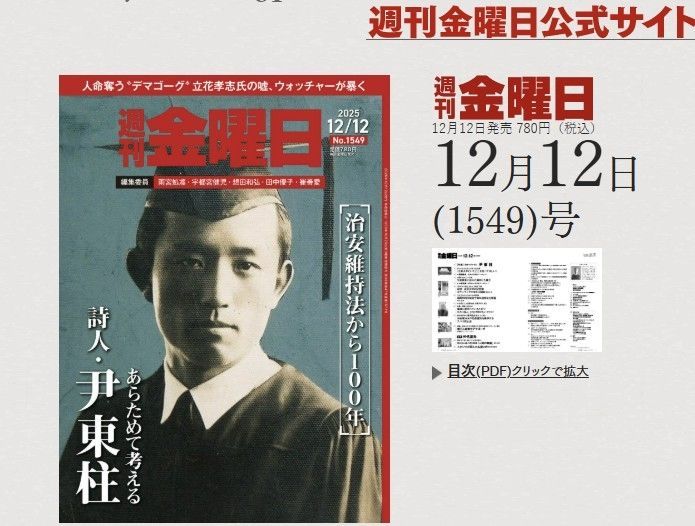
The magazine also included interviews with Renta Nishihara, President of Rikkyo University in Tokyo, who erected a memorial to Yoon Dongju on campus this past October, and Katsuhiro Kohara, President of Doshisha University in Kyoto, where Yoon Dongju studied.
The publication also featured an interview article that critically analyzed the connection between the Peace Preservation Law, which was applied to Yoon Dongju by the Japanese authorities, and the anti-espionage law currently being promoted by Sanae Takaichi's government. In 1985, Japan's ruling Liberal Democratic Party submitted the National Secrets Act, an anti-espionage bill, through a legislative initiative by its members. However, the bill was scrapped as concerns grew that broadening the interpretation and scope of national secrets could infringe upon individual freedoms. Recently, there has been a growing view within Japan that anti-espionage laws could criminalize certain ideologies.
The Tokyo Shimbun reported, "The Peace Preservation Law was originally created to prevent the spread of communism, which was popular worldwide at the time, into Japan. However, its targets were later expanded, and it was used to suppress not only communists but also liberals and those who did not align with the government's views."
Yoon Dongju was born on December 30, 1917, in Myeongdong Village, Bukgando, China (now Jilin Province) during the Japanese colonial period. He studied literature at Yonhui College, the predecessor of Yonsei University, and later studied abroad at Doshisha University in Kyoto, Japan. While studying in Japan, he was arrested for violating the Peace Preservation Law due to his anti-Japanese activities and was sentenced to two years in prison. He died at Fukuoka Prison on February 16, 1945, just six months before Korea’s liberation.
Yoon Dongju's poetry, which is widely read to this day, uniquely expresses universal emotions such as self-reflection, anguish about life, and the sense of helplessness felt by intellectuals under colonial rule.
© The Asia Business Daily(www.asiae.co.kr). All rights reserved.

![Clutching a Stolen Dior Bag, Saying "I Hate Being Poor but Real"... The Grotesque Con of a "Human Knockoff" [Slate]](https://cwcontent.asiae.co.kr/asiaresize/183/2026021902243444107_1771435474.jpg)















