"Research Stability Is Only the Starting Point...
Reform Must Be Completed in Compensation and Governance"
Following the abolition of the Project-Based System (PBS), experts have pointed out that the success or failure of reform at government-funded research institutes will depend on how the new system is implemented and what follow-up measures are introduced to prevent further instability at research sites.
The Korea Federation of Science and Technology Societies (KFSTS), a coalition of councils representing researchers at government-funded institutes, released a statement on the 18th. The federation described the decision to abolish PBS as a "historic turning point that dismantles a structure which has constrained research sites for the past 30 years." However, they warned that side effects may arise during the process of changing a long-standing system, and proposed that an annual impact assessment of PBS abolition should be conducted.
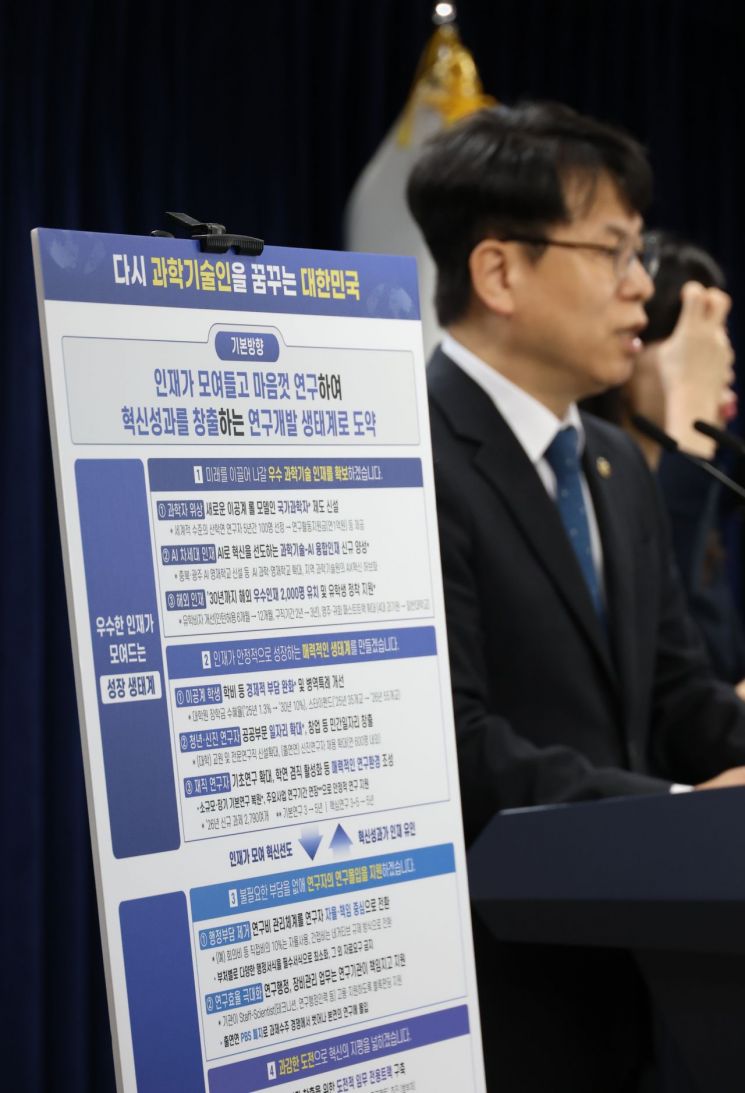 Park Ingyu, Director of the Innovation Headquarters at the Ministry of Science and ICT, announced the strategy for securing scientific and technological talent and plans to innovate the research and development ecosystem at the Government Seoul Office Building on the 7th of last month. Photo by Yonhap News
The federation emphasized that "if research immersion, administrative efficiency, and the creation of innovative outcomes are not continuously monitored, the new system could become yet another form of regulation." They called for a "rolling plan" approach, where the system is supplemented and improved based on evaluation results.
Compensation, Administration, and Governance Must Change Together
The federation also identified the improvement of compensation for outstanding researchers as an urgent issue. "At the core of securing national strategic technologies is, ultimately, people," they stated. "Wages at government-funded research institutes have long lagged behind increases in the private sector and the civil service, and the recent policy announcement did not specify a concrete timeline for improvement." They argued that, in addition to financial compensation competitive with the private sector, institutional mechanisms to enhance the social status and honor of researchers must be established. They also called for the swift confirmation of restoring the retirement age and abolishing the blanket application of the wage peak system.
The federation urged a cautious approach to the plan for integrated administration. While they agreed with the intention to reduce the administrative burden on researchers, they expressed concern that physical integration centered on the National Research Council of Science & Technology (NST) could actually reduce responsiveness in the field and delay research progress. They insisted, "The opinions of those on the ground must be fully reflected, and a pilot operation should be conducted before deciding whether to proceed."
Furthermore, they stressed that, in a structure where autonomy and responsibility are expanded, securing the legitimacy of institutional leadership is crucial. They called for the introduction of an official process that incorporates input from members in the selection of institute leaders.
The federation stated, "Researchers want to produce results that change the world, not just write proposals to secure research funding." They added, "This policy must not end as a reform for reporting purposes only, but should lead to a structure where government-funded research institutes deliver tangible results at the heart of national missions."
They concluded, "The design of the post-PBS era will determine the success or failure of the reform of government-funded research institutes," and emphasized, "The government must communicate as one team with those in the field to create a system that enables 'real research.'"
© The Asia Business Daily(www.asiae.co.kr). All rights reserved.

















