Passed the First Round of the Ministry of Land Contest
Securing 25 Billion Won in National Funding Upon Final Designation
Public Development of the 79,438m² Former Station Site
Establishing a Hub for Urban Regeneration and Balanced Development
The site of the former Gyeongju Station, an abandoned railway area remaining in the heart of downtown Gyeongju, is now highly likely to become a testbed for nationally led urban regeneration.
On December 18, Gyeongju City announced that the former Gyeongju Station site had been selected as a candidate in the "2025 Second Half Urban Regeneration National Pilot District Contest Project" organized by the Ministry of Land, Infrastructure and Transport.
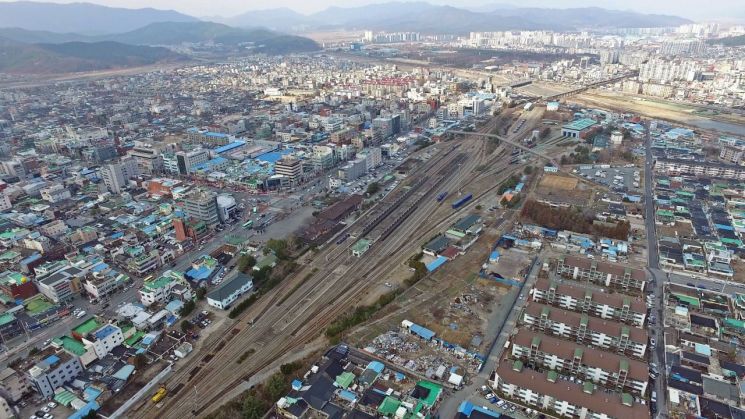 A panoramic view of the old Gyeongju Station site selected as a candidate for urban regeneration. Attention is focused on whether the abandoned station site, which had been unused for a long time after the railway relocation, can be transformed into a nationally led urban regeneration pilot district. Provided by Gyeongju City
This selection serves as a preliminary step toward designation as a national pilot district under the Special Act on Urban Regeneration. If finally designated, the district will receive support totaling 25 billion won from the national government.
This is being evaluated as a critical turning point that will determine the direction of downtown Gyeongju’s regeneration.
The Urban Regeneration National Pilot District is a large-scale public initiative to restore urban functions in areas where development has stagnated for a long time due to height restrictions, cultural heritage protection, and various regulations.
Gyeongju City plans to make the former Gyeongju Station site, which has remained unused for decades since the railway was relocated, a core hub for the regeneration of the declining downtown area.
The project site covers 79,438 square meters around the former Gyeongju Station and will be implemented in phases over five years, starting construction in 2027 and continuing until 2032.
The city plans to establish the following at the site: a "K-Heritage Complex Hub" that combines the historical value of the Silla royal capital with advanced technology; a "Future Mobility Integrated Hub" that links smart traffic control with eco-friendly transportation; and the "Gyeongju STAY Complex Town," which integrates residential, commercial, and accommodation functions.
The strategy is to preserve Gyeongju’s identity as a historic city while simultaneously incorporating future urban functions.
Gyeongju Mayor Joo Nakyoung stated, "The former Gyeongju Station site will be a core urban regeneration hub that will shape Gyeongju’s next 100 years. By establishing an institutional foundation and building consensus within the local community, we will secure final designation as a national pilot district and complete an urban regeneration model that citizens can truly experience."
© The Asia Business Daily(www.asiae.co.kr). All rights reserved.

















