Civil Society: "An Invalid Agreement Excluding Gwangju Citizens"
Local Government Heads and Political Circles: "A Turning Point with Concrete Implementation Measures"
There are differing evaluations from civil society, local government heads, and political circles regarding the joint statement issued by the six-party consultative group on the relocation of Gwangju’s military and civilian airports.
Civil society groups have argued that the agreement is invalid, claiming it does not reflect the interests and opinions of Gwangju citizens. In contrast, local government heads and political figures have viewed it as a turning point that includes specific implementation measures.
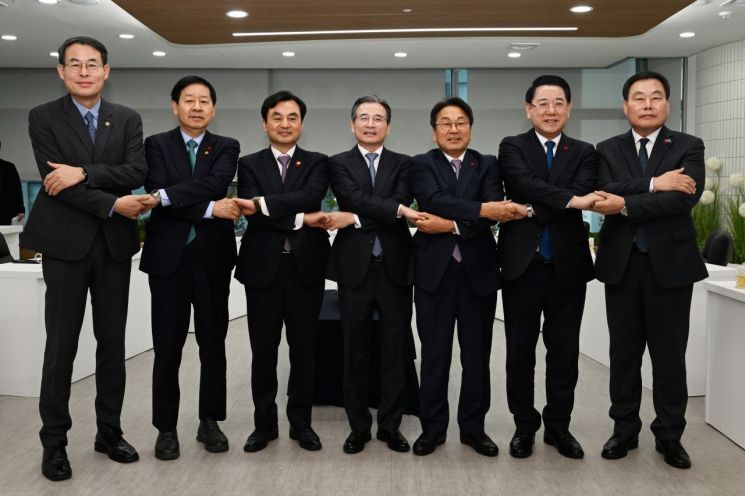 On the morning of the 17th, at Gwangju Urban Corporation in Seo-gu, Gwangju, attendees of the first meeting of the "Gwangju Military Airport Relocation Six-Party Consultative Group" joined hands after signing the joint statement. Photo by Yonhap News Agency
The Gwangju Airport International Route Restoration Citizens’ Committee released a statement on the 18th, asserting, “The joint statement, which only mentions the relocation of domestic routes at Gwangju Airport, is effectively a declaration of abandoning the airport.” They further argued, “Since the relocation site has not been definitively set as Muan, the agreement is invalid.”
The committee pointed out, “The interests and opinions of Gwangju citizens have been excluded, and the implementation plan lacks specificity, which could lead to prolonged delays in the relocation.” They added, “If only domestic routes are relocated first, Gwangju Airport could be reduced to a military facility with no civilian function.”
The committee also addressed the review of renaming Muan International Airport to “Kim Dae-jung Airport,” stating, “It is inappropriate to name an airport unrelated to the achievements of former President Kim Dae-jung after him.” They explained, “Muan International Airport did not originate as a national project by former President Kim, but rather from a regional political development initiative.”
On the other hand, the five district heads of Gwangju and the Gwangju City Party of the Cho Kuk Innovation Party evaluated the agreement positively. In a statement released that day, the Gwangju District Heads’ Council said, “The integrated relocation discussions for the military and civilian airports, which have been stalled for 18 years, have reached a turning point,” and described the agreement as “opening a new era of mutual prosperity for Gwangju and South Jeolla Province.” The council highlighted the inclusion of implementation measures such as the creation of a 1 trillion won resident support fund, the designation of Muan as a national industrial complex, and the relocation of domestic routes from Gwangju Airport.
The Gwangju City Party of the Cho Kuk Innovation Party also welcomed the agreement, calling it “an important milestone in resolving Gwangju’s 61-year-long aspiration.” However, they cautioned, “The concerns and criticisms of civil society must not be taken lightly,” and pointed out, “The structural limitations of the ‘donation for compensation’ model, the government’s responsibility for the massive relocation costs, and the anxiety over a partial relocation where only the civilian airport moves first are all issues that must be addressed during the project’s implementation.”
Members of the Gwangju City Council also stated in a position paper, “This agreement is the result of cooperation between the central and local governments, as well as between regions,” and emphasized, “Gwangju and South Jeolla Province must move beyond conflict and toward mutual prosperity.”
The six-party consultative group discussing the relocation of Gwangju’s military airport (comprising Gwangju City, South Jeolla Province, Muan County, the Ministry of Economy and Finance, the Ministry of National Defense, and the Ministry of Land, Infrastructure and Transport) held its first meeting the previous day and issued a joint statement that included government support measures. The agreement covered support measures for Muan, the establishment of the Honam Regional Aviation Office, a review of renaming Muan International Airport, and cooperation for amending the special law on military airport relocation.
© The Asia Business Daily(www.asiae.co.kr). All rights reserved.

















