Twin Birth Rate Nearly Double That of Other Countries
Birth Rate of Triplets or More Three Times Higher
"Convenience in Childbirth"...A Uniquely Korean Phenomenon
"Insufficient Policy Efforts Before Multiple Pregnancies"
There have been calls for a policy shift in South Korea to reduce the sharply rising rate of twin (multiple) pregnancies and births, as twin births are accompanied by high risks for both mothers and babies.
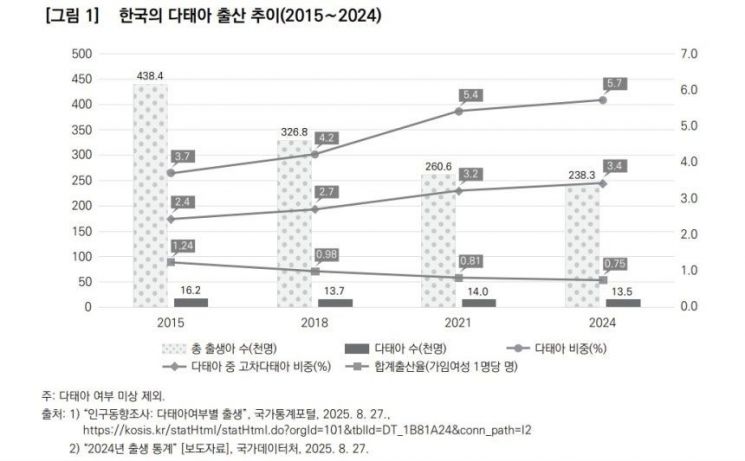
Bae Hyewon, a senior researcher at the Korea Institute for Health and Social Affairs, highlighted this issue in a report titled "Current Status and Implications of Multiple Birth Policies" released on December 18. According to the report, the proportion of twins among all newborns in South Korea increased from 3.7% (16,166 babies) in 2015 to 5.7% (13,461 babies) last year.
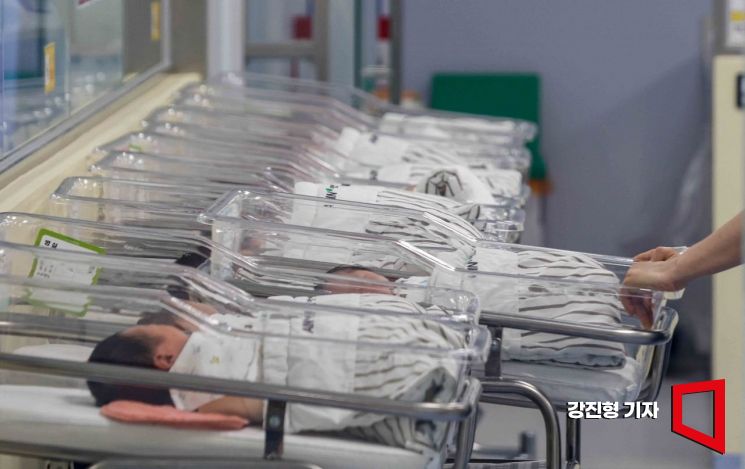 There has been a rise in the rate of twin (multiple) pregnancies and births, prompting calls for a policy shift to reduce this trend. The photo is for illustrative purposes and is unrelated to the content. The Asia Business Daily DB.
Among twins, the proportion of higher-order multiples (triplets or more) also rose from 2.4% (392 babies) to 3.4% (457 babies) during the same period. As of last year, South Korea's twin birth rate stood at 28.8 per 1,000 deliveries, which is exceptionally high compared to other countries. This is the second highest among countries included in the Human Multiple Births Database (HMBD), following Greece (29.5 per 1,000 deliveries), and is nearly double the HMBD average of 15.5 per 1,000 deliveries.
Twin Birth Rate Nearly Double That of Other Countries
The birth rate of higher-order multiples (triplets or more) is 0.67 per 1,000 deliveries, the highest among HMBD countries and three times the average (0.2 per 1,000 deliveries).
South Korea's total fertility rate is among the lowest in the world, yet its twin birth rate is extremely high and continues to rise, in contrast to the declining trend in other countries. The report pointed out that as the average maternal age increases and assisted reproductive technologies advance, a uniquely Korean phenomenon of "convenience in childbirth" has emerged, with parents aiming to have and raise two children at once through a single pregnancy and birth.
The average age of mothers at childbirth in South Korea rose from 32.2 years in 2015 to 33.7 years last year. Notably, the average age for mothers of twins is 35.3 years, which is higher than that of mothers of singletons (33.6 years).
The number of patients undergoing infertility treatments increased by 33% over seven years, from 121,038 in 2018 to 161,083 last year. Policies supporting twin pregnancies and births have also expanded in line with these trends. Major examples include financial support for infertility treatment for couples, medical expense support for high-risk pregnant women, and measures for supporting premature babies. Local governments are also providing birth grants for multiples and postpartum care expenses.
Twin Pregnancies and Births Pose Risks for Mothers and Babies...Prevention Needed
The report raised concerns that South Korea's policies regarding twins are mainly focused on "post-response" measures during pregnancy or around childbirth. It stated that twin pregnancies and births are relatively risky for both mothers and babies and should not be actively encouraged. The report also emphasized the need for preventive measures.
Since around the 2000s, many countries have shifted their multiple birth policies to a preventive approach, aiming to reduce twin births. The report noted, "Policies have been heavily weighted toward medical interventions and economic support for high-risk newborns after birth, as well as one-off economic assistance after childbirth," and added, "While twin births carry high risks for mothers and babies, there has been relatively little policy effort before pregnancy to protect maternal and fetal health and to reduce twin pregnancies."
The report particularly stressed the need to strengthen policies that guarantee health rights before pregnancy and lower the twin pregnancy rate. It also emphasized the importance of improving the quality and effectiveness of post-response policies during twin pregnancies and around childbirth.
Concerns have been raised that shifting policies to reduce the twin pregnancy and birth rate could exacerbate the ultra-low birth rate phenomenon. However, the report cited the example of the United Kingdom, stating, "The UK has managed to reduce the multiple birth rate while maintaining the overall birth rate at a certain level." The report further suggested that changing policy directions does not necessarily lead to a decline in the overall birth rate.
© The Asia Business Daily(www.asiae.co.kr). All rights reserved.
![Clutching a Stolen Dior Bag, Saying "I Hate Being Poor but Real"... The Grotesque Con of a "Human Knockoff" [Slate]](https://cwcontent.asiae.co.kr/asiaresize/183/2026021902243444107_1771435474.jpg)

















