Adoption Case Captured in Canada
Only 13 Documented Adoptions in 45 Years of Research
As the survival crisis for polar bears accelerates due to global warming, a touching scene has been captured in Canada: a polar bear adopting an orphaned cub and raising it alongside her own offspring. On December 18, Yonhap News, citing AFP, reported that this rare case of polar bear adoption was confirmed in Churchill, a coastal town on Hudson Bay in Manitoba, Canada. Adoption among polar bears is an extremely rare behavior observed globally.
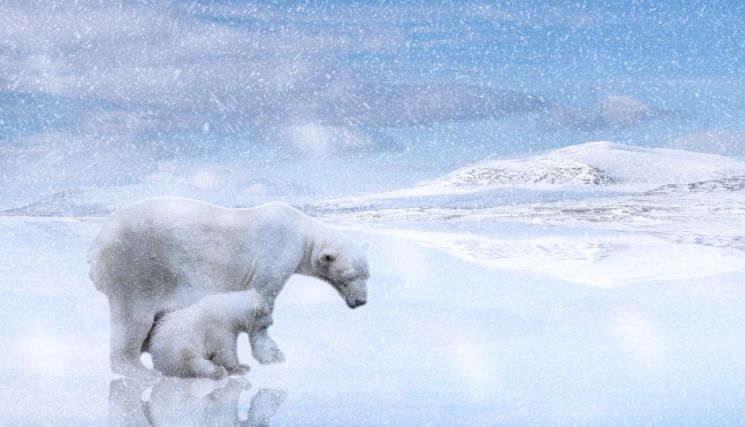
Last spring, a Canadian research team discovered a mother polar bear and her cub emerging from their den after giving birth, and attached identification markers to them for population research. When the team observed them again last month, they found another cub without a marker alongside the mother bear. Evan Richardson, a scientist with Environment and Climate Change Canada, explained, "Upon reanalyzing the data, we discovered that the mother polar bear had adopted a cub." He added, "In 45 years of polar bear research records, there have only been 13 documented cases of adoption, making it an exceptionally rare occurrence."
The video released by the research team shows the two cubs exploring the snowy landscape, with the mother bear watching over them. One cub is seen hurrying to catch up with the other. However, what happened to the biological mother of the adopted cub remains unknown. According to GPS tracking, this polar bear family has now moved to the sea ice region. The two cubs are estimated to be about 10 to 11 months old and are expected to stay with the mother for about another year and a half, learning hunting skills. The mother bear provides food to the cubs by hunting seals. Richardson commented, "It is truly heartwarming to confirm that a mother bear is caring for a cub that is not her own and that the cub has a chance to survive," and added, "Female polar bears are excellent mothers with a strong maternal instinct."
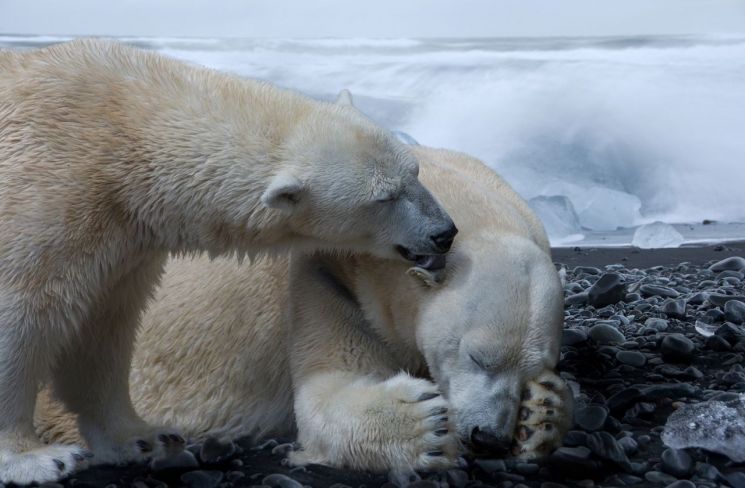
Meanwhile, recent research has found that polar bears are undergoing genetic changes to adapt to climate change. On December 13, a research team from the University of East Anglia in the United Kingdom published in the international journal 'Mobile DNA' that polar bears living in southeastern Greenland are exhibiting rapid genetic changes, which are linked to rising temperatures. The team explained that, based on analysis of polar bear blood samples collected by the University of Washington in the United States, the activity of transposable elements-known as 'jumping genes'-was more active in the southeastern population than in the northeastern population. Transposable elements move within the genome and regulate gene expression, helping organisms adapt quickly to rapidly changing environments.
In particular, the southeastern polar bears showed distinct changes in gene expression related to aging regulation, energy metabolism, and stress response. This is interpreted as an effort to survive amid warmer climates and changes in food sources. Alice Gooden, senior researcher at the University of East Anglia and lead author of the study, stated, "This research offers hope for the survival of polar bears, but it does not mean the risk of extinction has decreased." She emphasized, "Global efforts to reduce carbon emissions and slow the rate of temperature rise remain urgently needed."
© The Asia Business Daily(www.asiae.co.kr). All rights reserved.
![Clutching a Stolen Dior Bag, Saying "I Hate Being Poor but Real"... The Grotesque Con of a "Human Knockoff" [Slate]](https://cwcontent.asiae.co.kr/asiaresize/183/2026021902243444107_1771435474.jpg)

















