A team of Korean researchers has developed next-generation immune cells for the treatment of intractable diseases. In particular, these immune cells are expected to be effective in targeting cancer, as they employ strategies to lower the defense mechanisms of cancer cells.
The Korea Research Institute of Bioscience and Biotechnology (KRIBB) announced on December 17 that Dr. Joysook Park and her team at the Immunotherapeutics Research Center have developed “drNK” (direct reprogramming Natural Killer cell).
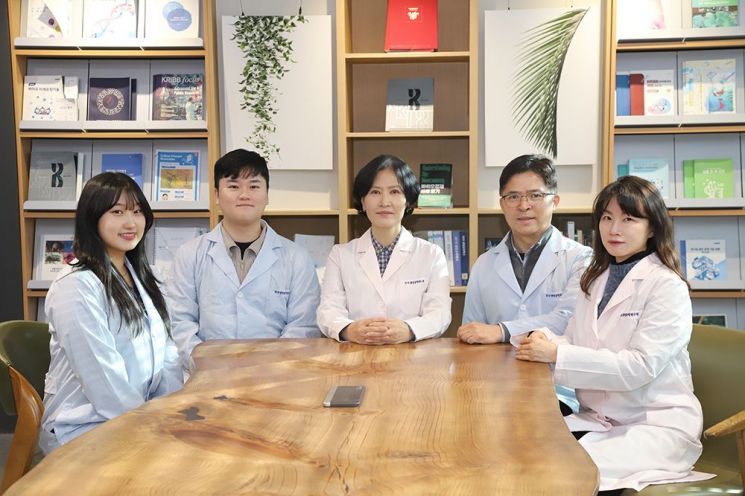 Dr. Joysook Park (third from the left) and members of the research team are posing for a commemorative photo. Provided by Korea Research Institute of Bioscience and Biotechnology
Natural Killer (NK) cells are innate immune cells in the human body. They play a role in immediately recognizing and eliminating cancer cells and cells infected by viruses. This characteristic has made NK cells a focus as next-generation immuno-oncology therapeutics.
However, in the actual application of NK cells for treatment, several limitations have emerged: it is difficult for NK cells to survive for extended periods in the body, they struggle to infiltrate tumor tissues, and their function is weakened by the strong defense mechanisms of cancer cells. As a result, despite the known positive roles of NK cells, they have shown limited effectiveness in clinical treatment.
To overcome these limitations, the research team devised a “direct reprogramming” technology. This technique converts ordinary somatic cells, such as those derived from skin or blood, directly into NK cells, without reverting them to a stem cell stage capable of differentiating into various cell types.
The direct reprogramming technology enables the stable and rapid production of NK cells with enhanced function by regulating a specific gene (BCL11B) that suppresses differentiation into NK cells. NK cells generated through this process demonstrate improved ability to recognize and attack cancer cells compared to conventional NK cells.
The research team named these cells “drNK cells.” Experimental results confirmed that drNK cells exhibited both enhanced cancer cell-killing ability and improved persistence within the body.
The team further validated the application of drNK cells in actual treatment processes using pancreatic cancer as a research model. Pancreatic cancer is notorious for forming a dense defensive environment around tumor cells, making immune cell infiltration difficult. For this reason, pancreatic cancer is known as one of the most challenging cancers to treat with immunotherapy.
During the validation process, the researchers also introduced a “CAR (Chimeric Antigen Receptor)”-a targeted recognition device-enabling drNK cells to more precisely identify and attack pancreatic cancer cells.
In particular, they designed the customized NK cells to selectively target only cancer cells by recognizing “Mesothelin,” a protein abundantly present on the surface of pancreatic cancer cells. These were named “MSLN-drNK,” and the team also applied strategies to weaken the intrinsic defense mechanisms of the cancer cells.
Additionally, the researchers inhibited PKMYT1, a protein involved in helping pancreatic cancer cells evade immune attacks, thereby creating an environment that makes the cancer cells more vulnerable to NK cell attacks.
The team’s validation process involved integrating three strategies into a single platform: enabling NK cells to accurately recognize and attack cancer cells, and simultaneously weakening the defensive environment of the cancer cells.
As a result, the binding and recognition signals between NK cells and cancer cells were strengthened, and the overall anticancer effect was enhanced. Most importantly, the team’s approach suggests the potential for expansion to not only pancreatic cancer but also various solid tumors and intractable diseases.
Dr. Park stated, “This study expands the supply base for therapeutic NK cells and presents a ‘customized treatment strategy’ for complex diseases that are difficult to target with a single approach. Our team will continue with follow-up research to improve safety and efficacy, laying the groundwork for actual clinical application.”
The research findings were also recently published in the international journal Journal of Hematology and Oncology.
© The Asia Business Daily(www.asiae.co.kr). All rights reserved.

















