High Exchange Rate Diagnosed as a Crisis for Prices and Polarization...
Continued Market-Calming Remarks
Recent Surge Driven by Domestic Supply-Demand Imbalances
Hints at Possibility of 'Level Adjustment'
"Grateful to the Ministry of Health and Welfare"
Coordination of National Pension Policies Expected to Improve Supply and Demand Factors
View That "Long-Term Won Depreciation Due to US Investment" Is "Excessive"
"As Governor, I State Clearly: We Will Not Act to Threaten the Market"
The previous day, as the won-dollar exchange rate surged and briefly exceeded 1,480 won during trading hours, the Bank of Korea's 'price briefing' effectively became a 'currency briefing.' Lee Chang-yong, Governor of the Bank of Korea, diagnosed the current high exchange rate situation as another crisis from the perspectives of price levels and growth polarization, and made several statements aimed at calming market sentiment.
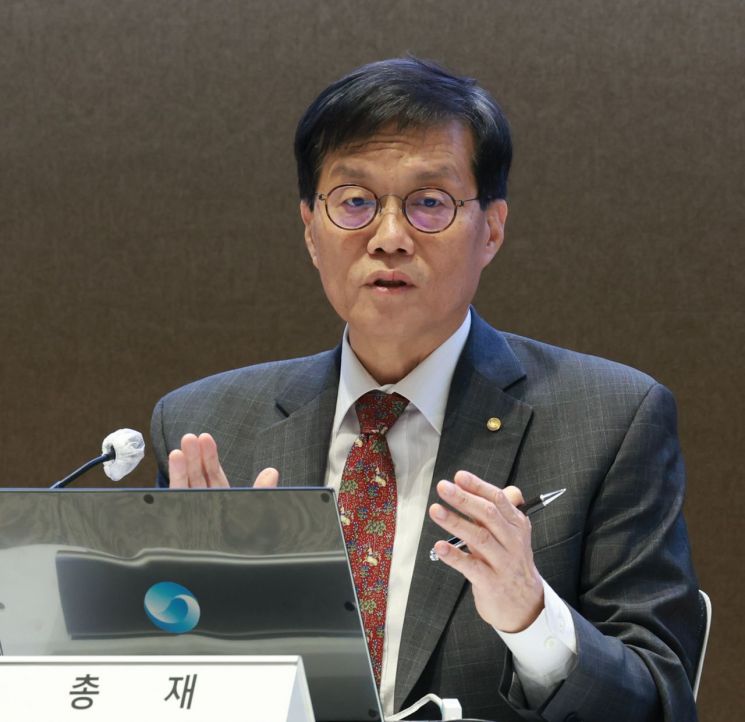 Lee Chang-yong, Governor of the Bank of Korea, is speaking at a press briefing on the 'Price Stability Target Operation Status Check' held at the Bank of Korea in Jung-gu, Seoul, on the afternoon of the 17th. Bank of Korea
Continued Market-Calming Remarks: "Coordination of National Pension Policies Will Improve Supply and Demand"
On December 18, the won-dollar exchange rate opened at 1,477.3 won on the Seoul foreign exchange market, down 2.5 won from the previous trading day, and fluctuated in the upper 1,470-won range in early trading. The previous day, following news of a foreign exchange swap involving the National Pension Service, the exchange rate managed to close weekly trading just below the 1,480-won mark (at 1,479.8 won), and fell to 1,474.5 won during overnight trading. However, despite the authorities' strong commitment to stabilizing the exchange rate, the decline remained modest, and the psychologically significant resistance level of 1,480 won continues to be under threat.
At the 'Price Stability Target Operation Status Check' briefing held the previous day at the Bank of Korea in Jung-gu, Seoul, Governor Lee assessed the current high exchange rate situation as "not a situation to worry about a currency crisis like in the past, but a crisis of a different kind." He explained that the high exchange rate has a significant impact on prices, and that the clear distinction between groups benefiting and suffering from the high exchange rate is intensifying growth polarization.
He continued to make remarks aimed at calming the market. While Governor Lee has previously emphasized that volatility, rather than the level itself, should be the focus when the exchange rate surges, this time he viewed it as a situation where 'level adjustment' is also possible. He judged that recent depreciation of the won is largely due to domestic factors such as supply-demand imbalances. Governor Lee stated, "I believe that there are unnecessarily large depreciations due to internal factors, so I think adjustments can be made not only in terms of volatility but also in terms of the level itself."
He also diagnosed that the recent decision by the National Pension Service to adjust its investment guidelines would act as a factor improving supply and demand. Governor Lee said, "I am very grateful that the Ministry of Health and Welfare and the National Pension Service have agreed to coordinate policies with macroeconomic impacts in mind," and emphasized, "Once the government's measures begin to take effect, it will take some time, but there will be improvements in supply-demand factors."
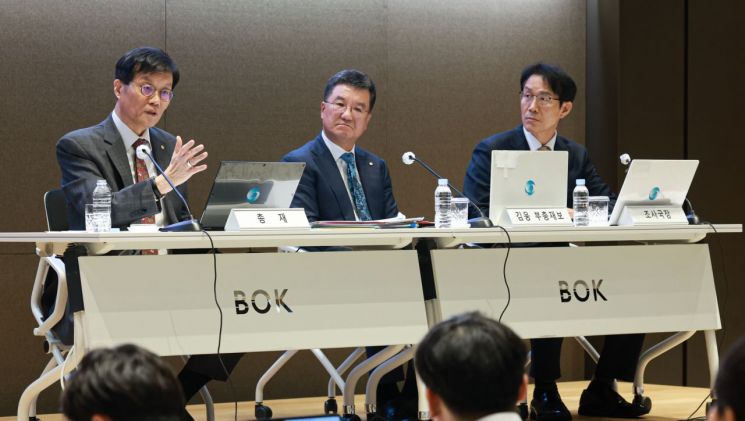 (From left) Lee Chang-yong, Governor of the Bank of Korea; Kim Woong, Deputy Governor; and Lee Jiho, Director of the Research Department, are answering questions at the press briefing on the 'Price Stability Target Operation Status Check' held at the Bank of Korea in Jung-gu, Seoul, on the afternoon of the 17th. Bank of Korea
"As Governor of the Bank of Korea, I State Clearly: We Will Not Invest in the US to a Degree That Threatens the Market"
Regarding the recent depreciation of the won, one cited factor has been the annual outflow of 20 billion dollars for investment in the United States. Governor Lee dismissed this as an 'excessive interpretation.' He explained, "The 20 billion dollars per year is a 'cap.' According to the bill submitted to the National Assembly, the Bank of Korea is required to supply this amount from interest and dividend income on foreign exchange reserves, but (the precondition is) that it is done within the scope of stabilizing the foreign exchange market." He continued, "As Governor of the Bank of Korea, I can state clearly that the Bank of Korea has no intention of providing funds for US investment to a degree that would threaten the foreign exchange market," adding, "As part of our duties, we will consult closely with the government on matters such as the amount of foreign currency remitted to ensure such a situation does not occur."
Meanwhile, the Bank of Korea forecasts next year's consumer price inflation rate at 2.1%. However, it also noted that if the current high exchange rate around 1,470 won persists, the inflation rate could rise by an additional 0.2 percentage points. Applying this to the forecast (2.1%), the rate could reach up to 2.3% next year.
© The Asia Business Daily(www.asiae.co.kr). All rights reserved.
!["The Woman Who Threw Herself into the Water Clutching a Stolen Dior Bag"...A Grotesque Success Story That Shakes the Korean Psyche [Slate]](https://cwcontent.asiae.co.kr/asiaresize/183/2026021902243444107_1771435474.jpg)

















