In Its First Overseas Clinical Trial,
Enblo Tablet Shows 30% Greater Improvement in Insulin Resistance Compared to Control Group
Daewoong Pharmaceutical announced on December 18 that its diabetes treatment, Enblo Tablet (ingredient: inavogliflozin), demonstrated improvements in insulin resistance and fat accumulation indicators in Phase 3 clinical trials.
Enblo Tablet achieved successful topline results in its Phase 3 clinical trial in China and is currently undergoing the New Drug Application (NDA) process for regulatory approval in China. This study proved that Enblo Tablet can improve insulin metabolic efficiency in addition to blood sugar control, marking a meaningful achievement in its first overseas clinical trial.
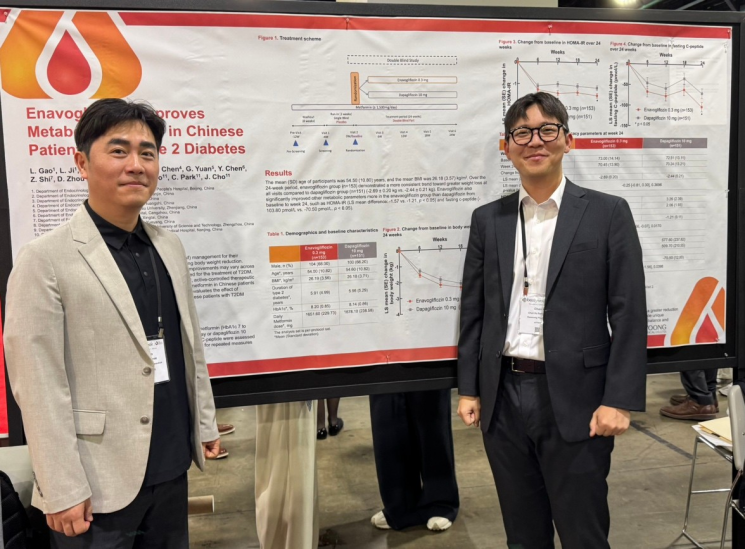 At the 2025 American Obesity Society conference, Na Jaejin, Head of Clinical Medical Center at Daewoong Pharmaceutical, and Park Chanho, Clinical Researcher, are taking a commemorative photo after presenting the results of Enblo's Phase 3 clinical trial in China. Daewoong Pharmaceutical
With these results, Daewoong Pharmaceutical has secured evidence for tailored treatments suitable for Asian patients. Based on this, the company plans to accelerate research into expanded indications such as obesity and metabolic diseases, as well as entry into the global market.
The study results were presented in poster form at the 2025 American Obesity Society (ObesityWeek) conference held in Atlanta, USA. Professor Linong Ji of Peking University People's Hospital in Beijing, China, served as the principal investigator, while Professor Leili Gao was the lead author of the poster.
The clinical trial was conducted on a total of 340 Chinese patients with type 2 diabetes. For 24 weeks, patients whose blood sugar was insufficiently controlled with the existing treatment metformin received either Enblo Tablet (0.3mg) or dapagliflozin (10mg) in combination, and the efficacy of the two drugs was compared.
As a result, the Enblo Tablet group (-1.57) showed a greater reduction in insulin resistance (HOMA-IR), with about 30% more improvement compared to the dapagliflozin group (-1.21). A decrease in insulin resistance means the body can process blood sugar more effectively with the same amount of insulin. Lower values are also known to have a positive effect in reducing the risk of weight gain and fat accumulation.
In addition, fasting C-peptide levels, an indicator related to insulin secretion and fat accumulation, decreased by about 47% more in the Enblo Tablet group (down 103.8 pmol/L) than in the dapagliflozin group (down 70.5 pmol/L). This is interpreted as helping to lower the risk of excessive fat accumulation. These results indicate that Enblo Tablet is not only effective in lowering blood sugar but may also help improve overall metabolic function in the body.
The potential of Enblo Tablet to improve metabolic function has been consistently observed in previous studies as well. In a domestic study presented at the 2024 American Obesity Society (ObesityWeek), changes in metabolic function indicators were observed, such as an increase in adiponectin (which promotes fat breakdown) and a decrease in leptin (related to fat accumulation and inflammation) after Enblo administration. Additionally, at the 2025 American Diabetes Association (ADA) conference this year, Enblo Tablet was shown to stably improve adipocyte hormone levels regardless of weight change, drawing continued attention from the global academic community.
Na Jaejin, Head of Clinical Medicine Center at Daewoong Pharmaceutical, said, "This study is significant as it confirmed that Enblo Tablet not only controls blood sugar but also improves both weight and insulin metabolism. As a domestically developed new drug that continues to be recognized for its achievements at global academic conferences, we aim to lead the paradigm of metabolic disease treatment for diverse patient groups, including those in Asia."
© The Asia Business Daily(www.asiae.co.kr). All rights reserved.
![Clutching a Stolen Dior Bag, Saying "I Hate Being Poor but Real"... The Grotesque Con of a "Human Knockoff" [Slate]](https://cwcontent.asiae.co.kr/asiaresize/183/2026021902243444107_1771435474.jpg)
















