Sharp Increase in Academic Dishonesty Involving Generative AI
AI-Related Cases Account for 18.8% of 224 Total Incidents
On November 15, during the midterm exam for the third-year course "Natural Language Processing (NLP) and ChatGPT" at Yonsei University, some students were found to have used artificial intelligence (AI) to solve exam questions. At Seoul National University, it was also revealed that a significant number of students in a liberal arts course for business school students used AI to answer midterm exam questions. As cases of academic dishonesty involving AI continue to emerge at major universities in Seoul, universities are struggling to come up with countermeasures. There are growing calls for effective educational systems that are in line with the times, as AI use becomes an everyday part of university life.
According to the Ministry of Education on December 19, a total of 224 cases of academic dishonesty were detected in undergraduate exams at 49 universities over the past six years. Of these, 42 cases (18.8%) involved the use of tools such as ChatGPT or smartphones.
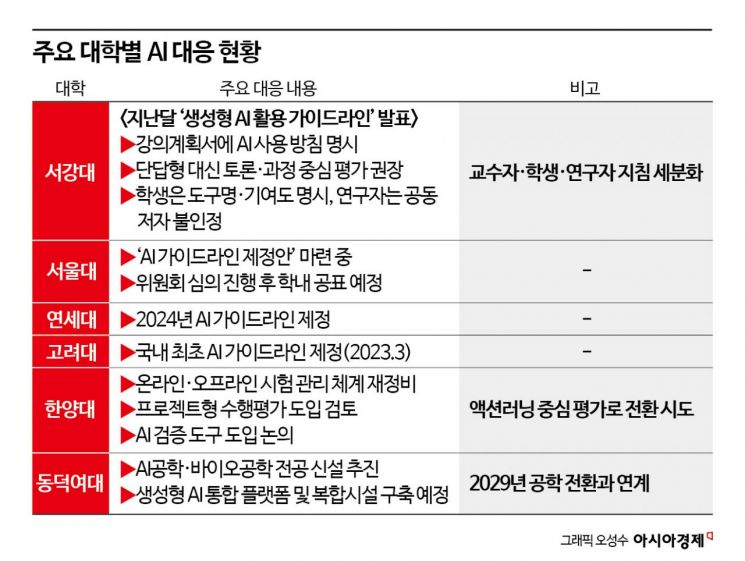
With AI becoming an unstoppable trend, it is now seen as a variable that is shaking up the methods and evaluation standards of university education. As a result, major universities are moving to introduce guidelines.
On November 25, Sogang University announced its "Generative AI Usage Guidelines." The guidelines instruct instructors to specify AI usage policies in their syllabi and recommend discussion- and process-based assessments over short-answer tests. Students are advised to clearly state the names of AI tools used and their level of contribution. For researchers, the guidelines clarify that AI cannot be recognized as a co-author and that researchers bear full responsibility for the results generated.
Seoul National University is currently preparing its own "AI Guidelines," which are undergoing review by key committees before finalization. A university official stated, "The specific details will be released after the guidelines are finalized and officially announced on campus." Korea University established and distributed its AI guidelines in March 2023, the first in the country, and Yonsei University followed in May last year. The Ministry of Education is also developing "AI Ethics Guidelines" for university students in collaboration with the Korean Council for University Education. The government plans to secure a budget and launch a research project involving education and AI experts early next year to complete the guidelines.
Hanyang University is restructuring its online and offline exam management systems to prevent AI-related academic dishonesty. The university is also considering moving away from one-off written tests to introduce project-based performance assessments, reflective journals, and oral evaluations as part of an action learning approach. A university official added, "We are also considering introducing dedicated verification tools to enhance the fairness of online exams."
The importance of AI guidelines has been demonstrated. According to a study by Professor Lee Taedong's research team at Yonsei University, published in the "Social Science Review" by the Yonsei University Institute of Social Sciences in May, the group that was allowed to use AI but provided with clear guidelines on citation methods achieved the highest results in terms of time efficiency and self-efficacy. In contrast, the group allowed to use AI without any standards showed a tendency toward lower learning effectiveness.
However, most AI guidelines remain declarative and theoretical, which remains a challenge. While ethical responsibilities are generally specified, in many cases there are no concrete disciplinary or sanction standards for violations. Regarding this, a university official explained, "AI guidelines are updated every semester."
Universities are also making efforts to integrate AI technology into their curricula. Dongduk Women's University, which is planning to transition to a coeducational institution in 2029, will introduce new majors in AI Engineering and Bioengineering within its engineering division. In the fields of culture, arts, and humanities, the university plans to establish interdisciplinary majors and micro-degree programs that combine engineering technology. In addition, the university is working to provide students with an integrated generative AI platform, establish AI-based multi-purpose complexes, and create new AI convergence research institutes to strengthen its infrastructure.
There are also calls for universities to actively include courses such as "AI Ethics" in their curricula and to continue providing related support. According to "The Current Status and Challenges of AI Ethics Education," published in April in the Journal of Artificial Intelligence and Humanities, instructors participating in AI ethics education evaluated the achievement of educational goals positively, but also reported facing several challenges, including a lack of educational materials, insufficient social interest, and a shortage of full-time faculty. Leading overseas universities such as Stanford, MIT, Oxford, and Harvard are already offering and operating AI ethics courses.
© The Asia Business Daily(www.asiae.co.kr). All rights reserved.
![Clutching a Stolen Dior Bag, Saying "I Hate Being Poor but Real"... The Grotesque Con of a "Human Knockoff" [Slate]](https://cwcontent.asiae.co.kr/asiaresize/183/2026021902243444107_1771435474.jpg)
















