Even Light Drinking Raises Risk of Atrial Fibrillation
East Asians with Low Alcohol Tolerance Should Be Cautious
A new study has found that even light drinking, equivalent to a single shot of soju, can have a negative impact on heart health. The analysis also suggests that East Asians, including Koreans, may face a higher risk of cardiovascular disease from the same amount of alcohol due to genetic factors.

On December 17, Gode Guro Hospital announced that a research team led by Professors Lee Daein and Kang Dongoh at the Cardiovascular Center of Gode Guro Hospital, along with Professor Kim Sunwon at the Cardiovascular Center of Gode Ansan Hospital, conducted a comprehensive analysis of large-scale cohort studies and randomized clinical trials. Their findings revealed that even a small amount of alcohol consumption significantly increased the risk of developing atrial fibrillation.
While some previous studies have suggested that alcohol consumption could have positive effects on certain cardiovascular diseases, there have been ongoing concerns about the limitations of such interpretations. This is because results have varied depending on the type of disease, drinking patterns, and individual characteristics.
According to the research team's analysis, even drinking the equivalent of one shot of soju statistically significantly increased the risk of atrial fibrillation. Atrial fibrillation is a representative arrhythmia directly linked to stroke, heart failure, and sudden death, and it often progresses without noticeable symptoms.
For those who drank the equivalent of 6 to 7 shots of soju per week, the risk of developing atrial fibrillation was about 8% higher compared to non-drinkers, and the risk increased further with higher alcohol consumption. In particular, binge drinking-consuming more than one bottle of soju at a time-was found to sharply raise the risk.
'Those with Low Alcohol Tolerance Face Greater Cardiovascular Burden'
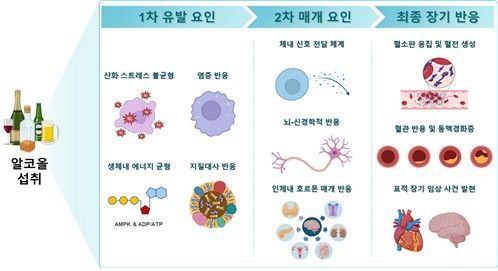 Schematic diagram of the pathophysiological mechanisms of alcohol consumption on cardiovascular health. Guro Hospital, Korea University
Differences due to genetic factors were also identified. Individuals with ALDH2 or ADH1B gene variants, which are common among Asians, were found to maintain higher levels of acetaldehyde in the body at the same level of alcohol consumption. This leads more easily to vascular inflammation and abnormal cardiac electrical conduction. This suggests that individuals who are genetically less tolerant to alcohol may be at risk even with light drinking, and that East Asians, including Koreans, may have a higher risk of alcohol-related cardiovascular disease.
In addition, it was observed that consuming more than 12 grams of alcohol per day (about 1.5 shots of soju) increased the risk of developing hypertension, with this trend being more pronounced in men than in women. Habits of excessive or binge drinking-consuming more than one bottle of soju (50g) at least once a week-were also found to increase the risk of coronary artery disease.
Professor Kim Sunwon stated, "These results go beyond the conventional approach of assessing the impact of alcohol based solely on the amount consumed. They show that the effects can vary greatly depending on individual genetic characteristics, underlying health conditions, and drinking patterns."
The findings of this study were published as an invited review in the international journal Trends in Cardiovascular Medicine.
© The Asia Business Daily(www.asiae.co.kr). All rights reserved.


















