Mass Production of Flying Cars Begins for Both Road and Sky
Maximum Speed of 177 km/h, Price Exceeds $300,000 per Unit
Safety and Regulatory Challenges Remain
US aviation startup Alef Aeronautics announced that, after more than a decade of development, it has begun mass production of the world’s first “flying car.” With flying cars, which until now had remained at the concept and prototype stages, entering the production phase with the goal of actual customer delivery, the entire future mobility industry is paying close attention.
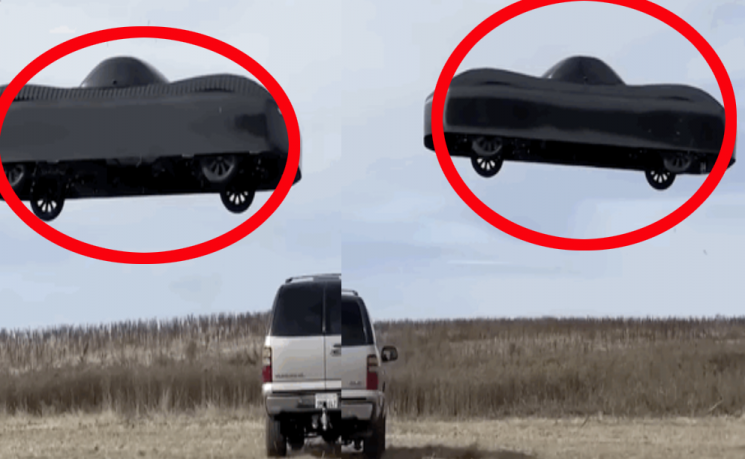 Test drive scene of Model A Ultralight. This model is powered 100% by electricity and can fly in the air at a maximum speed of approximately 177 km/h through multiple propellers installed around the driver's seat. Alef Aeronautics
On December 15 (local time), the UK’s Daily Mail reported that on December 9, Alef CEO Jim Dukhovny officially announced the start of production for the first flying car. The vehicle now entering production is the “Model A Ultralight.” Weighing approximately 385 kg, the Model A Ultralight is legally classified as an “ultralight low-speed vehicle,” similar to a compact electric car. It is powered entirely by electricity and can fly at a maximum speed of about 177 km/h using multiple propellers installed around the driver’s seat. Its most notable feature is its ability to take off and land vertically (VTOL) without a runway. Alef emphasizes its potential as a next-generation personal mobility solution, stating that it enables efficient travel even in urban areas by avoiding severe traffic congestion.
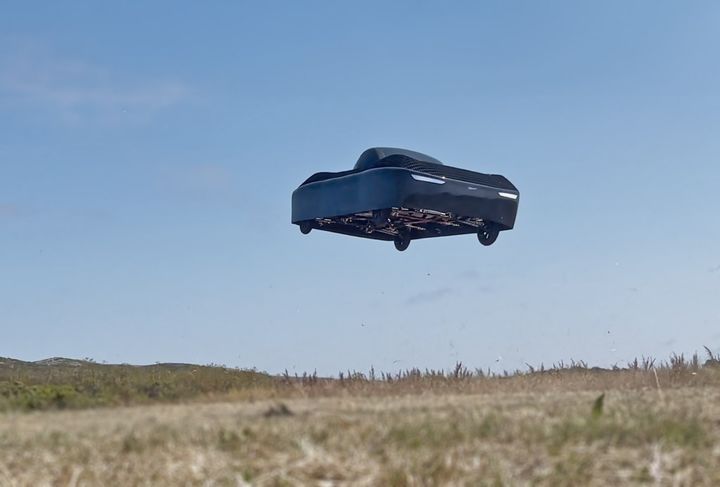 US aviation startup Alfre Aeronautics announced that it has begun production of the world's first flying car. Daily Mail
The vehicles will be hand-built over several months at Alef’s factory in Silicon Valley, California. The pre-order price is set at $300,000 (approximately 440 million KRW), and the initial units will be delivered to a select group of customers for pilot operation before gradually moving toward full commercialization. Considering safety issues, Alef has made it mandatory for customers receiving the vehicle to complete training on compliance with aviation laws and on maintenance. This reflects the fact that the vehicle, beyond being just a car, essentially carries the risks and management responsibilities of a personal aircraft. According to the company, about 3,500 pre-orders have been received so far, with total contract value reaching approximately $1 billion (about 1.4 trillion KRW).
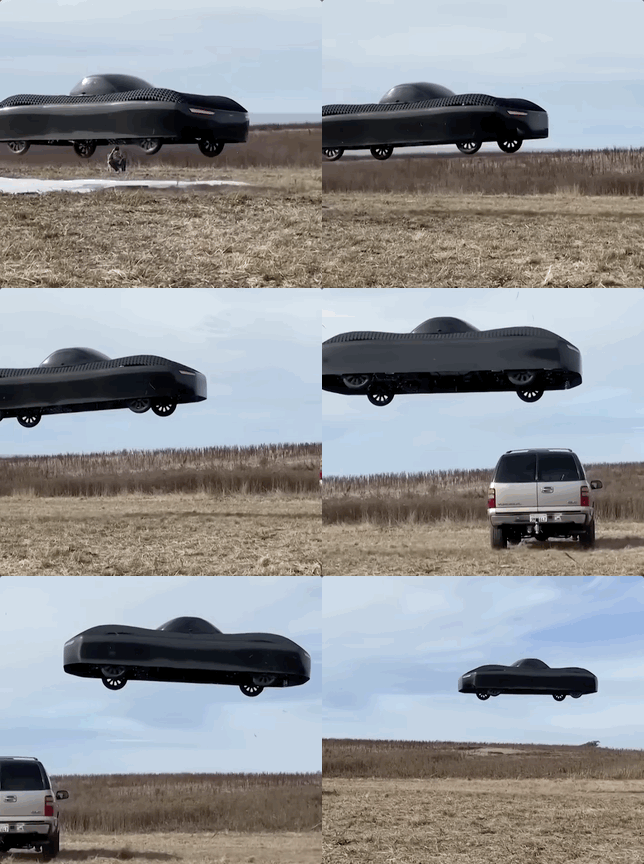 Test drive scene of Model A Ultralight. This model is powered 100% by electricity and can fly in the air at a maximum speed of approximately 177 km/h through multiple propellers installed around the driver's seat. Alef Aeronautics
The concept of a “flying car” has existed since the early 20th century. Companies such as Terrafugia in the US, PAL-V in the Netherlands, and AeroMobil in Slovakia have all showcased prototypes multiple times, but it has been extremely rare for any to reach full-scale commercialization. The main obstacles have been safety and regulation. Flying cars must comply with both road driving regulations and aviation laws, and there are numerous variables such as collision risks during low-altitude flight, mechanical failures, and pilot error.
In fact, there have been numerous accidents during the development of flying cars. In the past, a prototype from AeroMobil crashed during a test flight, with the pilot barely escaping using an emergency parachute. In the 1970s, a US engineer developing a flying car died in a test flight accident. More recently, during an overseas airshow rehearsal, two car-type flying vehicles collided and crashed midair, resulting in injuries, highlighting that safety concerns about flying cars remain unresolved.
The US Focuses on Regulation and Technology, While China Races Ahead with Mass Production
Alef Aeronautics’ announcement of mass production is considered a major milestone in the history of flying cars. However, experts point out that there is still a significant gap between limited pilot operations and widespread commercialization. This is due to numerous challenges, including cost burdens, safety certification, pilot training, and the establishment of urban air mobility (UAM) systems.
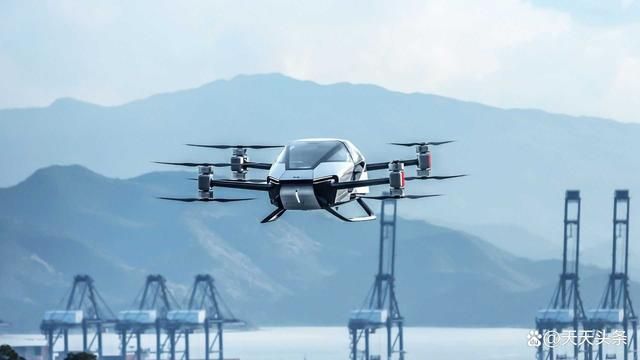
While the US is moving closer to commercialization based on technological prowess and regulatory infrastructure, China is accelerating the pace by focusing on mass production. Xpeng AeroHT, a subsidiary of Xpeng, has completed a dedicated flying car factory in Guangdong Province, China, and began trial production earlier this month. The annual production capacity is about 10,000 units, with 5,000 vehicles already pre-ordered from regions such as the Middle East, set for delivery starting next year. Last month, Wang Dan, Vice President of Xpeng AeroHT, unveiled a six-wheel vehicle and the two-seater detachable flying car “X2” at the Daegu Future Mobility event. Tesla has also expressed its intention to launch a flying car, but has yet to disclose any concrete models or timelines.
Flying cars are seen as a fusion of electric vehicle and urban drone technologies. The keys to commercialization are lighter batteries, stable flight control systems, and advanced autonomous flight algorithms. The global industry is already in fierce competition to secure these core technologies. GKN Aerospace is supplying lightweight airframe structures and electric wiring systems, while Umbra Group is expanding collaboration with major flying car manufacturers by providing actuators and motor control devices. Morgan Stanley has projected that the flying car market will reach $300 billion by 2030 and surpass $1 trillion by 2040. Whether Alef’s challenge will mark the “beginning of future transportation” or remain another expensive experiment is still uncertain. Nevertheless, the fact that the flying car, which remained a fantasy for decades, has now entered actual production lines symbolically marks the opening of a new chapter in human mobility.
© The Asia Business Daily(www.asiae.co.kr). All rights reserved.



















