Joint Statement Adopted on Relocation to Muan
1 Trillion Won Fund for Resident Support, Muan County to Have Priority on Development Profits
Muan International Airport to Be Developed as Southwestern Hub, Renaming Under Review
Special Act Amendment for Military Airport Relocation and Continued Operation of Consultative Body
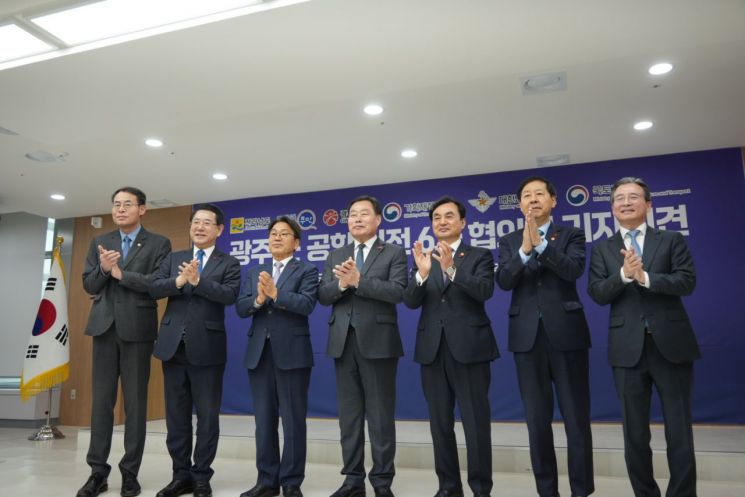 On the 17th, after the joint announcement of the six-party consultative body related to the relocation of Gwangju Military Airport at Gwangju Urban Corporation, a commemorative photo was taken. Photo by Song Bohyun
After more than a decade of negotiations, the government and local governments have reached a conclusion regarding the relocation of Gwangju Military Airport. On December 17, the government, Gwangju City, South Jeolla Province, Muan County, the Ministry of Economy and Finance, the Ministry of National Defense, and the Ministry of Land, Infrastructure and Transport jointly announced at a six-party consultative meeting in Gwangju that they had agreed to relocate Gwangju Military Airport to Muan.
At the six-party task force (TF) meeting on the relocation of Gwangju Military Airport, held that morning at Gwangju Urban Corporation, the government, relevant local governments, and related ministries adopted a joint statement reflecting this agreement.
According to the statement, the six-party consultative body recognized that the relocation of Gwangju Military Airport is a significant opportunity for regional development and also serves the interests of local residents. The government confirmed that this agreement is an important task for balanced national development and pledged to provide support for its complete implementation.
Gwangju City will ensure that Muan County, the area surrounding the new airport site, will have priority in securing development profits generated by the relocation project, so that these can be used for resident support programs. The funding for these resident support programs will total 1 trillion won, to be sourced from both Gwangju City's own funds and policy support and subsidies from the government, with detailed funding plans to be presented promptly.
South Jeolla Province and the government will promote the establishment of advanced industrial infrastructure and attract businesses to Muan County, including the creation of a national agricultural AX platform, new energy industries, and an aviation MRO center. They also agreed to expedite the designation of the Muan National Industrial Complex and to include additional support projects.
The government will work to develop Muan International Airport as the hub airport for the southwestern region by establishing a new Honam Regional Aviation Office and considering renaming Muan International Airport to "Kim Daejung Airport." In addition, the government will support the prompt relocation of Gwangju Airport's domestic flights to Muan Airport to coincide with the opening of the second phase of the Honam High-Speed Railway.
Furthermore, the government will cooperate to ensure the swift amendment of the "Special Act on the Relocation of Gwangju Military Airport" to facilitate the smooth progress of the relocation project. Muan County has agreed to cooperate with all necessary procedures for the relocation of Gwangju Military Airport to Muan, on the condition that the government, Gwangju City, and South Jeolla Province fulfill their commitments.
The government will continue to operate the six-party consultative body under its supervision to ensure the seamless implementation of this agreement, managing and advancing both the Gwangju Military Airport relocation project and the support programs for the surrounding areas.
Kim Yongbeom, Policy Chief, stated, "This agreement has paved the way for resolving regional conflicts that have persisted for over a decade through dialogue and consultation. I would like to thank the officials from local governments and central ministries who worked toward this agreement, and extend my congratulations to the citizens of Gwangju, residents of Muan County, and people of South Jeolla Province."
Meanwhile, Gwangju City plans to hold a briefing session on December 19 to share the details of the agreement with residents of Gwangsan District.
© The Asia Business Daily(www.asiae.co.kr). All rights reserved.

















