Sony and OmniVision Unveil New Products
Now on Par with Samsung in 200-Megapixel Sensors
DS Division Global Strategy Meeting Tomorrow
System LSI Division to Be a Key Agenda Item
ISOCELL HP5 Hailed as the "Ultimate" Sensor
Samsung Expected t
On December 18, Samsung Electronics is expected to hold a Global Strategy Meeting for its Device Solutions (DS) division at the Hwaseong plant, with business related to the System LSI division set to be a key agenda item. The System LSI division is responsible for developing products such as the Exynos mobile application processor (AP) and image sensors. Industry observers interpret this as Samsung having addressed urgent issues by focusing on strengthening its memory semiconductor capabilities, and now seeking to expand its efforts into quality management.
An industry insider stated on December 17, "Compared to Samsung's previous strategy meetings, this time, discussions regarding current issues in the System LSI division are expected to take up more time." In the past, Samsung's Global Strategy Meetings have primarily focused on memory, a high-profit business, but the atmosphere is expected to be different at this meeting.
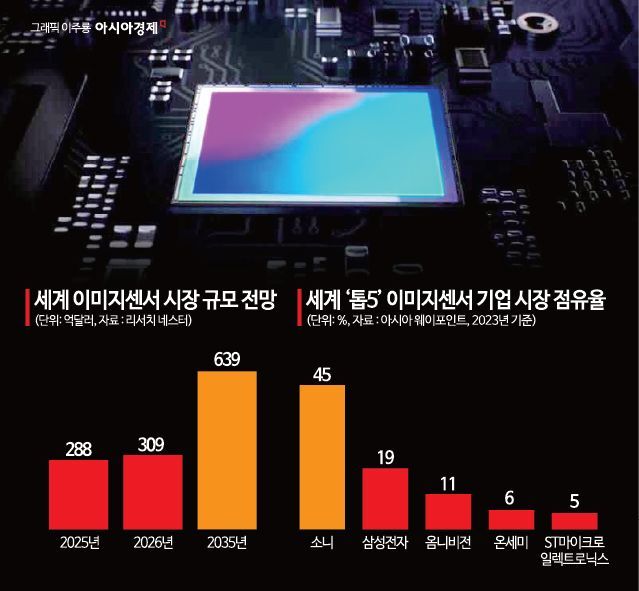
The industry anticipates that image sensors, a core area of work for the System LSI division, will be a central agenda item at the meeting. Image sensors have been a field where Samsung has established a strong technological position, but changes have been detected in the 200-megapixel segment, an area where the company had previously led over the past five years. This year, Sony Semiconductor Solutions from Japan and OmniVision from China each released new products capable of achieving 200 megapixels, putting them on par with Samsung Electronics. In September 2021, Samsung became the first in the industry to introduce the ISOCELL HP1, which packed 200 million pixels, each measuring 0.64μm (1μm is one-millionth of a meter). However, with Sony and OmniVision now able to produce 200-megapixel sensors, the competitive landscape is set to change. In October, Sony unveiled its first 200-megapixel camera sensor for smartphones, the LYT-910, followed by OmniVision's announcement on November 11 of the OVB0D, a camera sensor with the same resolution and purpose.
An image sensor is a semiconductor that detects and transmits information used to form images. It converts light waves entering a device into small electrical signals containing information, which are then processed into images. While image sensors are used in a wide range of devices, including automobiles, home appliances, and more recently, robots, their role in smartphones has become particularly prominent. Currently, many companies are competing in the active pixel sensor (CMOS sensor) segment, one of several types of image sensors.
Sony recently shifted its strategy from focusing on high-performance sensors with just 50 megapixels to a new approach. Meanwhile, China has changed the market dynamics by launching large-scale investments at the government level. Local Chinese companies such as SYSPCB have projected that the domestic image sensor industry, which was valued at $72 billion (about 106 trillion won) last year, will grow by 10% annually to reach $90 billion (about 137 trillion won) by 2027.
There is analysis suggesting that Samsung Electronics will prominently feature its 200-megapixel image sensor, the ISOCELL HP5, which was unveiled in October, at the beginning of next year. This product uses the world's first 0.5μm ultra-fine pixel technology and has been described as the "ultimate" 200-megapixel sensor. There are also reports that the ISOCELL HP5 will be incorporated into the Galaxy S26 series, scheduled for release at the end of February next year. Supplying image sensors for the iPhone 18, a contract won from Apple in August, is also an important task. Samsung Electronics plans to supply Apple with its latest ISOCELL image sensors.
There is also speculation that Samsung's image sensors could be used in space applications. The Korea Aerospace Administration recently reported that it will develop a 10cm-class ultra-high-resolution optical satellite by 2029, allocating a project budget of 44.5 billion won. High-performance image sensors are required for this project, and some in the industry consider Samsung Electronics a strong candidate. An industry insider commented, "With the development of image sensors for satellites as a pretext, there is a possibility that Samsung Electronics will have the conditions to develop high-performance image sensors."
© The Asia Business Daily(www.asiae.co.kr). All rights reserved.

















