In an Interview with The Asia Business Daily on the 17th
'SPID Platform' Combines AI and Autonomous Experimentation
Over 400,000 Antibody Data Points Accumulated
Anti-Obesity Drug Candidate to Be Unveiled Next Year
Proteina, an artificial intelligence (AI)-driven antibody drug development company, has announced its goal to discover three new drug candidates, including an anti-obesity treatment, by the first half of next year and to pursue out-licensing (technology transfer) of these candidates from the second half of the year onward. The company also revealed plans to accelerate its collaboration with Samsung Bioepis, which recently declared its transition into a new drug development company, aiming to supply all planned drug candidates within next year.
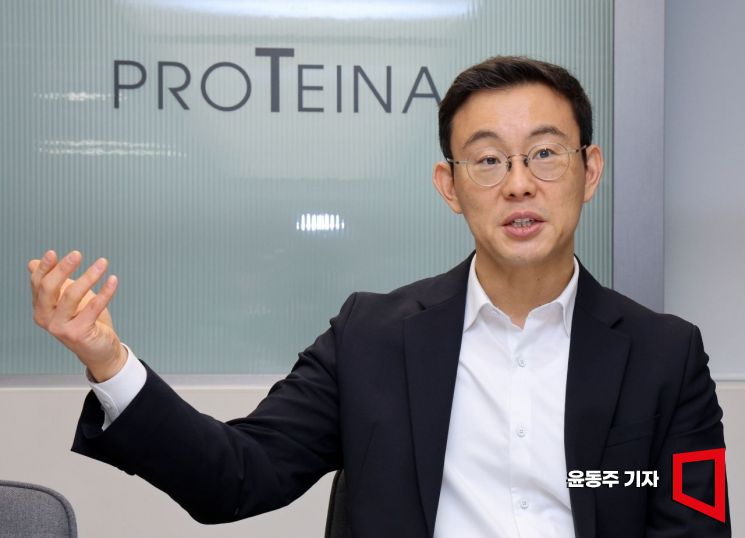 Yoon Taeyoung, CEO of Proteina, is being interviewed by The Asia Business Daily. Photo by Yoon Dongju
Three Significant Drug Candidates to Be Identified Next Year... Targeting at Least One Licensing-Out Deal
Yoon Taeyoung, CEO of Proteina and Professor at the Department of Biological Sciences at Seoul National University, stated in an interview with The Asia Business Daily on December 17, "Our goal is to identify around three candidates through accelerated development by the first half of next year, and to achieve one or two meaningful licensing-out deals in the second half." He added, "Among these, there is an asset (drug candidate) that could be highly competitive in the anti-obesity market."
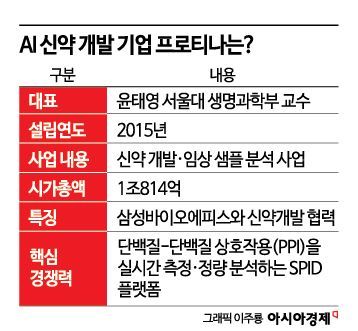
Proteina was founded in 2015 by CEO Yoon while he was a professor at KAIST. Based on its 'SPID (Single-molecule Protein Interaction Detection) platform,' which quantifies protein-protein interactions (PPI) at the single-molecule level, the company initially focused on clinical sample analysis but has recently ventured into AI-driven drug development.
The core of Proteina's business strategy is 'compressed development of biobetters (or biobests).' Starting from antibodies whose efficacy has been confirmed in early stages such as preclinical or Phase 1 clinical trials, the company uses AI-powered autonomous experimentation to enhance efficacy and physicochemical properties within a few months, creating new candidates with significantly altered sequences. Since these are entirely new antibody designs, they are free from patent issues. CEO Yoon emphasized, "What used to take at least two to three years to identify a candidate can now be compressed into three to four months."
In the field of obesity, Proteina is targeting the niche of 'maintenance' rather than 'weight loss competition.' CEO Yoon explained, "While GLP-1 (glucagon-like peptide-1) analogs are highly effective, their high discontinuation rates are due to injection aversion and high cost, and stopping the medication leads to rebound weight gain. We are considering positioning an antibody drug administered once every three months to help maintain weight and minimize rebound." Proteina is currently developing new antibody candidates with enhanced functionality, starting from antibodies under development by global big pharma companies.
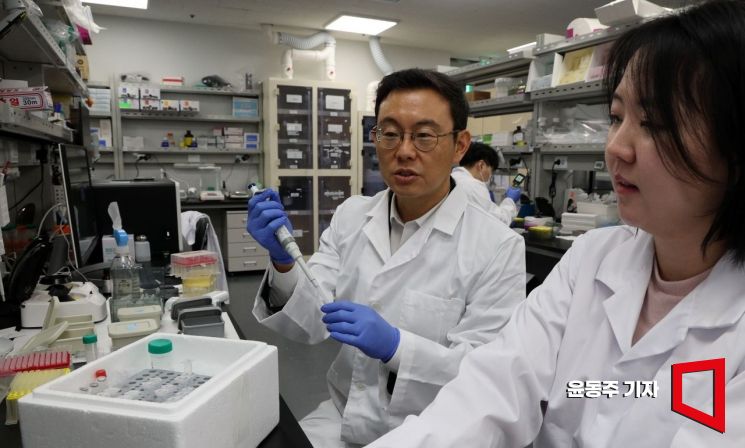 Yoon Taeyoung, CEO of Proteina, is conducting sample analysis work in the laboratory. Photo by Yoon Dongju
Collaboration with Samsung on New Drugs... Accelerating Efficacy and Safety with AI-Autonomous Experimentation Loop
Collaboration with Samsung Bio is also gaining momentum. Proteina, as part of a consortium with Samsung Bioepis and Professor Baek Minkyoung's research team at Seoul National University, has been selected as a participant in a 47 billion won national project for 'AI-driven antibody drug development' and is currently carrying out the project. The core goal is to discover ten drug candidates by 2027 and to advance at least one candidate to IND (Investigational New Drug) submission. CEO Yoon said, "Promising candidates discovered by Proteina will be supplied to Samsung Bioepis by next year. After the first half of next year, we will ensure that Samsung Bioepis can sufficiently proceed with subsequent development stages, including process development, toxicity evaluation, and IND submission."
In antibody drugs, the antibody (drug) has six 'loops' known as CDRs (complementarity-determining regions) that protrude and bind to antigens (targets), blocking signal transmission or modulating immune responses to treat diseases. However, these CDRs are not fixed structures but have 'flexible' variable conformations, making structural design with AI challenging.
Proteina solved this issue with a 'closed-loop' system that combines AI and autonomous experimentation. Whereas conventional AI models trained mainly on published data, Proteina's proprietary platform generates large-scale experimental data and feeds it back into AI training and design. When Professor Baek Minkyoung's team at Seoul National University uses their generative AI for antibody design, 'AbGPT,' to narrow down antibody candidates, Proteina's 'SPID platform' manufactures the actual antibodies and verifies efficacy and safety, feeding the results back to the AI. By repeating this cycle-each lasting two to three weeks-three to four times, the company can identify new drug candidates within three months that surpass existing drugs in efficacy, safety, and productivity.
CEO Yoon highlighted the strength of AI-based antibody design: "AI boldly explores combinations that humans would not select, creating entirely new antibodies." While researchers typically take a conservative approach, focusing on mutations or sequences that maintain or improve binding affinity between antibody and antigen, AI performs 'aggressive design' by mixing in mutations that may reduce or eliminate binding, combining multiple mutations simultaneously. Even if individual mutations appear to reduce performance, applying several together can produce candidates with much stronger binding than the original. This process-producing and experimentally validating thousands to tens of thousands of candidates-allows the company to rapidly secure 'new' drug candidates with sequences significantly different from the original.
The reason Samsung partnered with Proteina lies in its 'experimental big data generation capabilities.' CEO Yoon explained, "We are not yet at the stage where AI-designed antibodies immediately become drugs. To select high-quality candidates from thousands or tens of thousands of AI-designed molecules and convert them into actual drugs, experimental big data is essential. Proteina's speed in producing and testing antibodies is among the best in the world, and for Samsung, a latecomer in drug development, speed was crucial, which is why they chose to collaborate with us." Proteina also evaluates not only binding affinity but also productivity, safety, and immune cell interactions when screening drug candidates. CEO Yoon added, "We are focusing our development efforts on reducing the probability of failure in the later stages of development."
© The Asia Business Daily(www.asiae.co.kr). All rights reserved.
![Clutching a Stolen Dior Bag, Saying "I Hate Being Poor but Real"... The Grotesque Con of a "Human Knockoff" [Slate]](https://cwcontent.asiae.co.kr/asiaresize/183/2026021902243444107_1771435474.jpg)


















