[Planning] Uijeongbu City Unveils "Our Neighborhood Policy Roadmap: Songsan 2-dong Edition"
Uijeongbu Songsan 2-dong Announces Policy Roadmap Focusing on "Nature, Transportation, and the Future"
From Ecological Restoration Centered on Minrak Stream to Expanded Metropolitan Transit... Major Changes Ahead
More Convenient and Pleasant Living... Comprehensive Policies to Enhance Quality of Life
Commute Times Reduced by 40 Minutes... Minrak Stream Waterfront Park Connection and Park Golf Course Development
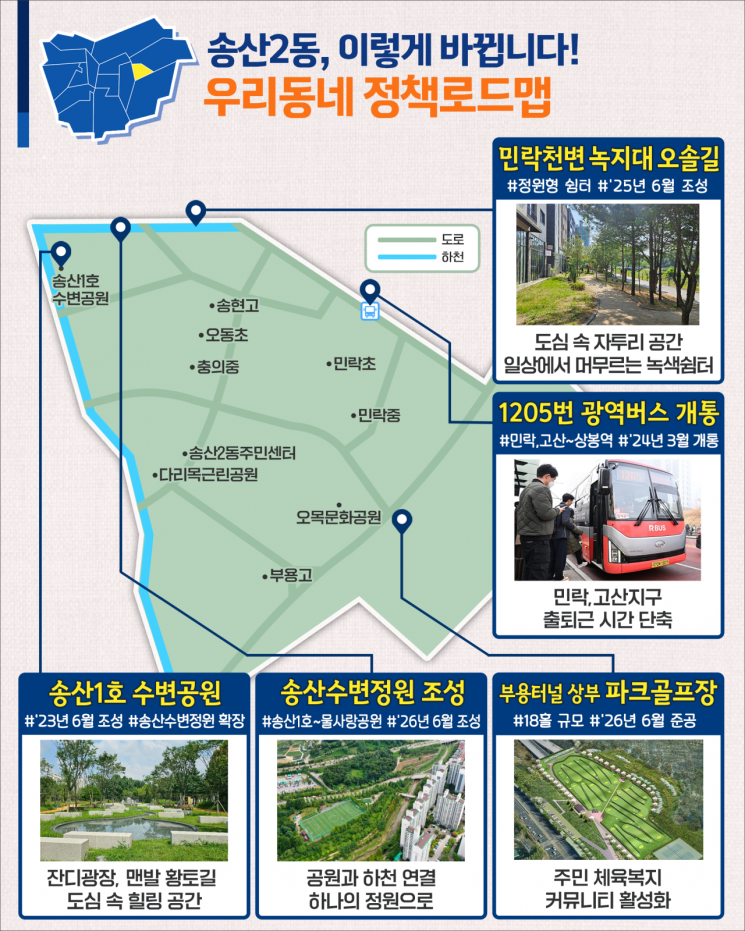
Uijeongbu City in Gyeonggi Province (Mayor Kim Donggeun) announced the "Our Neighborhood Policy Roadmap" for Songsan 2-dong on December 16, which organizes information on administration, infrastructure, welfare, and culture closely related to citizens' daily lives at the local level. The city presented a blueprint to transform Songsan 2-dong into a future-oriented city with eco-friendly green spaces and a convenient transportation network.
Restoring the Ecological Axis for Closer Nature... Realizing a Walkable City Centered on Minrak Stream
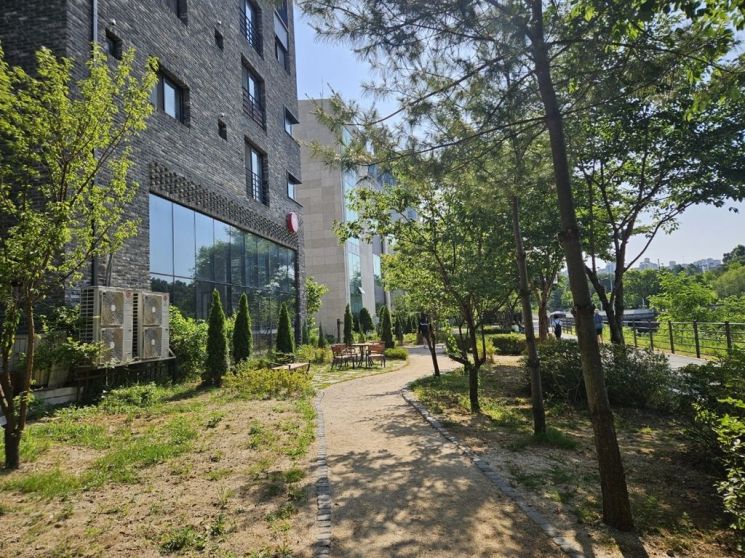
The city is accelerating the creation of a daily life-oriented ecological foundation in Songsan 2-dong, focusing on Minrak Stream, the area's main natural axis, through initiatives such as utilizing green spaces, establishing cultural spaces, and improving the pedestrian environment.
In the unused green area at 776-9 Minrak-dong, the city created a "Ssamtzi Park" this year, blending a trail and a garden-style rest area. The 200-meter trail, paved with decomposed granite, is centered around a rest area equipped with round tables and chairs. A total of 1,494 trees and shrubs, including Blue Angel, Emerald Green, Tricolor Spirea, and Azalea, have been planted, making it a popular relaxation spot for citizens.
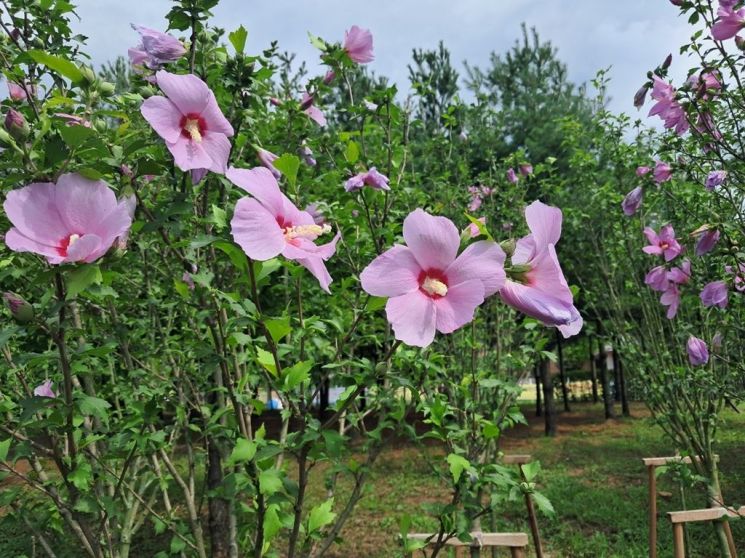
Along the Minrak Stream promenade (near 886 Minrak-dong), about 300 Rose of Sharon trees were planted last year to create "Mugunghwa Hill." After being selected for a Korea Forest Service project, the city established a Rose of Sharon colony on a 3,570-square-meter green area, installing comprehensive guide boards and plant nameplates to highlight the significance of the national flower.
In particular, the area under Gungchon Bridge on Minrak Stream has been transformed into a cultural rest area, attracting attention as a new model for urban stream space utilization. In 2023, performance seating and media art installations were completed, turning it into a healing space where residents can directly experience cultural activities.
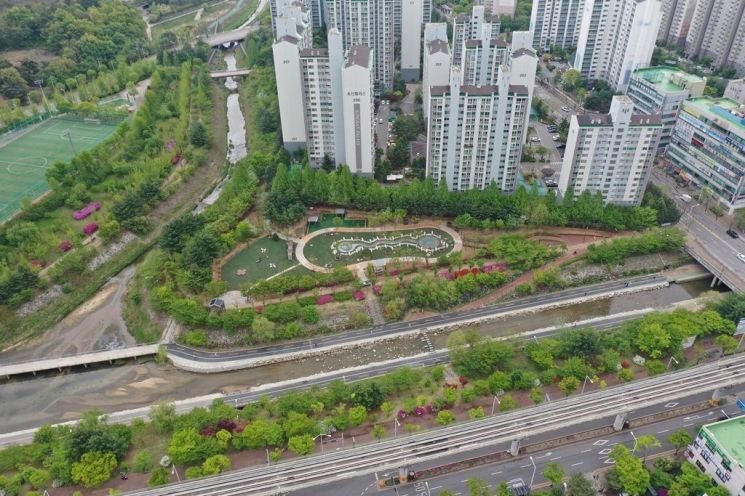
Additionally, starting with the "Songsan 1ho Waterfront Park" established in 2023 at the confluence of Buyong Stream and Minrak Stream (around 731-1 Minrak-dong), the city is expanding a pedestrian-friendly urban environment through a connected green axis along Minrak Stream, allowing citizens to walk and rest. The waterfront park, which features a loess trail, a grass plaza, and a forest rest area, serves as a family-oriented relaxation space where people can experience nature within the city.
Furthermore, a new 240-meter barefoot loess path was created last year in Darimok Neighborhood Park (near Yonghyeon Elementary School) along Buyong Stream, allowing residents to walk barefoot and enjoy health and relaxation in their daily lives.
Alongside these efforts, the city implemented the "Urban Clean-Up Project" in Minrak 2 District last year, integrating 324 outdated signboards and removing 220 posts, for a total of 544 facilities improved. This has resulted in a more walkable street environment, simultaneously enhancing driver visibility and pedestrian safety.
Commuting and School Commutes Transformed... Improved Transportation Measures in Songsan 2-dong
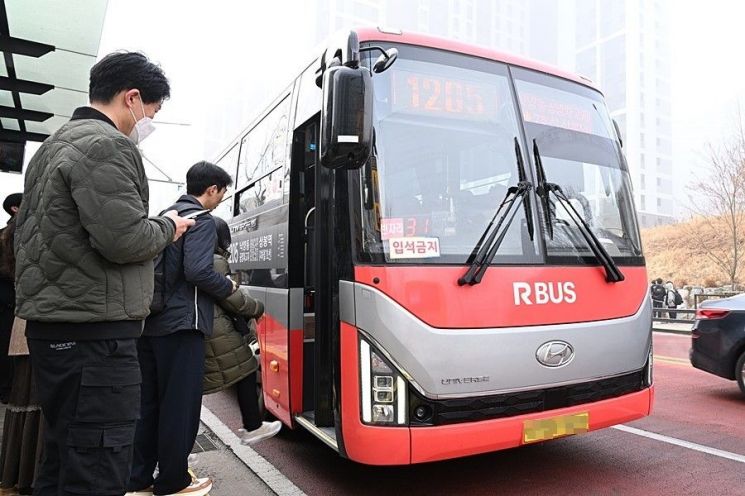
The city is expanding public transportation, such as metropolitan and public buses, to improve transportation conditions in Songsan 2-dong, which is far from subway stations.
Metropolitan Bus No. 1205, which began operation in March last year, connects Minrak and Gosan Districts to Sangbong Station in Seoul, shortening citizens' commuting times and improving accessibility to Seoul. Since its launch, monthly ridership has increased by about 14.5%, helping to alleviate transportation inconveniences. In particular, Sangbong Station serves as a major transfer hub where various subway lines and KTX converge, greatly enhancing transfer convenience for citizens.
The "Uijeongbu 01 Public Bus," in operation since February last year, is Uijeongbu's first semi-public village bus under direct city management. This has improved punctuality and speed, providing stable transportation services to residents of Minrak and Gosan Districts. The route has been extended to Suraksan Station and the Urban Airport Surak Terminal, further strengthening connections to Seoul's subway and airport buses.
Student transportation welfare is also being improved. The "Uijeongbu Student School Bus," which originated from student proposals, officially began operation in August last year, enhancing safety and efficiency for students commuting to and from school.
Notably, the introduction of the school bus has reduced students' daily commute times by about 40 minutes on average, resulting in tangible changes in daily life. From March this year, routes have been adjusted to reflect demand, and the introduction of eco-friendly hydrogen buses has more than doubled ridership. In addition, students and parents can check the real-time location of the school bus via Kakao Map, further increasing satisfaction for both groups.
Expanding the Living Sphere in a Future-Oriented Urban Environment... New Connecting Roads, Park Golf Course, and Waterfront Garden
The city is working to improve living conditions for Songsan 2-dong residents by expanding transportation infrastructure, creating sports facilities, and connecting green axes as part of various future-oriented urban environment projects.
First, the city is promoting the construction of the "Minrak-Gosan Connecting Road" to resolve the disconnected road network between Minrak and Gosan Districts.
Although both districts are fully developed residential areas adjacent to each other in Songsan-dong, the lack of a connecting road has forced citizens to detour via national highways, causing inconvenience. In particular, severe congestion and traffic jams occur repeatedly during commuting hours, resulting in chronic traffic problems.
To address these issues, the city plans to construct a 1.1-kilometer connecting road (including a 488-meter tunnel). Once completed, this road will not only connect Minrak and Gosan Districts but also improve access to the nearby Complex Cultural Convergence District, thereby enhancing inter-regional connectivity and residential conditions.
In response to the demand for recreational sports, the city broke ground on the "Buyong Park Golf Course" project in November. A 34,000-square-meter sports park is planned on the long-unused land above Buyong Tunnel (around San 100-35 Minrak-dong), with an 18-hole park golf course to be built on about 10,000 square meters of the site.
This aims to provide a recreational sports space accessible to all citizens, with plans to improve the surrounding walking trails and install amenities such as shade structures and benches. The city is focusing on accessibility and safety for residents, developing sports infrastructure that promotes both health and leisure.
Additionally, the city is pursuing the "Songsan Waterfront Garden Project," which will integrate parks, green spaces, and streams-previously separated by facility-into a unified, garden-like space.
The project will connect Gonje Neighborhood Park to the Minrak 2 District Waterfront Park, and new barrier-free ramps, grass plazas, and green walking trails will be created within Gonje Neighborhood Park.
The core goal is to create a walkable environment within the city and provide residents with more pleasant spaces to enjoy nature.
An official from Uijeongbu City stated, "Through this policy roadmap, residents of Songsan 2-dong will enjoy a more comfortable and convenient environment. We will continue to strengthen communication with residents and share ongoing changes in administrative services."
Meanwhile, the "Our Neighborhood Policy Roadmap" is an initiative that systematically organizes policies and current issues for each of the city's 15 districts to share changes in citizens' daily lives and strengthen communication with residents. The next installment will feature Songsan 3-dong.
© The Asia Business Daily(www.asiae.co.kr). All rights reserved.



















