86.8 Billion Won Invested in a Future-Oriented Digital Botanical Garden
Expected to Attract 460,000 Visitors Annually and Become a Regional Landmark
Ulsan Ulju County is accelerating the construction of the tentatively named "Ulju County Ganjeolgot Botanical Garden," a project underway in the Ganjeolgot area, one of the region's leading tourist attractions.
On December 16, Ulju County held a press briefing at the county office press center, attended by County Governor Lee Sungul, Deputy Governor Yoon Deokjung, and relevant officials, to present the botanical garden development plan and future schedule.
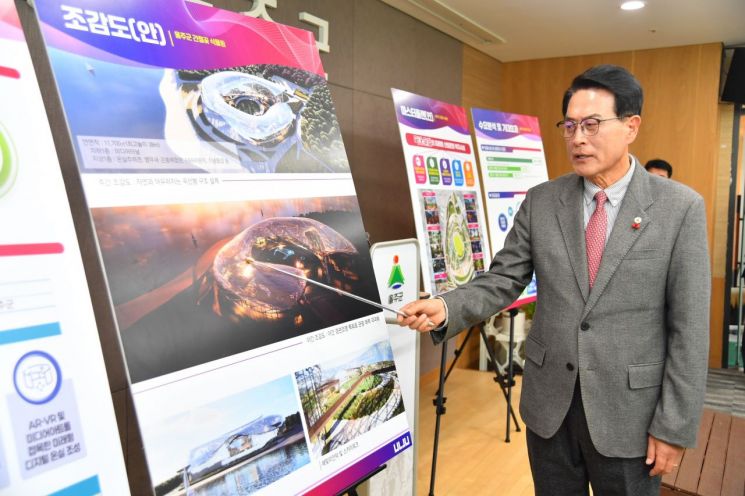 On the 16th, Ulsan Ulju County held a press briefing on the construction project of the Ganjeolgot Botanical Garden, where Lee Sungul, the county governor of Ulju, explained the project overview and future plans. Provided by Ulju County
The "Ulju County Ganjeolgot Botanical Garden" will be established as Korea's only future-oriented forest culture and welfare facility, combining traditional greenhouses with digital technology. With a total project budget of 86.8 billion won, the garden will be built within Ganjeolgot Park, at 31 Daesong-ri, Seosaeng-myeon, Ulju County, on a site covering 53,000 square meters, with the goal of completion by 2030.
The botanical garden will have a total floor area of 11,700 square meters and a maximum height of 38 meters. The basement level will feature a media tunnel, while the first floor will house a greenhouse exhibition hall, a parrot and insect experience center, an F&B lounge, a souvenir shop, and more.
The concept is "A World Tour of Plants in Korea." Various plants themed around the five oceans and six continents will be exhibited in the traditional greenhouse, while a digital greenhouse incorporating augmented reality (AR), virtual reality (VR), and media art will provide a differentiated visitor experience. In addition, the facility will include Korea's longest 450-meter media art tunnel, a skywalk, a sky adventure, and an artificial aurora, offering a range of interactive attractions.
According to a feasibility study by the Korea Research Institute for Local Administration, the annual demand for the Ganjeolgot Botanical Garden is projected at 460,000 visitors. In a survey of 1,000 residents in Ulsan, Busan, and Gyeongnam, 82.5% of respondents supported the construction of the botanical garden, and 69.1% expressed an intention to visit, indicating a positive outlook from potential users.
The economic impact is also expected to be significant. In Ulsan alone, the project is anticipated to generate 8.32 billion won in production inducement, 4.04 billion won in value-added inducement, and create 592 jobs. Nationally, the figures are projected at 13.13 billion won in production inducement, 5.91 billion won in value-added inducement, and 852 jobs. The benefit-cost ratio (B/C) was calculated at 0.499. Policy analysis suggested that if the facility and operation surpass those of the Geoje Botanical Garden, it could serve as a landmark attraction.
Based on the results of the master plan and feasibility study, Ulju County plans to proceed with architectural and detailed design, aiming to begin construction in 2028 and complete the project by 2030.
Governor Lee Sungul stated, "If a year-round garden landmark where flowers bloom in all seasons is added to Ganjeolgot, where the sun rises first in Korea, it will mark a turning point that transforms the paradigm of tourism in Ulju. We will do our utmost to ensure that the Ganjeolgot Botanical Garden becomes a landmark tourist attraction representing not only Ulju but all of Korea."
© The Asia Business Daily(www.asiae.co.kr). All rights reserved.

















