Additional Investment in CNP New Material, a Joint Venture with CNGR
Responding to ESS Demand... Annual Production Capacity to Expand to 50,000 Tons
Conversion of Existing Ternary Production Lines Also Planned... Supply to Begin at End of Next Year
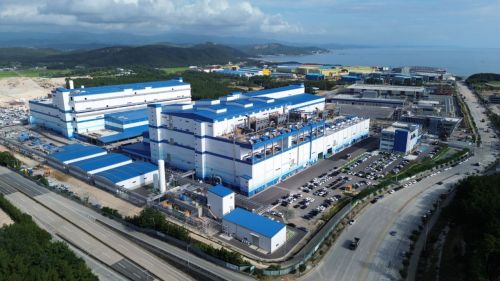 A panoramic view of POSCO Future M's anode material factory in Yeongilman 4 Industrial Complex, Pohang. POSCO Future M plans to convert part of the existing anode material production line in Pohang into an LFP production line and start supply from the end of 2026. POSCO Future M
POSCO Future M announced on December 16 that it has decided to build a lithium iron phosphate (LFP) cathode material factory to respond to the rapidly growing energy storage system (ESS) market.
The company held a board meeting the previous day and approved the plan to construct a dedicated LFP cathode material factory in the Yeongilman 4 General Industrial Complex in Pohang. Construction will begin in 2026, with mass production scheduled to start in the second half of 2027. All LFP cathode materials produced at this facility will be supplied exclusively for ESS applications.
POSCO Future M will promote the construction of the LFP cathode material factory through additional investment in CNP New Material Technology, a joint venture established with China’s CNGR in 2023. Previously, in August, POSCO Future M signed a memorandum of understanding (MOU) with CNGR and FINO, CNGR’s Korean subsidiary, to pursue the LFP cathode material business for ESS, and has since been reviewing the project.
With this investment, POSCO Future M plans to expand its maximum annual production capacity to 50,000 tons.
Separately, to enter the LFP market early, POSCO Future M also plans to convert part of the existing ternary NCM cathode material production line at its Pohang plant into an LFP cathode material production line, with supply scheduled to begin at the end of 2026.
LFP batteries have lower output compared to ternary batteries such as nickel-cobalt-manganese (NCM) and nickel-cobalt-aluminum (NCA), but their advantages include lower cost and longer lifespan. As a result, they are increasingly being used in various fields, including ESS and low-cost electric vehicles.
With demand for ESS LFP batteries in the North American market surging recently, domestic battery companies are converting existing ternary battery production lines to LFP battery lines. Battery manufacturers are seeking to source materials from Korea in response to the U.S. government’s efforts to curb reliance on China. In Korea, the government has also expanded the scoring criteria for domestic materials in the central contract market bidding for battery energy storage systems (BESS).
Following POSCO Future M’s investment decision, the supply of domestically produced LFP cathode materials is expected to increase, intensifying competition for orders. In Korea, L&F is investing 338.2 billion won to build an LFP production plant with an annual capacity of up to 60,000 tons in the National Industrial Complex in Dalseong-gun, Daegu. The company aims to complete construction in the first half of next year and begin mass production in the second half.
Meanwhile, POSCO Future M is developing next-generation cathode materials to respond to changes in the electric vehicle and ESS markets. Together with the POSCO Holdings Future Technology Research Institute, which oversees research and development for the POSCO Group, POSCO Future M has completed pilot development of lithium manganese rich (LMR) cathode materials. In the second half of the year, the company also completed pilot development of ultra-high-nickel cathode materials for premium electric vehicles and high-voltage mid-nickel cathode materials.
© The Asia Business Daily(www.asiae.co.kr). All rights reserved.
!["The Woman Who Threw Herself into the Water Clutching a Stolen Dior Bag"...A Grotesque Success Story That Shakes the Korean Psyche [Slate]](https://cwcontent.asiae.co.kr/asiaresize/183/2026021902243444107_1771435474.jpg)
















