Chairman Choi Yoonbum Brings in U.S. Government as White Knight
Youngpoong and MBK Signal Legal Action in Response
Management Rights Dispute Expands to Korea-U.S. Industry and Security
Negative Public Opinion Intensifies for MBK Due to Homeplus

Choi Yoonbum, Chairman of Korea Zinc, has brought in the U.S. government as a "white knight," putting the Youngpoong and MBK Partners camp on the defensive. Not only has their advantage in the shareholding battle disappeared, but the confrontation has also expanded from a simple management rights dispute to an issue linked to industrial and security policies of both the United States and Korea. For MBK, which is already facing negative public opinion due to the Homeplus controversy, it is now difficult to mount a counterattack, no matter how sophisticated their legal arguments may be.
Chairman Choi Yoonbum's U.S. White Knight... Youngpoong and MBK Respond with Legal Action
According to industry sources on December 16, Korea Zinc held an extraordinary board meeting the previous day and decided to issue new shares equivalent to 10.3% of the company’s total shares to a joint venture (JV) involving the U.S. government. If this capital increase succeeds, Chairman Choi’s side will have a shareholding equal to that of the Youngpoong and MBK Partners camp, which is currently the largest shareholder.
At present, the Youngpoong and MBK Partners alliance holds 44.24% of Korea Zinc’s shares. In contrast, Chairman Choi and his related parties hold 19.41%. Even with friendly parties such as Hanwha included, their side only reaches about 32%, making it inevitable that they would eventually lose control of the board. If the capital increase is successful and the U.S. government JV acquires new shares amounting to 10.3% of Korea Zinc’s total issued shares, the Youngpoong and MBK Partners camp's stake is expected to be diluted to around 40%. Chairman Choi’s side would also be diluted to around 29%, but with the 10.3% stake from the U.S. JV joining as an ally, their effective shareholding would reach parity at around 39%. This would make it uncertain whether Youngpoong and MBK Partners can maintain control of the board at next year’s regular shareholders’ meeting.
Youngpoong and MBK Partners have announced that they will file for an injunction, claiming the new share issuance is invalid. In a statement, they pointed out, "A capital increase that sacrifices existing shareholders through a non-transparent share transfer structure does not meet management needs and directly violates the principle of shareholder equality."
Separately, they may also file a main lawsuit seeking to nullify or cancel the board resolution. They are expected to question whether there was sufficient due diligence on the business feasibility of the U.S. smelter construction project and whether outside directors were properly informed in advance. In addition, they could file a shareholder derivative suit, alleging that board members violated their fiduciary duties under the revised Commercial Act. This would mean comprehensive legal pressure on the CEO, the inside and outside directors who approved the agenda, and the audit committee members.
Management Rights Dispute Expands to Korea-U.S. Industry and Security... Tilted Public Opinion
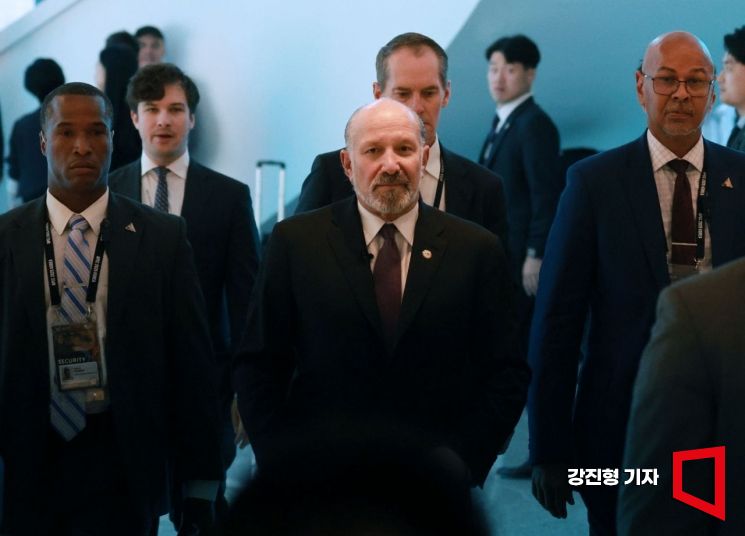 Howard Lutnick, U.S. Secretary of Commerce, is attending the Korea-U.S. Business Roundtable event at the Asia-Pacific Economic Cooperation (APEC) CEO Summit held at Gyeongju Arts Center in Gyeongbuk on October 29, 2025. Photo by Kang Jinhyung
However, some analysts believe the outcome is already decided. This is because Howard Lutnick, U.S. Secretary of Commerce, has publicly welcomed Korea Zinc’s decision to invest in building a smelter in the United States, turning the management rights dispute into an issue connected to U.S. industrial and security policy.
On December 15 (local time), Secretary Lutnick posted on his social media, "Starting in 2026, the United States will secure priority access to Korea Zinc’s expanded global production, putting America’s security and manufacturing first," and added, "I congratulate President Donald Trump for delivering yet another huge win for America." By mentioning President Trump, this was not just a show of support or lip service, but an attempt to establish the outcome as a fait accompli.
As a result, Korea Zinc now stands at the center of key terms such as U.S. supply chain restructuring, decoupling from China, and alliance cooperation. The situation has moved beyond logic into the realm of "taking sides." No matter how sophisticated the legal counterarguments from the Youngpoong and MBK Partners alliance, it will be difficult for them to escape the frame of "undermining a U.S. strategic minerals project."
Moreover, the negative narrative surrounding MBK, accumulated through the Homeplus case, is likely to further intensify public criticism against them. Since the courts do not completely disregard the broader context of the times, it is expected that they will take a more cautious approach to various lawsuits, including applications for injunctions. If pressure from institutional investors such as the National Pension Service, which is extremely risk-averse regarding political and diplomatic issues, and foreign pension funds is added, MBK’s room for maneuver could be significantly reduced.
An investment banking industry insider commented, "From a purely legal perspective, Youngpoong and MBK could still put up a fight, but the frame has already shifted, expanding to public opinion, politics, and international relations. They need to quickly devise an exit strategy or prepare for a long-term battle, such as securing additional shares."
© The Asia Business Daily(www.asiae.co.kr). All rights reserved.
!["The Woman Who Threw Herself into the Water Clutching a Stolen Dior Bag"...A Grotesque Success Story That Shakes the Korean Psyche [Slate]](https://cwcontent.asiae.co.kr/asiaresize/183/2026021902243444107_1771435474.jpg)

















