Recognition of Air-Source Heat as Renewable Energy, Revisions to Tariffs and Construction Standards
Targeting a Reduction of 5.18 Million Tons of Greenhouse Gases
The government has officially designated the deployment of heat pumps as a national priority to drive decarbonization in the thermal energy sector. The goal is to distribute 3.5 million heat pumps by 2035, thereby reducing greenhouse gas emissions by 5.18 million tons.
On December 16, the Ministry of Climate, Energy and Environment announced its “Plan to Promote Heat Pump Deployment” at the Industrial Competitiveness Enhancement Ministers’ Meeting and Growth Strategy Task Force (TF) meeting held at the Government Complex Sejong. Thermal energy accounts for about half of total energy consumption and has a high dependence on fossil fuels, making it a major contributor to greenhouse gas emissions in the energy sector. The government views the transition of heating and hot water systems to electricity-based heat pumps as a key solution for achieving carbon neutrality in the building sector.
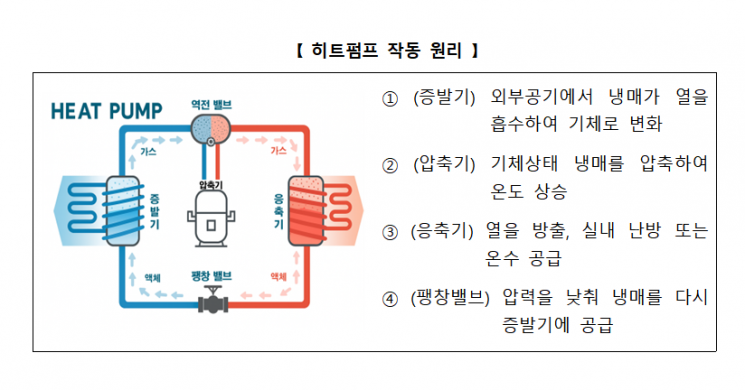
Heat pumps are devices that use ambient heat sources such as air, geothermal, or water to provide heating, cooling, and hot water simultaneously. Because they do not burn fuel directly, they do not emit carbon dioxide directly. According to the government, heat pumps are two to three times more energy efficient than conventional gas boilers and are regarded as a representative clean thermal technology capable of replacing fossil fuel-based heating.
Through this initiative, the government plans to gradually address the high installation costs and institutional barriers that have been identified as initial obstacles to adoption. Priority support will be provided for installing heat pumps linked with solar power in single-family homes and community facilities, such as village halls, particularly in areas without city gas supply. The transition to heat pump heating will also be expanded in social welfare facilities, such as nursing homes, and in flower and vegetable farms. For facilities with high energy consumption, such as public baths, swimming pools, and accommodations, installation subsidies and long-term low-interest loans will be offered in parallel.
In the public sector, the government will expand the deployment of “building self-sufficient heat pumps,” which combine heat pumps, solar power, and energy storage systems (ESS), in schools and government buildings. After reviewing the outcomes of related budget projects, the government plans to gradually increase deployment from 2027 onward and is also considering introducing financial support through long-term installment payments.
Institutional improvements will proceed in parallel. The government will seek to amend relevant laws to officially recognize air-source heat as renewable energy and plans to include heat pumps among the eligible equipment for high-efficiency energy support. Taking into account the domestic preference for floor heating, national standards (KS) and environmental certification criteria will be established for residential air-to-water heat pumps, and a separate electricity rate option will be allowed to alleviate the burden caused by the progressive electricity tariff system.
The certification standards for new zero-energy buildings (ZEB) will be revised to count heat energy produced by heat pumps as renewable energy, and the government will promote measures to assign additional weight to heat pump deployment performance under the Energy Efficiency Resource Standard (EERS) program. Amendments to housing construction standards and building energy-saving design standards have also been announced to encourage the use of heat pumps in multi-family housing.
From an industrial perspective, the government will expand the development and demonstration of large-capacity and ultra-high-temperature heat pump technologies. Key tasks include developing large systems suitable for multi-family housing and district heating, as well as high-temperature heat pump technologies that recover and utilize waste heat from industrial processes. The government also plans to establish the Heat Pump Industry Association to support the development of statistics, standardization, professional workforce training, and export promotion.
Minister of Climate, Energy and Environment Kim Seonghwan stated, “Achieving carbon neutrality in the building sector is a challenge that can no longer be postponed,” adding, “By expanding the deployment of heat pumps, we will simultaneously achieve decarbonization across the entire thermal energy sector and strengthen industrial competitiveness.”
© The Asia Business Daily(www.asiae.co.kr). All rights reserved.

















