National AI Strategy Committee Announces AI Action Plan on 100th Day
Securing Infrastructure Including GPUs... Establishing Compact Data Centers
Securing Physical AI Data and Technology... Accelerating AX
Transitioning Some Public Systems to Private Cloud
Regarding Concerns Over the AI Basic Act: "Will Consider Amendments if Issues Arise"
The government has unveiled its Artificial Intelligence (AI) Action Plan, which sets the goal of becoming the world leader in physical AI by 2030. Commonly referred to as the "AI Action Plan," this initiative includes expanding infrastructure such as data centers while also accelerating AI transformation (AX) across industries. To achieve this, the government aims to secure core technologies and data for physical AI by 2030.
The National Artificial Intelligence Strategy Committee held a press conference on the afternoon of December 15 at Seoul Square in Jung-gu, Seoul, to commemorate the 100th day since the committee's launch and announced the "Republic of Korea Artificial Intelligence Action Plan," which includes these objectives.
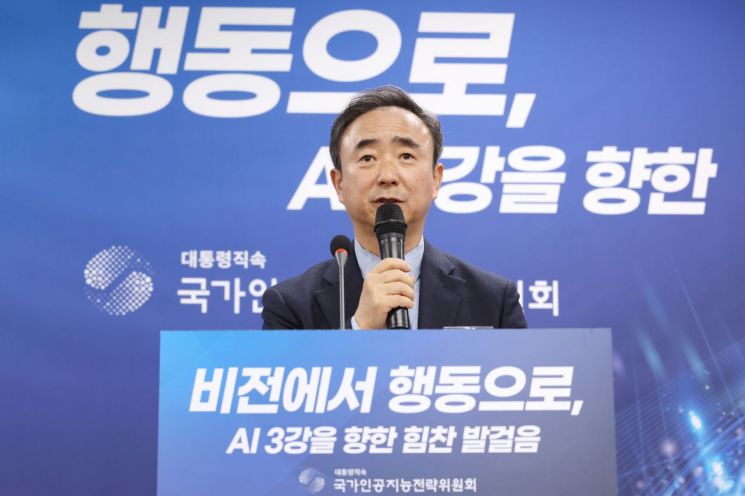 On the afternoon of the 15th, Lim Moonyoung, Vice Chairman, is briefing at the 100-day press conference of the National Artificial Intelligence Strategy Committee held at Seoul Square in Jung-gu, Seoul. Photo by Yonhap News Agency
The National Artificial Intelligence Strategy Committee, launched on September 8, is the nation’s top-level AI strategy body. The press conference was attended by Vice Chairman Lim Moonyoung, eight subcommittee chairs, and five task force leaders.
The plan unveiled at the event is structured around three pillars: building the AI ecosystem, accelerating AI transformation (AX), and promoting an AI-based society. It contains a total of 98 tasks to be implemented by various ministries, which were developed by subcommittees and task forces composed of private sector experts.
The plan emphasizes rapid implementation. Lim Moonyoung, Vice Chairman of the AI Strategy Committee, stated, "Above all, we must respond quickly," adding, "We focused on enabling both the private and public sectors to adapt rapidly, and since speed is crucial, the action plan specifies deadlines for each task."
To foster the AI ecosystem, the plan calls for expanding infrastructure such as data centers based on advanced graphics processing units (GPUs) and domestically produced AI semiconductors. It also introduces a continuous security inspection system utilizing white-hat hackers.
To secure core AI talent, the government will establish a mandatory AI education framework across elementary, middle, and high school curricula and promote interconnection among various AI talent development programs. Legal frameworks will also be revised to ensure that the use of original personal data and copyrighted materials for AI training does not infringe on rights.
Next, the plan aims to accelerate AX in areas where Korea has strengths. Based on this, the government will strengthen full-cycle AI capabilities and expand the export of full-stack AI solutions. Additionally, it will invigorate the AI-based K-content creation ecosystem and accelerate defense AX by establishing a defense AI data center.
Shim Seungbae, Head of the AI and Informatization Research Division at the Korea Institute for Defense Analyses and Chair of the Defense and Security Subcommittee, stated, "It is necessary to establish standards for defense data collection and refinement, as well as data security classification," adding, "Depending on the classification, we will prepare for cloud migration at the data level, utilizing either private or military clouds."
The plan also includes the opening of public data and integration with private platforms. By adopting an AI-native government work management platform, the government aims to break down administrative silos and develop plans for opening public data, such as court rulings. Furthermore, an AI-based integrated civil service platform will be established in connection with private platforms.
The migration of public systems to private clouds will also be pursued. From next year, services such as D-Brain, the Postal Information System, and the Safety Didimdol Service will begin transitioning to private clouds and launch disaster recovery (DR) projects.
Finally, the plan includes the establishment of a "Plan for Promoting an AI-Based Society" to contribute to the global AI society. Through this, Korea aims to become a leading nation in the AI-driven economic and safety ecosystem.
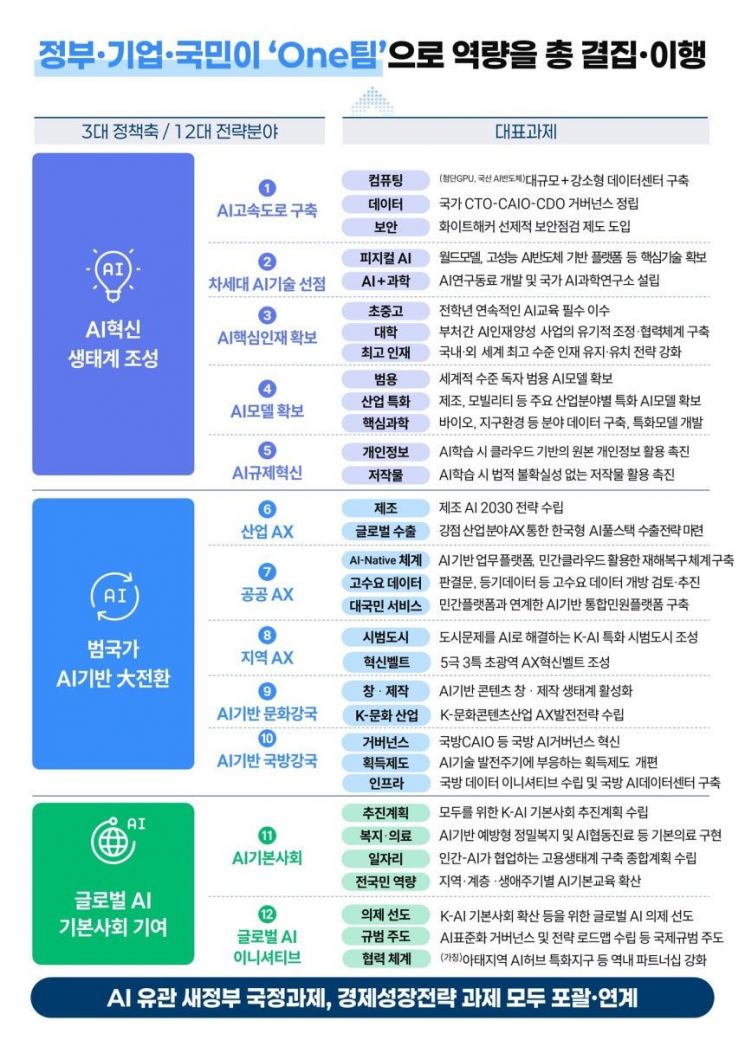 The National Artificial Intelligence Strategy Committee held a press briefing on the afternoon of the 15th at Seoul Square in Jung-gu, Seoul, commemorating 100 days since the committee's launch, and announced the "Republic of Korea Artificial Intelligence Action Plan." Provided by the National Artificial Intelligence Strategy Committee
The committee plans to publish the action plan on its website until January 4 of next year to collect public feedback. It will also gather opinions from industry, academia, research institutions, civil society, and major organizations and groups.
According to the committee, the plan also includes newly identified tasks discovered after the establishment of national policy objectives. Notably, these include shifting the security paradigm from post-incident response to proactive prevention, and efficiently redesigning public systems by leveraging private sector capabilities.
The plan encourages inter-ministerial cooperation during its implementation. Vice Chairman Lim emphasized, "A significant portion of the action plan is dedicated to laying the foundation for AI in Korea, including securing infrastructure, nurturing talent, and regulatory innovation, as well as supporting industries. To promote cooperation among ministries, we have included many 'funnel strategy' tasks that require consultation on specific issues within a set timeframe."
Since its launch, the committee has completed the formation of eight subcommittees and three task forces, and has established a policy review system centered on experts. It has also taken charge of coordinating national responses to major AI-related issues.
Vice Chairman Lim stated, "The committee has strived to work in new ways as an organization preparing for the AI era," adding, "Going forward, we will closely monitor and coordinate the implementation of the AI Action Plan by each ministry, and work even harder to ensure tangible results."
Meanwhile, regarding concerns about regulations related to the AI Basic Act, which is scheduled to take effect in January next year, Vice Chairman Lim said, "It is not appropriate to comment while the law is still in progress," but added, "We will monitor the implementation process, listen to public opinion if any issues arise, and consider amendments or other improvements to the law as needed."
© The Asia Business Daily(www.asiae.co.kr). All rights reserved.
![Clutching a Stolen Dior Bag, Saying "I Hate Being Poor but Real"... The Grotesque Con of a "Human Knockoff" [Slate]](https://cwcontent.asiae.co.kr/asiaresize/183/2026021902243444107_1771435474.jpg)

















