A Solution to Youth Outflow...
Emphasizing the Need for Industrial Transformation
The Gwangju Branch of the Democratic Party's Honam Development Special Committee has proposed attracting semiconductor companies to the Gwangju region in order to strengthen youth employment and the local industrial base.
On December 15, the Honam Development Special Committee Gwangju Branch held a press conference at the Gwangju City Council to propose attracting semiconductor companies to Gwangju. The event was attended by Lee Byunghoon, Senior Vice Chairperson of the Democratic Party's Honam Development Special Committee, along with other committee members.
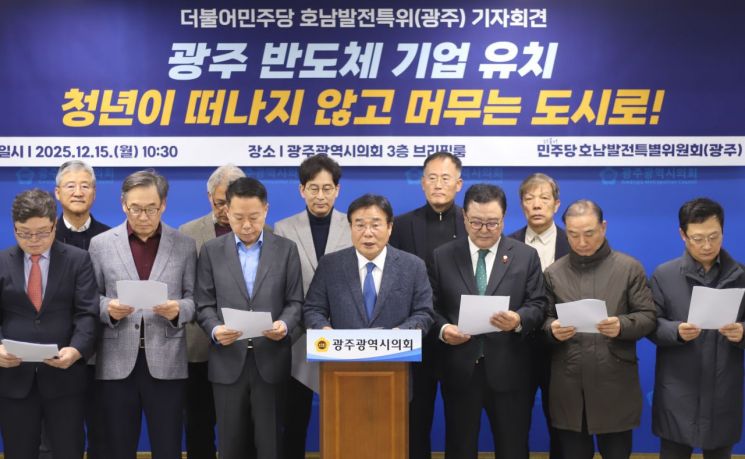 On the 15th, the Democratic Party's Honam Development Special Committee Gwangju Branch held a press conference at the Gwangju City Council proposing the attraction of semiconductor companies to Gwangju. Provided by the Honam Special Committee
The committee stated that Gwangju is facing a structural crisis due to the outflow of young people and the weakening of the regional industrial base. As an alternative to overcome this, the committee emphasized the need to create quality jobs for youth and to transform the economic structure, centering on the semiconductor industry. In 2024, approximately 73% of Gwangju’s total net population outflow consisted of young people.
Senior Vice Chairperson Lee said, "President Lee Jaemyung recently emphasized the importance of the semiconductor industry and the need to build a new industrial ecosystem centered on the southern region, which is rich in renewable energy," adding, "We are grateful for the government's attention and direction." He continued, "Among the regional development tasks identified by the Honam Development Special Committee Gwangju Branch, the most urgent issues are population decline and youth outflow. To create a city where young people want to stay, it is essential to create quality jobs, and the semiconductor industry could be one solution."
He also pointed out that the semiconductor industry’s concentration in the Seoul metropolitan area is facing limitations such as instability in power and water supplies and rising costs of industrial land. He explained that Gwangju and Jeonnam are regions equipped with renewable energy, abundant water resources, and research infrastructure. Gwangju’s AI data center, AI mobility base, and the educational and research infrastructure provided by Chonnam National University, GIST, and KEPCO Tech were also cited as key strengths.
Senior Vice Chairperson Lee argued that the Bitgreen Industrial Complex and the National Future Vehicle Industrial Complex could serve as candidate sites for automotive semiconductor plants, while the Advanced District 3 could be developed as a hub for advanced packaging and semiconductor research and development (R&D). He also stated that comprehensive government-level support is needed, including attracting anchor companies, establishing demonstration centers, nurturing talent, supporting R&D, and designating RE100 industrial complexes.
© The Asia Business Daily(www.asiae.co.kr). All rights reserved.

















