Bank of Korea Gwangju-Jeonnam Branch Hosts Regional Economy Joint Seminar
Number of Foreigners Doubles in 10 Years, Compared to 1.7-Fold National Increase
"High Nationality Concentration Hinders Social Integration...Migration Dispersion Policies Needed"
The increase in the number of foreigners in the Gwangju and Jeonnam regions is significantly outpacing the national average, prompting calls for policies with mid- to long-term goals such as mutually beneficial employment strategies for both domestic and foreign workers, as well as improvements to the population structure.
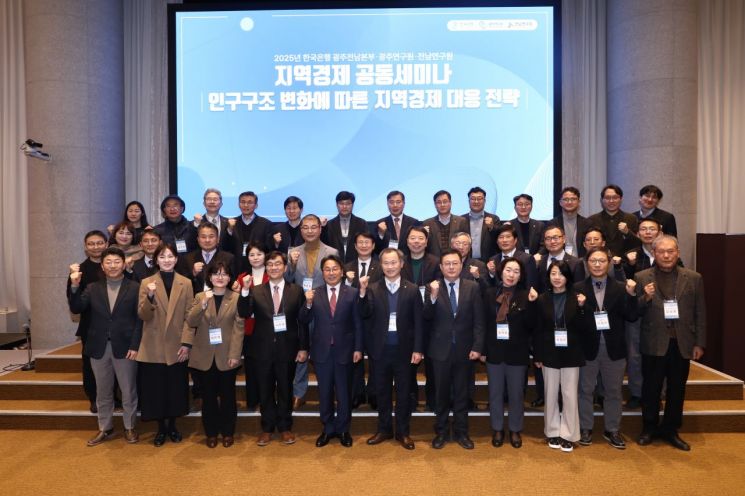
On the afternoon of December 15, at the Holiday Inn Hotel in Gwangju, Lee Chanyoung, Professor of Economics at Chonnam National University, and Ahn Jiyeon, Head of the Economic Research Team at the Gwangju-Jeonnam Branch of the Bank of Korea, delivered a presentation titled "Current Status of Foreigners in Gwangju and Jeonnam and Analysis of Their Economic Impact on the Region" at the "2025 Regional Economy Joint Seminar."
According to the presentation by Professor Lee and Head Ahn, between 2013 and 2023, the number of foreigners in Gwangju increased from 16,000 to 35,000, a 2.2-fold rise, while in Jeonnam, the figure grew from 25,000 to 62,000, a 2.5-fold increase.
This far exceeds the national growth rate, which rose from 1,121,000 to 1,935,000, a 1.7-fold increase during the same period.
As of 2023, the areas with the largest foreign populations among cities, counties, and districts in Gwangju and Jeonnam were Gwangsan-gu (21,000) and Buk-gu (6,600) in Gwangju, and Yeongam-gun (9,600) and Naju-si (5,100) in Jeonnam.
Professor Lee noted that, in particular, the southern coastal regions of Goheung, Wando, Jindo, and Shinan in Jeonnam saw the largest increases during this period, reflecting the replacement of an aging fishing workforce with foreign workers.
Professor Lee analyzed, "Regions with a high concentration of foreigners from the same country tend to see greater increases in foreign populations, indicating that the influx of foreigners is driven more by the presence of their compatriot communities than by economic opportunities."
He further suggested, "While a high concentration of a single nationality can promote immigration, it may hinder social integration. Therefore, it is desirable to adjust entry policies to consider national diversity and to implement migration dispersion policies that provide spatial analysis incentives."
Regarding whether there is a net outflow of domestic residents from areas with high foreigner density, he stated, "Although the effect is not statistically significant, there is a potential trend in which foreign inflows change the local residential environment and domestic residents move to other regions in search of higher-skilled jobs."
Regarding concerns that an increase in low-wage, low-skilled foreign workers could hinder the creation of high value-added industries in the region, he added, "There was no statistically significant negative impact; in fact, the specialization and expansion of division of labor in the production structure may enhance capital investment efficiency."
Professor Lee and his colleagues proposed, "Since the employment relationship between domestic and foreign workers is complementary rather than substitutive, it is necessary to develop mutually beneficial employment strategies for both groups through role-sharing and job reallocation."
© The Asia Business Daily(www.asiae.co.kr). All rights reserved.

















