Thousands of Bunkers Planned Along Baltic Borders
Surge in Private Bunker Installations in Germany and Switzerland
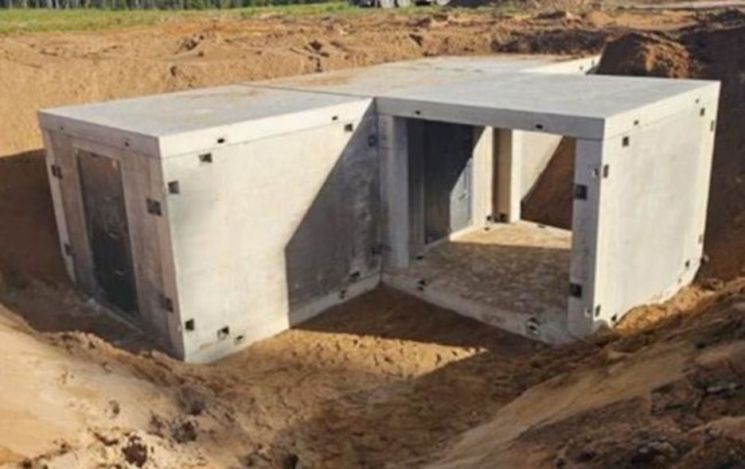 A concrete bunker installed by the Estonian government in the border area with Russia. Estonian Defence Investment Centre website
The three Baltic states-Estonia, Latvia, and Lithuania-have officially launched the "Bunker Network" project, which involves constructing thousands of bunkers along their borders with Russia. In Eastern European countries like Ukraine, where most of the terrain is flat, bunkers are considered effective in defending against Russian artillery attacks. As a result, large-scale construction is expected to continue. Across Europe, there is a growing trend of building bunkers, with an increasing number of middle-class families in Germany and Switzerland choosing to build bunkers in their homes instead of swimming pools or other amenities.
Estonia Begins Bunker Construction... Aiming to Install 600 by 2027
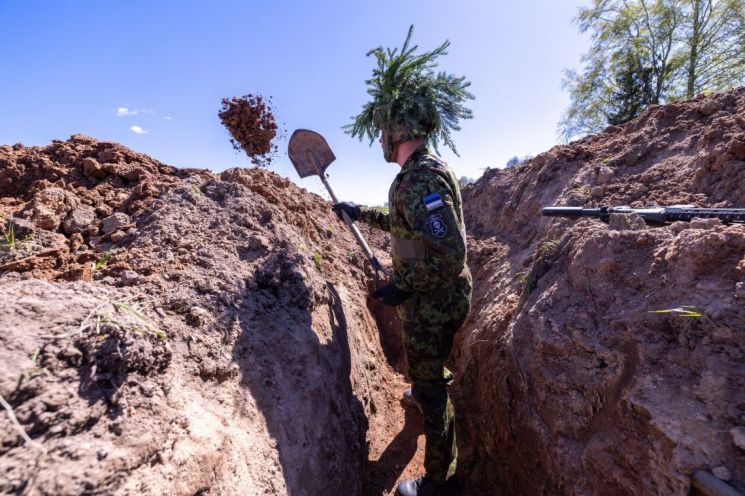 The image shows Estonian soldiers involved in bunker facility construction. Photo by Estonian Ministry of Defense website
According to Defense News, a U.S. defense media outlet, the Estonian government began constructing bunkers along the border with Russia on December 12 (local time). This initiative follows the bunker network project agreed upon by the three Baltic states in January of this year. Estonia plans to build 600 bunkers, Latvia 1,116, and Lithuania 2,758 along the Russian border, creating a joint defensive line known as the "Baltic Defense Line." The total budget for this project amounts to 300 million dollars (approximately 443 billion won).
Each bunker measures 35 square meters (about 10 pyeong) and can accommodate 10 soldiers. They are constructed as concrete boxes to withstand attacks from the Russian military's main artillery weapon, the 152-millimeter self-propelled gun. Anti-tank mines and obstacles are being installed near the bunkers to slow down any potential Russian advance as much as possible in the event of a conflict.
The Estonian Ministry of Defense originally planned to complete all 600 bunkers by the end of 2027, starting last year. However, construction began about a year later than scheduled, and progress has been slow. Defense News reported, "The cost continues to rise due to increased raw material prices and difficulties in negotiating land purchases with private landowners."
"Bunkers Are Optimal for Blocking Russian Offensives"
 The appearance of the barbed wire fence built around Vinski, the border area between Estonia and Russia. Photo by AP Yonhap News
The reason the Baltic states are installing bunker barriers is that, like Ukraine, most of their territory consists of flat land. The highest point in the Baltic region is Suur Munamagi in Estonia, with an elevation of only 318 meters above sea level. To block the advance of the Russian military, which possesses a vast number of tanks and combat vehicles, a bunker defense line is considered essential.
In particular, interconnected bunkers have proven highly effective in the war in Ukraine. Andris Spruds, Latvia's Minister of Defense, said in an interview with The Washington Post, "In 2023, although Ukrainian forces counterattacked Russian-occupied territories, they ultimately could not break through the defensive line of bunkers and minefields stretching for hundreds of kilometers," emphasizing, "This is an important example of how old and inexpensive defensive solutions can have significant outcomes in modern warfare."
The North Atlantic Treaty Organization (NATO) also plans to create an "Eastern Flank Deterrence Line" to deter Russian military provocations, based on the Baltic states' defensive line. Chris Donahue, NATO Allied Land Command, stated at the recent Land Euro conference, one of NATO's security meetings, "Starting with the Baltic states' defensive line, we are developing joint launch platforms and a cloud-based coordination system to respond to Russian attacks, which we call the Eastern Flank Deterrence Line," adding, "The core of this deterrence line is to unify the defense plans of each region."
Surge in Private Bunker Installations in Germany and Switzerland... "Spreading to Middle-Class Households"
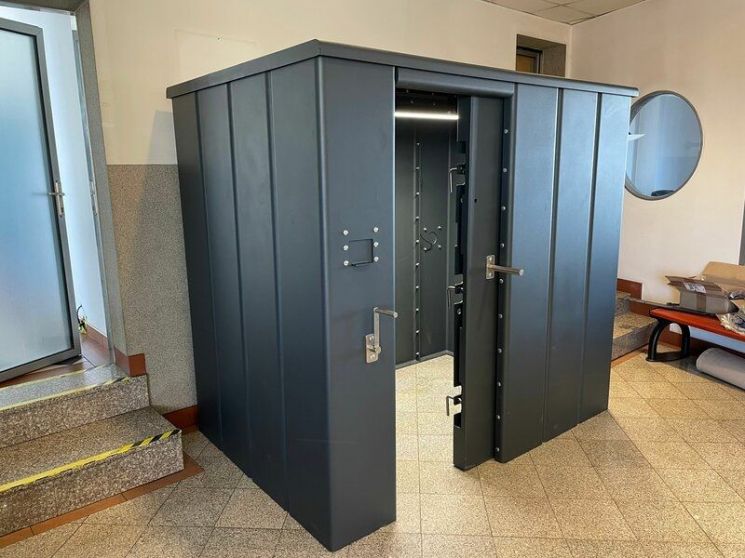
Even in countries further from the front lines, such as Germany and Switzerland, the growing threat of war from Russia has led to increasing demand among middle-class families to build bunkers in their homes for shelter.
BSSD, a German manufacturer of civilian bunkers, stated that inquiries about private bunker installations have increased more than threefold, from about 300 before the war in Ukraine to 1,000 recently. CEO Mario Piede said in an interview with The Economist, "Bunkers and panic rooms, which were once sought after by the wealthy, are now in demand among middle-class families as well," and noted, "There is a trend of building bunkers instead of swimming pools or garages."
Even in Switzerland, where there are reportedly 370,000 private and public bunkers-enough to accommodate the entire population-demand for private bunkers continues to rise. Xavier Brun, CEO of Bunker Swiss, a bunker manufacturer, told The Washington Post, "Since the war in Ukraine, there has been a growing demand for customized bunker installations," adding, "Although the price of a single bunker ranges from 40,000 to 100,000 dollars (about 60 million to 150 million won), many people are proceeding with installations."
© The Asia Business Daily(www.asiae.co.kr). All rights reserved.



















