Focused Investment in Regional Growth and Improved Living Conditions
Designing the Future of Ulsan through Roads, Railways, and Urban Spaces
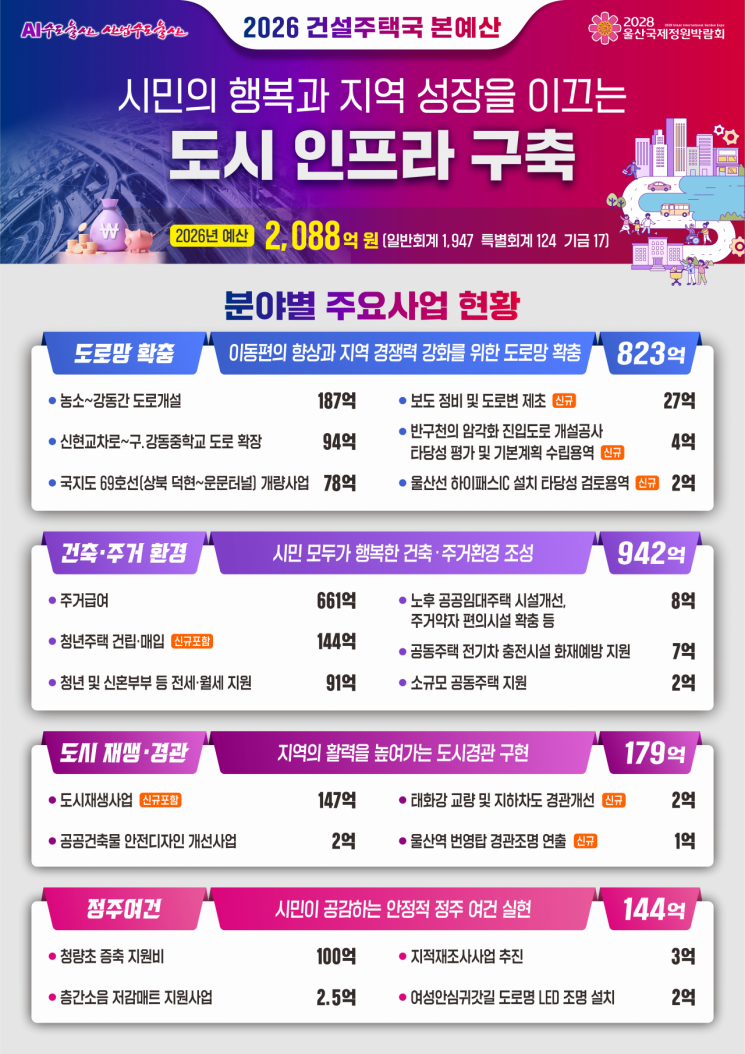
In 2026, Ulsan City will invest 208.8 billion won to restructure urban infrastructure throughout the city.
The city aims to establish a foundation for sustainable regional growth by expanding the local transportation network, increasing the supply of public housing, and improving the living environment.
To this end, Ulsan City has allocated a total budget of 208.8 billion won for the construction and housing sector for the coming year.
Additionally, a special account of 12.4 billion won has been set aside, which includes 10 billion won for the school land charge to support the expansion of Cheongnyang Elementary School. The city has also significantly strengthened vacant house maintenance projects such as the 'Vacant House Remodeling Project,' and established a 1.7 billion won fund for urban and residential environment maintenance.
The 2026 budget for the housing and construction sector will be invested in: ▲expanding the road network to improve mobility and strengthen regional competitiveness; ▲creating a happy architectural and residential environment for all citizens; ▲enhancing urban landscapes to revitalize the region; and ▲realizing stable living conditions that resonate with residents. These efforts aim to build urban infrastructure that leads to citizen happiness and regional growth.
1. Expanding the Road Network to Improve Mobility and Strengthen Regional Competitiveness
First, a total of 82.3 billion won will be invested in road construction to strengthen regional connectivity and improve convenience for citizens' movement.
The city will continue the 'Nongso-Gangdong Road Construction Project,' which connects existing downtown areas such as Hogye and Changpyeong with the Gangdong tourism and residential district, thereby enhancing mobility and expanding living areas. Additionally, the city plans to comprehensively improve traffic conditions through the renovation of aging roads, restructuring of congested sections, and the creation of safer pedestrian environments.
Major projects include: ▲18.7 billion won for the Nongso-Gangdong Road; ▲9.37 billion won for the expansion of the Sinhyeon Intersection to (former) Gangdong Middle School Road; and ▲7.8 billion won for the improvement of National Road No. 69 (Sangbuk Deokhyeon to Unmun Tunnel).
Furthermore, to support the successful hosting of the '2028 International Garden Expo,' the city has allocated 2.7 billion won for sidewalk improvements and roadside mowing projects in the Beonyeong-ro, Namsan-ro, and Myeongnyun-ro areas, providing a pleasant urban image to visitors to Ulsan.
In addition, a feasibility study and basic planning service for the construction of an access road to the Banggucheon Petroglyphs, aimed at improving visitor accessibility, has been newly allocated 400 million won. A feasibility review service for the installation of the Ulsan Line Hi-Pass Interchange (IC), to address increased traffic demand due to the development of the Seoul-San area, has also been newly allocated 170 million won.
2. Creating a Happy Architectural and Residential Environment for All Citizens
A budget of 90.4 billion won has been allocated to the architecture and residential sector to expand the supply of public housing and provide comprehensive residential welfare support for vulnerable groups.
Some 66.1 billion won will be invested in rental assistance for low-income households and housing repairs, with plans to provide differentiated rental support up to a maximum standard rent, taking into account housing type and costs.
With an investment of 14.4 billion won, the city will supply a total of 150 units of affordable and pleasant youth rental housing in six locations, including Daldong and Samsandong, which are popular among young people. An additional 118 units of newly built, privately participated 'purchase agreement-type rental housing' will also be supplied to help revitalize the construction market.
A further 9.1 billion won will be allocated to support housing for newlyweds and youth housing cost support projects, establishing a stable residential foundation.
Additionally, 800 million won will be allocated to improve the living environment of public rental housing that is over 15 years old, as well as to enhance the living environment for housing-vulnerable groups, providing tailored improvements for greater residential convenience.
3. Enhancing Urban Landscapes to Revitalize the Region
A total of 17.9 billion won will be invested in the urban landscape sector to continue projects such as improving the landscape of Taehwagang bridges and underpasses, as well as revitalizing aging residential areas in the old downtown.
In preparation for the 2028 Ulsan International Garden Expo, the city will embark on a full-scale innovation of the Taehwagang landscape. A new budget of 120 million won has been allocated for the landscape design of Taehwagang bridges, improving specialized designs and nighttime lighting from Taehwa Bridge and Myeongchon Bridge to Hakseong Bridge and Beonyeong Bridge.
Following this year's landscape improvement project for the Gangbuk underpass, 50 million won has been allocated for the design of the Gangnam underpass landscape improvement project next year. For four underpasses-Samho, Beonyeong-Gangnam, Hakseong-Gangnam, and Samsan-the city will apply aesthetic designs that reflect local characteristics and improve lighting differentials, enhancing driver visibility and creating a more beautiful urban space.
Additionally, 130 million won will be invested in the 'KTX Ulsan Station Beonyeong Tower Night Lighting Improvement Project,' strengthening its symbolism as Ulsan's main gateway and actively utilizing it as a promotional structure to support the successful hosting of the 2028 International Garden Expo.
The city will continue to promote urban regeneration projects to boost urban vitality and, in collaboration with companies, will expand industrial complex landscape projects that improve the color and art design of aging factory exteriors.
4. Realizing Stable Living Conditions That Resonate with Citizens
A total of 14.4 billion won will be invested to improve residential environments and operate stable cadastral administration, thereby enhancing living conditions for citizens.
The city will expand the support project for installing noise-blocking mats, previously available only to households with two or more children, to include those with at least one child, with a budget of 250 million won. The maximum subsidy per household will also be increased from 700,000 won to 1.4 million won.
The 'Housing Damage and Grievance Counseling Support Center' will continue to operate to protect members of local housing cooperatives and victims of rental fraud, providing litigation and legal counseling services through professional attorneys.
Additionally, the number of 'Real Estate Lectures (Academy)' will be increased from two to three sessions, aiming to help stabilize housing for ordinary citizens by sharing information on various real estate policies and ways to prevent real estate transaction accidents.
Furthermore, 200 million won will be invested in the 'Women's Safe Return Home LED Street Nameplate Installation Project' to create a safer residential environment.
Lee Jaeup, Director of the Construction and Housing Bureau of Ulsan City, stated, "We plan to use the budget efficiently to make Ulsan a cleaner and better place to live," adding, "We will continue to improve urban infrastructure, such as expanding the road network, to boost urban vitality and implement policies that lead to citizen happiness and regional growth without any setbacks."
© The Asia Business Daily(www.asiae.co.kr). All rights reserved.
![Clutching a Stolen Dior Bag, Saying "I Hate Being Poor but Real"... The Grotesque Con of a "Human Knockoff" [Slate]](https://cwcontent.asiae.co.kr/asiaresize/183/2026021902243444107_1771435474.jpg)
















