Youngpoong and MBK Criticize Korea Zinc's U.S. Smelter Construction
Direct Investment in Korea Zinc Shares Opposed: "Defending Management Control"
Concerns Over Decline in Korean Smelter Exports and Technology Outflow
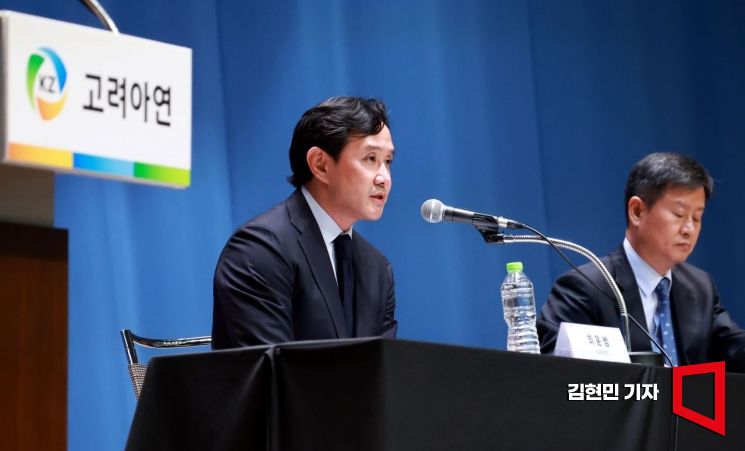 Choi Yunbeom, Chairman of Korea Zinc, is speaking at the Korea Zinc press conference held at the Korea Chamber of Commerce and Industry in Jung-gu, Seoul on November 13 last year. On the right is Park Giduk, CEO. On that day, Chairman Choi stated, "I will step down from the position of chairman of the board as soon as possible and have an outside director take over as chairman of the Korea Zinc board." Photo by Kim Hyunmin
Youngpoong and MBK Partners, who are engaged in a management dispute with Choi Yunbeom, Chairman of Korea Zinc, have strongly objected to Korea Zinc receiving equity investment from the U.S. government for the construction of a smelter in the United States. They argue that accepting investment not in the smelter itself but in Korea Zinc's headquarters amounts to abandoning South Korea's 'zinc sovereignty' in order to defend management control.
On December 15, Youngpoong and MBK stated their position in response to news that Korea Zinc's management would convene an extraordinary board meeting that day to discuss a third-party allotment of new shares to fund the U.S. smelter construction. Despite the significance of this matter for the company's future, directors from Youngpoong and MBK claim they were not informed in advance and were thoroughly excluded from the discussion process. Currently, the Korea Zinc board consists of 11 members from Korea Zinc and 4 from MBK and Youngpoong, excluding 4 registered directors who are suspended from duty, out of a total of 19.
They further criticized the decision as one that sacrifices the nation's core strategic asset, 'zinc sovereignty,' for Chairman Choi's personal defense of management control. They pointed out that it defies business logic for the U.S. government to invest in Korea Zinc's headquarters rather than in the local smelter construction project.
Youngpoong and MBK argued, "In a normal business structure, investors would be expected to invest equity in the project company for the U.S. smelter to be built, but this proposal instead opts for participation in a third-party allotment of new shares by Korea Zinc headquarters. This suggests the main purpose is not simply fundraising, but to secure voting rights and recruit a white knight to help defend Chairman Choi's management control."
They also pointed out the abnormal structure in which Korea Zinc bears the entire burden of nearly 10 trillion won in funding and risk, while granting a valuable 10% stake to U.S. investors. They warned that this raises concerns of board members' breach of fiduciary duty, as well as possible violations of the revised Commercial Act's duty of loyalty to shareholders. They questioned whether there is a genuine business need to urgently raise capital by diluting equity in a large-scale plant construction project that will take years from design to completion.
They expressed doubts about the true nature of the U.S. government investment, noting that it is rare for a U.S. government agency to use a joint venture for 'indirect investment' in a foreign private company. Youngpoong and MBK stated, "We must question whether this is a genuine investment or hastily arranged funds using the U.S. government as a shield. Korea's economic security and shareholder value cannot be traded away just to defend Chairman Choi's management control."
They also voiced skepticism about the U.S. smelter construction itself. Building a 'twin plant' to the Ulsan Onsan Smelter, they argued, would not only hollow out the domestic smelting industry but could also lead to the outflow of key companies. Youngpoong and MBK stated, "If domestic production and export volumes are replaced by local production in the U.S., it would effectively spell the end of exports for domestically produced minerals, and the outflow of unique smelting technology accumulated over decades would become inevitable. Rather than rushing the matter through an extraordinary board meeting, the business feasibility should be reviewed thoroughly and carefully over time."
© The Asia Business Daily(www.asiae.co.kr). All rights reserved.
![Clutching a Stolen Dior Bag, Saying "I Hate Being Poor but Real"... The Grotesque Con of a "Human Knockoff" [Slate]](https://cwcontent.asiae.co.kr/asiaresize/183/2026021902243444107_1771435474.jpg)
















