"Flexible Entry, Strict Exit Structure"
The venture industry has raised its voice, calling for a revision of the KOSDAQ's technology-based special listing criteria. In a situation where KOSDAQ's role as a "venture capital market" has weakened, industry leaders argue that lowering the entry barrier for technology companies while enforcing stricter delisting standards for underperforming firms is necessary for KOSDAQ to reestablish itself as the core funding market for ventures and startups.
According to the Korea Venture Business Association's "KOSDAQ Market Revitalization Measures and Venture Business Opinion Survey" released on December 15, respondent companies identified "expanding technology-based special listings (52.3%)" and "easing listing requirements (46.8%)" as the most needed KOSDAQ policy improvements. There was a consensus that the performance requirements for technology-based special listings should be relaxed so that companies are evaluated primarily on their technological capabilities, thereby improving the listing environment for tech firms.
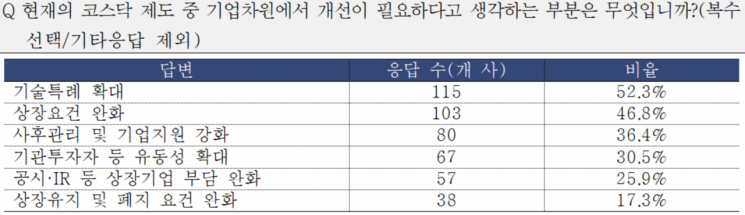 Excerpt from the Korea Venture Business Association's "KOSDAQ Market Revitalization Measures and Venture Business Opinion Survey" results. Korea Venture Business Association
As for policy priorities to revitalize KOSDAQ, "improving the technology evaluation system (51.8%)" received the highest response rate. This was followed by "expanding funding sources such as policy funds (50.9%)," with more than half of respondents in agreement. Since 59.1% of companies cited "government policy funds" as their primary method of fundraising, it is clear that there is strong demand for policy funding and subsidies.
This survey was conducted by the association to urge the government to establish a vision for the "KOSDAQ 3000 era." While the KOSPI index recently surpassed 4,000, reaching an all-time high, the KOSDAQ index remains in the 900s. Since the launch of the new administration in June until the end of last month, the KOSPI index rose by 42%, whereas the KOSDAQ increased by only 22%. As of the end of last year, venture companies accounted for 625 out of 1,607 listed KOSDAQ firms, representing 39% of the total.
The survey results showed that 85% of unlisted venture companies planning an initial public offering (IPO) hoped to list on KOSDAQ. Of these, 61.8% were planning "special listings (based on technology or growth)," while 35.3% were preparing for "general listings." More than 90% of companies hoping to list on KOSDAQ expected to raise capital through the listing, confirming KOSDAQ's status as the core funding market for venture companies.
Furthermore, a majority of respondents agreed with the idea of making KOSDAQ market entry more flexible while applying stricter standards for delisting. Specifically, 80.5% supported easing listing requirements, and 84.0% supported strengthening the criteria for removing underperforming companies.
The association also emphasized, "When reviewing listing applications, financial requirements should be minimized (including approval of loss-making companies), and the evaluation system should focus on technological capability and growth potential to relax entry requirements." The association stressed that this approach is essential to restoring KOSDAQ's original function as a venture capital market. It also recommended that companies failing to meet innovation criteria or exhibiting moral hazard should be delisted in a timely manner, thereby establishing a virtuous cycle of easy entry but strict exit-a "multiple births, multiple deaths" structure.
In addition, given the high stock price volatility characteristic of venture companies, the association argued that long-term institutional investment capable of withstanding temporary valuation losses is necessary. To this end, it called for the creation of a "KOSDAQ Revitalization Fund" and the mandatory allocation of statutory funds to venture investment, thereby encouraging greater participation by institutional investors.
Lee Jeongmin, Secretary General of the Korea Venture Business Association, stated, "Revitalizing the KOSDAQ market is key to creating a virtuous cycle in a healthy venture ecosystem. Through this, we can attract domestic and foreign capital, activate tech startups, and secure the driving force for scaling up, making it possible for the KOSDAQ index to reach 3,000. A national roadmap is needed to achieve the 'KOSDAQ 3000' era."
© The Asia Business Daily(www.asiae.co.kr). All rights reserved.

















