WSJ Interview
"It May Take Time for Voters to Feel the Economic Achievements"
President Donald Trump of the United States stated that he cannot be certain whether the ruling Republican Party will retain its majority status in the House of Representatives in the midterm elections next November, adding that voters have not yet fully felt the impact of his economic policies. He also argued that the Federal Reserve (Fed) should lower the benchmark interest rate to below 1% one year from now.
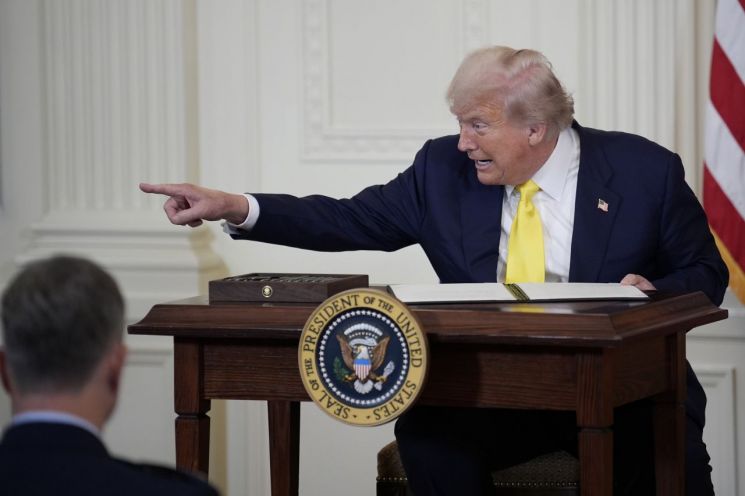
In an interview with The Wall Street Journal (WSJ) conducted in the Oval Office on the 12th (local time) and released on the 13th, President Trump highlighted the achievement of attracting billions of dollars in investment since the launch of his second administration, stating, "I have created the greatest economy in history, but it may take time for people to understand all of this."
He said, "All the capital pouring into our country is being used to build many things, including automobile plants and artificial intelligence (AI)," and added, "I cannot say for certain how these will affect voters. All I can do is focus on my work."
When asked about the possibility of the Republican Party losing its majority in the House in the midterm elections, he responded, "I can't say," showing a cautious stance. However, he added that even if the effects of large-scale investments are not immediately apparent, visible results could emerge in the second quarter of next year.
Although concerns about an economic downturn were raised following tariff hikes and immigration restrictions after the launch of Trump’s second administration, the U.S. economy has generally maintained solid growth. This year’s annual real gross domestic product (GDP) growth rate is expected to reach about 3%. However, as these achievements have not been evenly distributed, there are assessments that, despite strong macroeconomic indicators, working- and middle-class Americans are actually feeling worse off. Since 2020, the cumulative inflation rate has reached around 25%, and the burden of high prices and living costs remains significant. With signs of slowing employment growth, consumer sentiment is also weakening.
President Trump placed the blame for inflation on the previous Joe Biden administration, predicting, "By the time the election is held in a few months, I believe prices will enter a stable phase."
The White House has announced that President Trump and his aides will actively promote economic policies by increasing direct contact with voters. The administration is emphasizing major achievements such as tax cuts, deregulation at the federal level, expanded domestic energy production, encouraging the return of manufacturing to the United States, and reducing the trade deficit and reliance on overseas supply chains through new trade agreements.
Regarding tariff policy, President Trump argued that if the Supreme Court rules reciprocal tariffs illegal, "it would be a terrible thing for the United States." He added that while other legal measures exist, "they are not fast and are not desirable from a national security perspective."
On the issue of Fed appointments, he stated, "Just because there is good news (such as on employment), I will not appoint anyone to the Fed who would automatically raise interest rates sharply to curb inflation." He further expressed his hope that the current benchmark interest rate of 3.5-3.75% would fall below 1% a year from now. With the term of Fed Chair Jerome Powell set to expire in May next year, this is seen as a renewed emphasis that a rate-cutting stance will be a key criterion for nominating the next Fed chair.
President Trump also reiterated that midterm elections have historically worked against incumbent presidents.
He said, "Even those who have had successful presidencies have experienced defeat in the midterms," adding, "That is the only factor working against us. I don't know why." He continued, "Statistically, it is very difficult to win," and emphasized, "All we can do is try our best to win."
According to the WSJ, since World War II, there have been only two instances where the ruling party increased its seats in the House during midterm elections: under President Bill Clinton in 1998 and President George W. Bush in 2002. This demonstrates how strongly midterm elections have served as a referendum on the administration.
The U.S. House of Representatives elections are held every two years, and in the next election, which will take place in the middle of the president’s term, all 435 seats in the House and about one-third of the 100 Senate seats will be contested. The Republican Party achieved a "red sweep," securing majorities in both the House and Senate in the last presidential election. However, if the party loses in the upcoming midterms, there are projections that President Trump could quickly enter a lame-duck period.
Additionally, when asked if there was anything he would have done differently in the first year of his second term, President Trump replied, "Overall, no." He emphasized, "The largest amount of money in history flowed into the United States, the stock market reached an all-time high, and we closed the border."
© The Asia Business Daily(www.asiae.co.kr). All rights reserved.

















