Reserve Requirements and Deposit Insurance Premiums Excluded from Loan Interest Rates
Education Tax Rate Increases Also Prohibited
In the future, banks will not be allowed to include various statutory costs, such as contributions to guarantee funds, in the additional interest rate when calculating bank loan interest rates.
On December 13, an amendment to the 'Banking Act' was passed at the National Assembly plenary session. Currently, banks reflect contributions to guarantee funds such as the Credit Guarantee Fund and the Technology Guarantee Fund as statutory costs in the additional interest rate, in accordance with the Korea Federation of Banks’ self-regulation guidelines titled 'Model Standards for Enhancing the Rationality of Loan Interest Rate Systems.'
There have been calls for a loan interest rate calculation system that balances the principle of beneficiary burden in policy guarantee programs with banks’ social responsibilities.
First, it will be prohibited to reflect in bank loan interest rates the reserve requirements under the 'Banking Act,' deposit insurance premiums under the 'Depositor Protection Act,' contributions to the Korea Inclusive Finance Agency under the 'Act on the Support for Financial Life of the Underprivileged,' and various guarantee fund contributions under individual laws. However, in the case of guarantee fund contributions under individual laws, up to a percentage specified by Presidential Decree, which must not exceed 50% of the statutory contribution rate under the relevant law, may still be reflected in loan interest rates.
In addition to various contributions, the recent increase in the education tax rate for financial and insurance businesses under the amended 'Education Tax Act,' which was passed by the National Assembly, will also be prohibited from being reflected in loan interest rates.
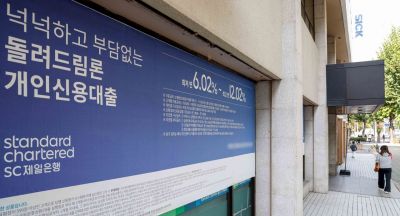 On the 23rd, as domestic market interest rates and bank loan interest rates rapidly rise, a banner displaying loan interest rates is hung on the exterior wall of a commercial bank in Seoul. Photo by Kang Jinhyung aymsdream@
Furthermore, banks will be required to check compliance with the prohibition on reflecting statutory costs in loan interest rates at least twice a year, and to record and manage these checks. The obligation to prohibit, inspect, record, and manage the reflection of statutory costs must also be incorporated into their internal control standards.
If banks violate the prohibition on reflecting statutory costs in loan interest rates, or fail to fulfill their obligations to inspect, record, and manage compliance, they may be subject to administrative sanctions. For example, banks may face corrective orders or business suspensions, while executives and employees may be subject to measures such as removal from duty, recommendations for dismissal, demotion, salary reduction, or disciplinary warnings.
This amendment is scheduled to take effect in June next year, six months after the law is promulgated. The Financial Services Commission stated, "We plan to prepare thoroughly for the implementation of the law, including the establishment of subordinate regulations and IT system development in the banking sector, so that there are no setbacks." The commission also said, "After the law takes effect, we will continue to monitor banks’ compliance with the prohibition on reflecting statutory costs in loan interest rates, in cooperation with the Financial Supervisory Service."
© The Asia Business Daily(www.asiae.co.kr). All rights reserved.
![Clutching a Stolen Dior Bag, Saying "I Hate Being Poor but Real"... The Grotesque Con of a "Human Knockoff" [Slate]](https://cwcontent.asiae.co.kr/asiaresize/183/2026021902243444107_1771435474.jpg)











