Four Key Strategies Covering the Entire Industry Cycle
From Seed Production to Processing and Marketing
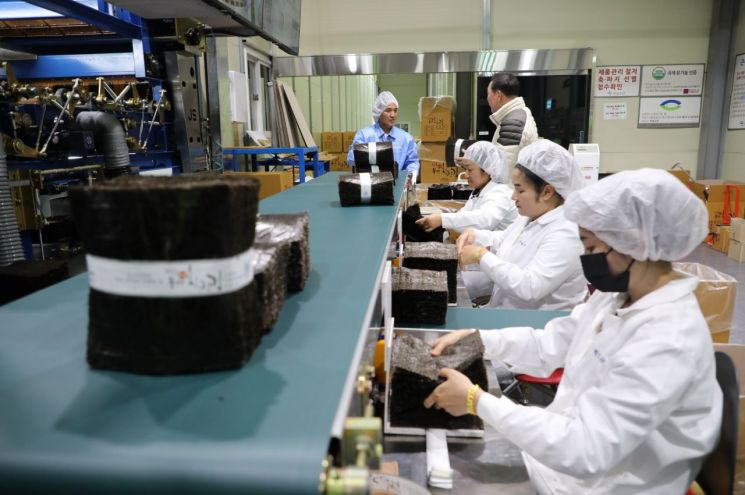 Jeollanam-do Province is preparing a plan to expand seaweed exports that covers the entire industry cycle from seed production to export in order to secure leadership in the seaweed export market. Provided by Jeonnam Province
Jeollanam-do Province has established a plan to expand seaweed exports that covers the entire industry cycle from seed production to export, aiming to secure leadership in the seaweed export market through the production of high-quality seaweed and the development of competitive products. The goal is to achieve $700 million in exports by 2030.
The seaweed export expansion plan consists of four key strategies: securing competitiveness through the development and distribution of new seaweed varieties; ensuring stable production of eco-friendly, high-quality raw seaweed; modernizing processing facilities, innovating quality, and building distribution networks; and attracting export companies, strengthening safety, and expanding marketing. These strategies are supported by 23 specific action items. The total project budget through 2030 is 423.5 billion won.
By strategy, the province will develop four new seaweed varieties by 2030 to respond to climate change and ensure stable seed production, distributing them to seaweed aquaculture farmers. Support will be expanded for land-based seaweed seeding facilities and smart seaweed seed cultivation facilities. In addition, a regional customized fisheries seed commercialization center will be established in Jindo to support seed research and field technology in response to climate change, such as high water temperatures.
To ensure a stable supply of raw seaweed and lead future aquaculture technology in response to climate change, the province will develop land-based seaweed aquaculture technology, support direct payment systems for eco-friendly seafood certification, and distribute new seaweed activation agents to establish a foundation for eco-friendly seaweed farming.
Efforts will be made to modernize processing facilities and strengthen hygiene and quality competitiveness by replacing outdated dried seaweed dryers, expanding joint wastewater treatment facilities for seaweed washing water, and developing and validating AI-based solutions for grading dried seaweed quality. Additionally, the province plans to gradually establish an international dried seaweed exchange and large-scale logistics complexes (FPC and FDC) to build a global supply chain and distribution infrastructure capable of large-volume supply.
The province will also establish a comprehensive support system for the seaweed industry by founding the National Seaweed Industry Promotion Institute, creating the K-GIM International Export Complex, and attracting large-scale export investment companies. Customized support for export companies will be strengthened by hosting the K-GIM International Expo, developing premium export brand products, and providing direct payment support for export-specialized items.
Son Younggon, head of the Fisheries Distribution and Processing Division of Jeollanam-do Province, said, "The 500 million won budget for establishing the master plan for the National Seaweed Industry Promotion Institute, a core project for fostering the seaweed industry in Jeollanam-do, has been included in the national budget for 2026." He added, "This will be an important turning point not only for the development of Jeollanam-do’s seaweed industry but also for opening the future of Korea's fisheries industry." He further emphasized, "By thoroughly implementing this seaweed export expansion plan, we will increase seaweed exports from the current $360 million in 2024 to $700 million by 2030."
© The Asia Business Daily(www.asiae.co.kr). All rights reserved.
![Clutching a Stolen Dior Bag, Saying "I Hate Being Poor but Real"... The Grotesque Con of a "Human Knockoff" [Slate]](https://cwcontent.asiae.co.kr/asiaresize/183/2026021902243444107_1771435474.jpg)
















