More Groups Forming to Buy in Bulk and Share
Jang Sungyeon, a 34-year-old office worker living alone, participates in a "bulk sharing group" about three times a month. She buys foods that are only sold in bundles, such as bagels, donuts, and meat, at a large supermarket near her workplace, and then splits them with neighbors she has connected with in an online chatroom. Jang said, "Buying the whole bundle is too much for me to eat alone, but by sharing, I can take just the amount I need and consume more economically."
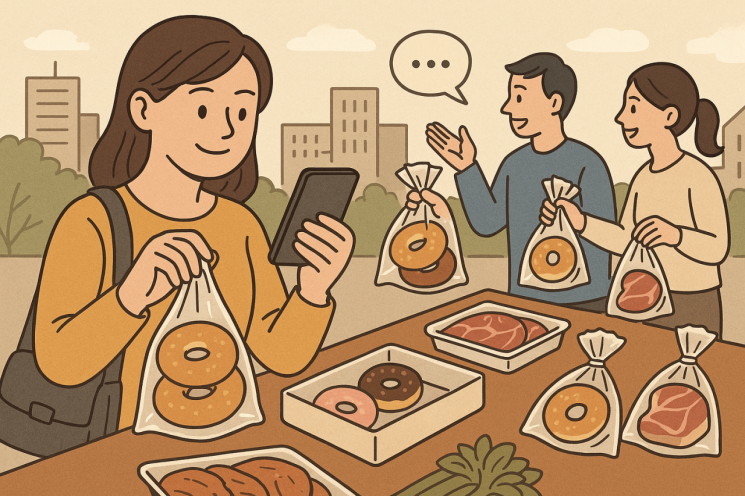
Recently, "bulk sharing consumption," where people buy bundled products from large supermarkets together and split them according to their needs, has emerged as a new trend in saving money.
According to the secondhand trading app Danggeun, the number of bulk sharing groups created from January to last month increased 6.7 times compared to the same period last year. The popularity is attributed to the ability to purchase only the necessary amount, reducing waste and lowering the burden compared to buying in bulk alone.
In the "Seoul Station Costco Bulk Sharing Group," which has 100 participants, a box of 12 bagels priced at 9,990 won was recently split, with each bagel costing 833 won. One participant said, "Desserts are usually sold in large quantities, which can be overwhelming, but with bulk sharing, I can just take enough for the day, which is great." The bulk sharing trend, which began with daily necessities and food, is now expanding into various areas such as flowers, pet supplies, and coffee beans.
The spread of bulk sharing consumption is driven by soaring prices and the increase in single-person households. According to the National Data Office, the food price index last month was 127.1 (with 2020 as 100), marking a 27.1% increase over five years. The number of single-person households reached a record high of 8,045,000 as of last year.
Kim Siwol, a professor of consumer studies at Konkuk University, analyzed, "In a situation where prices are high and the number of single-person households is increasing, the practice of splitting large-volume products is a naturally expanding consumption pattern. Going forward, bulk sharing consumption is likely to become a lifestyle that transcends age groups, and online platforms and the retail industry may institutionalize it as a form of service."
© The Asia Business Daily(www.asiae.co.kr). All rights reserved.

















