Space Agency Announces 2026 Work Plan
Advancing All Sectors from Reusable Launch Vehicles and Satellites to Next-Generation Aircraft
South Korea is set to embark in earnest on a lunar exploration roadmap and the strategic advancement of all areas within the aerospace sector, based on its domestically developed launch vehicle.
On December 12, the Korea Space Agency announced its "2026 Work Plan," which centers on launching a lunar communication orbiter with the Nuriho in 2029 and attempting a lunar lander mission in 2032 using a next-generation reusable launch vehicle. In its work report to the President, the Space Agency outlined seven core tasks encompassing all areas, including space transportation, satellites, exploration, aviation, industrial policy, and international cooperation.
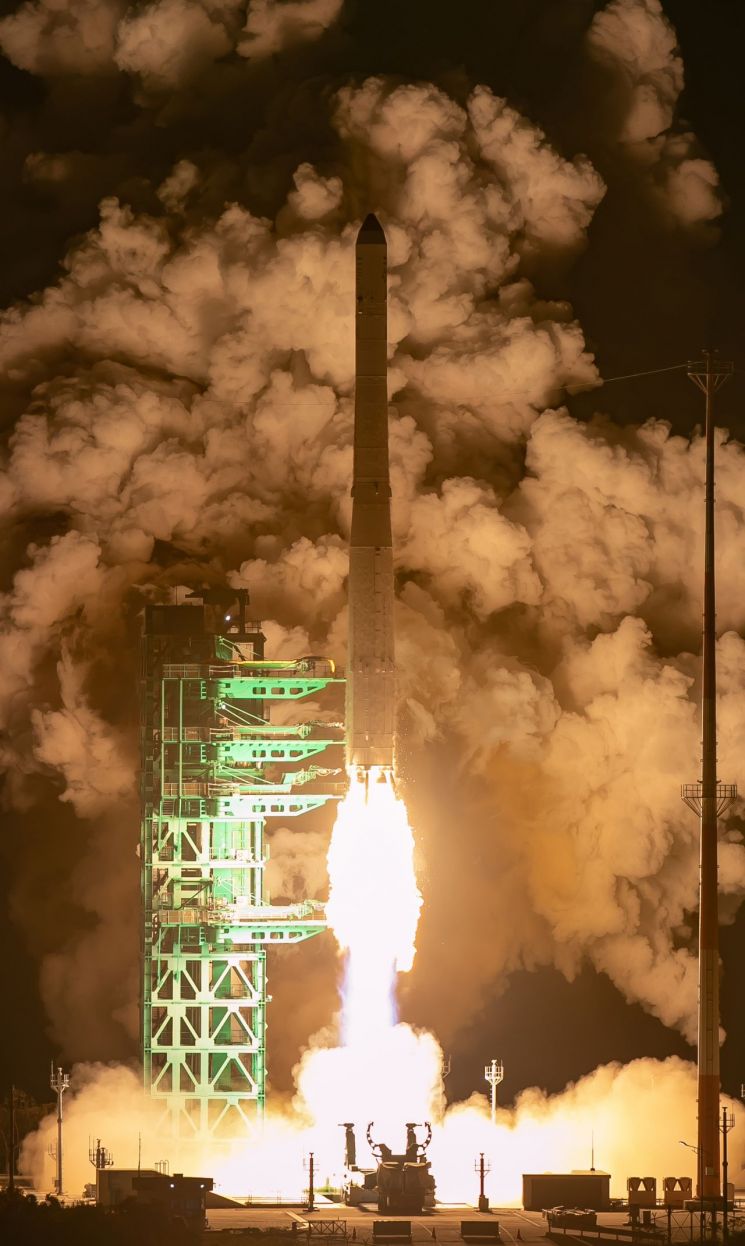 The Korean launch vehicle Nuriho was launched in the early morning of the 27th of last month at Naro Space Center in Goheung-gun, Jeollanam-do. Provided by the Korea Space Agency
Establishing a 'Korean-Style Space Transportation System' through Repeated Nuriho Launches and Next-Generation Reusable Launch Vehicles
This plan was formulated based on achievements in 2025. The Space Agency confirmed its independent development capabilities for launch vehicles and satellites through the successful fourth launch of the Nuriho, led by private companies, the launches of the third Next-Generation Mid-Sized Satellite and the seventh Multipurpose Practical Satellite, as well as the establishment of the revised Fourth Basic Plan for Space Development Promotion and the Space Science Exploration Roadmap.
The Space Agency explained that, "While we have established basic capabilities, narrowing the gap with advanced countries requires low-cost, high-frequency launches and the expansion of the industrial ecosystem," and thus devised the 2026 plan accordingly.
Yoon Youngbin, Administrator of the Korea Space Agency, stated, "We will increase reliability by launching the Nuriho annually and develop the next-generation launch vehicle as a reusable model to reduce launch costs to about 10% of the current level." Currently, the launch cost of the Nuriho is known to be about $24,000 to $26,000 per kilogram. The Space Agency plans to complete the development of a reusable launch vehicle by 2035 and reduce this cost to the $2,000 range (about 3 million won).
Administrator Yoon also commented, "By regularizing the launch cycle, we can raise the Nuriho's success rate to over 90% by 2032," adding, "The successful fourth launch of the Nuriho, led by the private sector, marks a significant turning point in Korea's space development, shifting from government-led to private sector-centered initiatives."
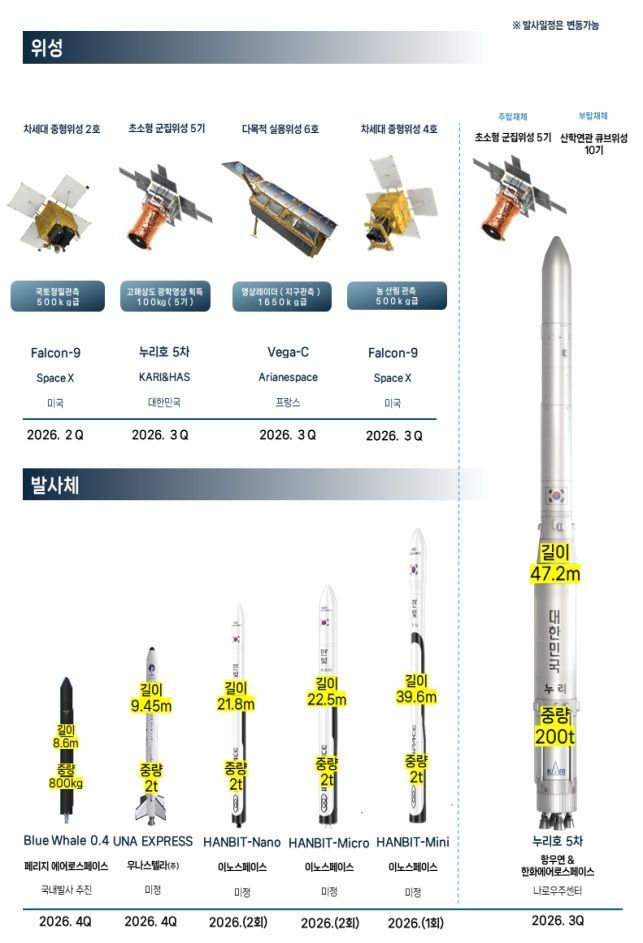
Reorganization of the space transportation system will also begin in earnest. The Space Agency will revise the next-generation launch vehicle development plan to focus on 'reusable launch vehicles' and start preliminary design in 2026. In 2026, the fifth launch of the Nuriho will demonstrate multi-payload deployment capability by launching five ultra-small cluster satellites (No. 2 to No. 6) at once. From the seventh launch onward, a company-led commercial launch system will be piloted, covering everything from satellite orders to launch operations.
After 2029, the Space Agency plans to implement a "Nuriho follow-up launch package contract" (launches 8 to 11, one per year) for public satellites, aiming to reduce launch gaps and enhance predictability and profitability in the domestic launch vehicle industry.
2029 Lunar Communication Orbiter, 2032 Lander... Full-Scale Deep Space Exploration Preparation
The lunar exploration plan is also being specified step by step. The basic system design for the lunar communication orbiter is underway, and the configuration of payloads such as the rover is being finalized.
The Space Agency aims to launch in 2029 by utilizing both the Nuriho and an orbital transfer vehicle. Administrator Yoon explained, "Before launching the lander, we must carry out the orbiter mission to secure key technologies such as deep space communication and navigation," adding, "The lander mission is an essential challenge to progress to the next stage." The 2032 lunar lander will be launched with a next-generation, reusable launch vehicle, marking a significant milestone in Korea's acquisition of deep space exploration capabilities.
The launch infrastructure will also be expanded. The government will reinforce aging facilities at the Naro Space Center and gradually expand essential facilities for operating national flagship launch vehicles, such as large assembly buildings and satellite testing facilities.
By 2027, a private launch site will be established to accommodate both corporate and defense needs, and the development of an 'orbital transfer vehicle' to meet new service demands such as in-orbit transfers and refueling will proceed under private sector leadership. The Space Agency stated, "We will legislate the 'domestic launch principle,' which mandates launching our satellites with our launch vehicles, and establish a system that prioritizes the use of domestic launch vehicles for public and defense satellites."
Accelerating Technology Development Across Satellites, Exploration, and Aviation
In the satellite sector, a feasibility study for securing a low Earth orbit satellite communication network will be newly pursued. Under the Ministry of Science and ICT, a "K-LEO Communication Alliance" (tentative name) will be formed, involving the Space Agency, Ministry of National Defense, Defense Acquisition Program Administration, and both public and private sectors, to review whether to independently build a low Earth orbit satellite communication network, which is emerging as a core national infrastructure in the 6G era, and to determine the most efficient forms of international cooperation from a mid- to long-term perspective. The Space Agency explained, "As the communication infrastructure, which was previously ground-based, expands into satellite and aviation domains, a strategy that considers communication, space, and defense demands together is necessary."
Development and launch of advanced satellites for public missions will also continue. In 2026, launches are planned for the second and fourth Next-Generation Mid-Sized Satellites, the sixth Multipurpose Practical Satellite, and the second to sixth ultra-small cluster satellites. In addition, the development of core technology for ultra-high-resolution optical satellites with 10-cm class resolution and a preliminary feasibility study for the Cheollian-6 satellite will be promoted to achieve world-class observation and communication satellite capabilities. To expand satellite data utilization, the "Satellite Utilization Promotion Act" will be enacted, and AI-based satellite information service demonstrations will be supported to open up high-value-added service markets such as agriculture, disaster response, and urban management.
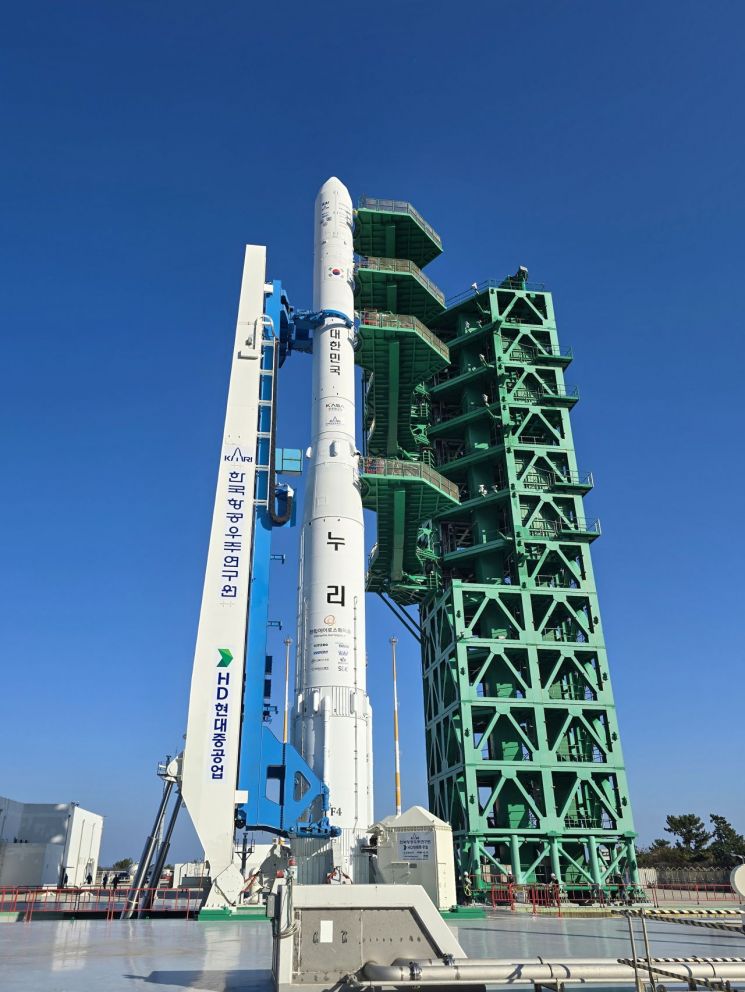 Nuriho, having completed preparations for the fourth launch at the launch pad built by HD Hyundai Heavy Industries, awaits launch. Provided by the Space Agency
In the field of exploration, Artemis cooperation between South Korea and the United States will be fully launched, including launching the domestically developed space radiation measurement satellite K-RadCube aboard Artemis II and sending the LUSEM space environment measurement instrument on a U.S. commercial lunar lander.
Other initiatives include the international Square Kilometer Array (SKA) project, which presumes Korean corporate participation, and L4 heliosphere exploration. The Space Agency plans to foster a new space exploration industry ecosystem by supporting space manufacturing platforms and exploration technology startups based on public research outcomes.
In the aviation sector, technology development will be strengthened in four core areas: drones, future aircraft, aircraft engines, and aviation materials and components. This includes securing long-endurance technology for AI-based intelligent drones and stratospheric drones, developing electric-gas turbine hybrid propulsion systems, achieving independent models and self-sufficiency in materials and components for civil gas turbine aircraft engines, and developing automated processes and eco-friendly lightweight materials. The plan also includes forming "Team Korea" to participate in international joint development (Risk & Revenue Sharing Partner, RSP) projects for civil aircraft.
Refining the Aerospace Ecosystem through Legislation, Operational Systems, and International Cooperation
Institutional reforms to support the aerospace industry have also been announced. The government will pursue the reorganization of the "National Aerospace Committee," which integrates space and aviation operations, the enactment of the "Basic Aerospace Act," the "Aerospace Industry Promotion Act," and the establishment of the "Aerospace Industry Promotion Agency." Through these measures, a comprehensive industrial development strategy will be established, encompassing public demand creation, regulatory improvement, talent development, civil-military cooperation, and regional strategies.
In terms of international cooperation, the plan is to strengthen K-space diplomacy by identifying follow-up tasks for Korea-U.S. Artemis cooperation, launching joint projects with major countries such as the European Union, France, Italy, and India, expanding new partnerships with countries such as Canada, Brazil, and Egypt, and dispatching public-private delegations alongside companies.
Administrator Yoon stated, "For the first time, the Space Agency's budget will exceed 1 trillion won in 2026," adding, "Through strategic investments in the fifth Nuriho launch, the start of reusable launch vehicle development, securing core technologies for advanced satellites and future aircraft, and expanding international cooperation, we will lay the foundation for South Korea to become one of the world's top five aerospace powers."
© The Asia Business Daily(www.asiae.co.kr). All rights reserved.



















