Ministry of Science and ICT Briefs Presidential Office on December 12
Five Consortiums Developing AI Models
AI Budget Expanded to 9.9 Trillion Won
3.1 Trillion Won Invested in Four Major Regional Innovation Projects
Punitive Fines Considered for Security Breaches
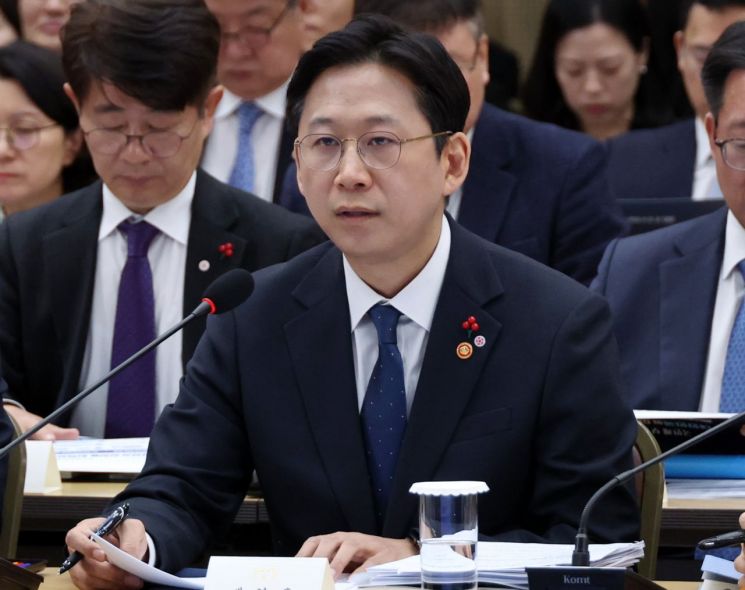
Vice Prime Minister and Minister of Science and ICT Baek Kyunghoon announced plans to develop a domestically produced artificial intelligence (AI) foundation model that ranks among the world’s top 10 by next year, and to host a “National AI Competition” in March 2026 to deliver AI services that citizens can directly experience. Regarding the recurring hacking and security incidents, he stated, “The government will launch a comprehensive response,” and revealed that punitive fines are being considered for companies that repeatedly cause security breaches.
On December 12, at a presidential office work briefing held at the Government Sejong Convention Center, Vice Prime Minister Baek presented the “2026 Ministry of Science and ICT Work Plan,” which includes these initiatives. First, the AI budget will be expanded to 9.9 trillion won, and 260,000 graphics processing units (GPUs) will be secured to significantly enhance the nation’s AI computing capacity. Additionally, an independent AI model ranking within the world’s top 10 will be developed and released as open source.
Specialized AI services will also be expanded across all aspects of daily life and industry. The “Top 10 AI Projects for Public Welfare,” established through a survey of ministry needs-including an AI-based national tax information advisor and an AI agricultural product consumption information platform-will be implemented, and specialized AI models will be developed for sectors such as defense, manufacturing, and culture. The National AI Competition will be held to strengthen talent discovery and entrepreneurship connections. On this day, President Lee Jaemyung emphasized, “The key is to create an AI environment that everyone can easily use and learn from.” Vice Prime Minister Baek explained, “After building an independent sovereign AI model, we plan to use it to provide AI services that citizens can truly experience.” He added, “Consultations with companies are necessary, and for now, we plan to prioritize university students and vulnerable groups, who are currently the most frequent users of generative AI.”
Regarding the status of the national AI foundation model development, Vice Prime Minister Baek stated, “Currently, five consortiums are competitively developing models, with both development and service companies participating.” He also mentioned the need to support companies that are eliminated during the consortium competition and to broaden the base for AI utilization. When President Lee inquired, “Even if companies are not selected, can’t they utilize or collaborate on their own?” Baek replied, “We plan to support companies that are not selected so they can continue their businesses.”
To drive a national AI transformation, four major regional AI innovation projects totaling 3.1 trillion won will be promoted. The Daegyeong region will focus on bio and robotics, Jeonbuk on AI factories, the Southwest region on mobility and energy, and the Southeast region on ultra-precision manufacturing, establishing region-specific AI ecosystems. The government also announced a “full-scale war” to strengthen corporate responsibility and enhance hacking response capabilities, including the introduction of punitive fines for personal data leaks, in order to realize a safe AI and digital nation.
A science and technology-based innovation growth strategy will also be pursued in parallel. The Ministry of Science and ICT will invest a total of 5.9 trillion won in “K-Moonshot Projects” targeting breakthrough strategic technologies such as humanoids, next-generation semiconductors, bio, quantum, and nuclear fusion. The plan includes early development of a domestically produced quantum computer (targeted for 2028), securing early commercialization technology for nuclear fusion, and challenging research tasks such as AI bio and synthetic biology.
In the space sector, the government will foster a private-led space industry ecosystem, building on the success of the fourth Nuri rocket launch. The goal is to increase the Nuri rocket’s launch success rate to 90% by 2032 and to develop reusable launch vehicles by 2035, reducing launch costs to around $2,500 per kilogram, similar to SpaceX. Plans also include launching a lunar communication orbiter using the Nuri rocket in 2029 and developing a lunar lander with next-generation launch vehicles.
Reforming the research and development (R&D) ecosystem was also presented as a core task. An R&D system that allows for failure will be introduced, establishing a dedicated track for retries and shifting evaluations from results-based to process-based. Support for basic research will be expanded to 3-5 years, and the budget for regionally planned autonomous R&D projects will increase from 160 billion won in 2026 to 1.1 trillion won by 2030. The plan also includes designating 20 national science leaders next year, expanding scholarships and research living stipends for graduate students in science and engineering, and establishing AI gifted schools.
© The Asia Business Daily(www.asiae.co.kr). All rights reserved.

















