The three major indices on the New York Stock Exchange showed mixed results on the 11th (local time). The Dow Jones Index continued its strong performance, reaching a record high following the Federal Reserve's interest rate cut the previous day. However, concerns over technology stock valuations resurfaced after Oracle's earnings announcement, putting downward pressure on the S&P 500 and Nasdaq indices.
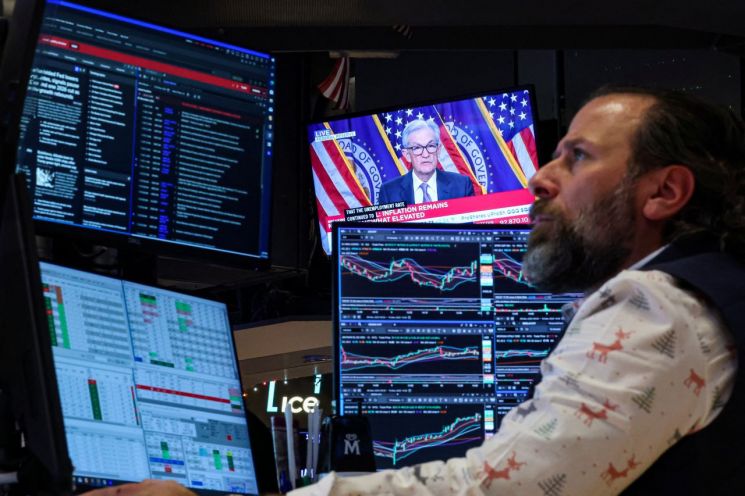
As of 12:05 p.m. in New York, the blue-chip Dow Jones Index had surged 563.05 points (1.71%) from the previous session to 48,620.8, breaking its all-time intraday high. The large-cap S&P 500 Index was trading at 6,871.7, down 14.98 points (0.22%), while the tech-heavy Nasdaq Index was at 23,447.5233, down 206.632 points (0.87%).
By stock, Oracle plunged 13.7%. In its fiscal 2026 second quarter (September to November) earnings release the previous day, Oracle reported revenue and operating profit increases of 14% and 10.5%, respectively, but both figures fell slightly short of market expectations. Furthermore, the company raised its capital expenditure outlook, fueling concerns over the monetization of AI investments. As a result, other technology stocks also performed poorly. Nvidia fell 3.15%, while Broadcom and AMD dropped 3% and 3.1%, respectively. In contrast, Visa soared 4.9% after Bank of America upgraded its investment rating.
Susannah Streeter, a strategist at Panmure Liberum, commented, "The market is becoming increasingly cautious about AI-related spending," adding, "This is a stark contrast to the situation in mid-2025, when there was great optimism in response to signals of increased capital expenditure." She further noted, "Oracle, having financed much of its investment through debt, was one of the weakest links."
The previous day, the Federal Reserve held its final Federal Open Market Committee (FOMC) meeting of the year and cut the federal funds rate by 0.25 percentage points to a range of 3.5% to 3.75% per year. This marked the third consecutive rate cut following those in September and October. However, internal disagreements over monetary policy direction were evident, as three of the twelve voting FOMC members dissented (two favored holding rates steady, and one advocated a 0.5 percentage point cut). The dot plot, which outlines future rate projections, indicated one additional rate cut each in 2026 and 2027.
Although the decision was described as a "hawkish cut" (favoring monetary tightening), the stock market rose instead. This was because Federal Reserve Chair Jerome Powell delivered a more dovish message than expected, placing greater emphasis on the risks of a slowdown in employment rather than inflation. Powell stated, "There are significant downside risks in the labor market," and added, "Excluding tariff factors, inflation is in the low 2% range. Tariff-driven inflation is expected to peak in the first quarter of 2026 and weaken in the second half of the year." The Fed's decision to resume short-term Treasury purchases earlier than anticipated also sent an accommodative signal to the market.
Additionally, the Fed's Summary of Economic Projections (SEP) eased market concerns by projecting that the core Personal Consumption Expenditures (PCE) inflation rate would decline from 3.0% at the end of this year to 2.5% by the end of 2026.
As a result, Wall Street is anticipating a more accommodative monetary policy than the Fed's current projection of just one rate cut next year. According to CME FedWatch, the interest rate futures market is currently pricing in a 72.2% probability that rates will fall by more than 0.5 percentage points by the end of next year.
However, with internal divisions within the Fed and variables such as the nomination of the next chair still unresolved, many believe the path of rates next year remains highly uncertain. Consequently, there are forecasts that stock market volatility could increase further in the coming year.
Chris Zaccarelli, CIO of Northlight Asset Management, stated, "It is not surprising to see short-term optimism in the market as the Fed continues to cut rates despite economic growth," but added, "However, if investors realize that rate cuts may take longer than expected or may not materialize at all, this rosy illusion could be shattered."
U.S. Treasury yields declined. The 10-year U.S. Treasury yield, the global benchmark for bond rates, fell 4 basis points (1bp = 0.01 percentage point) from the previous session to 4.12%. The 2-year Treasury yield, which is sensitive to monetary policy, also dropped 4 basis points to 3.51%.
© The Asia Business Daily(www.asiae.co.kr). All rights reserved.

















