Eight Major Economic Organizations, Including the Korea Chamber of Commerce and Industry, Meet with the Democratic Party
Discussion on Commercial Act Amendment for Mandatory Treasury Share Cancellation
"Continuous Communication Is Needed, Not Just One or Two Meetings"
The Korean business community, in a meeting with the ruling party, expressed concerns about the push for the third amendment to the Commercial Act, which includes a mandatory share buyback cancellation, and conveyed the need to moderate the pace of its implementation.
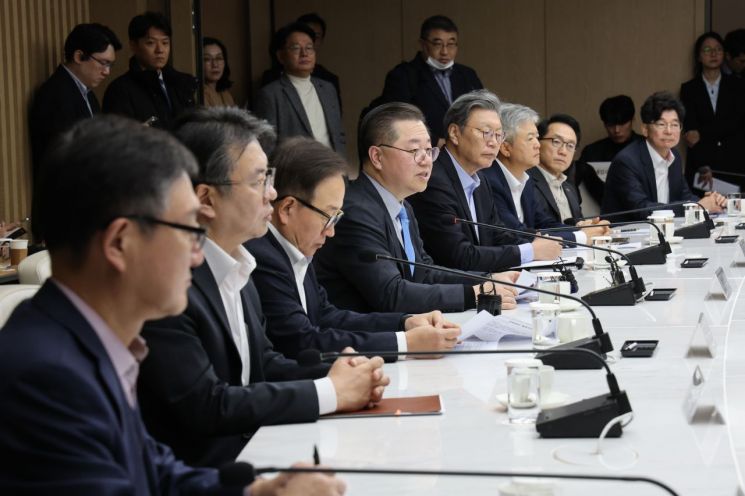 Park Iljun, Senior Vice President of the Korea Chamber of Commerce and Industry, is speaking at the meeting between the Democratic Party's KOSPI 5000 Special Committee, the Economic Criminal and Civil Liability Rationalization Task Force, and eight economic organizations held on the 11th at the Korea Chamber of Commerce and Industry in Jung-gu, Seoul. Photo by Yonhap News
On the morning of the 11th, eight major economic organizations, including the Korea Chamber of Commerce and Industry, presented the collective voice of the business sector at a meeting with the Democratic Party's KOSPI 5000 Special Committee and the Task Force on Rationalizing Economic Criminal and Civil Liability, held at the Chamber's headquarters in Jung-gu, Seoul.
The meeting was attended by Park Iljun, Senior Vice President of the Korea Chamber of Commerce and Industry; Kim Changbeom, Senior Vice President of the Federation of Korean Industries; Lee Donggeun, Senior Vice President of the Korea Employers Federation; Lee Inho, Senior Vice President of the Korea International Trade Association; Oh Kiwoong, Senior Vice President of the Korea Federation of SMEs; Jung Wooyong, Vice President of Policy at the Korea Listed Companies Association; Lee Hojun, Senior Vice President of the Korea Association of Middle Market Enterprises; and Kim Junman, Director General of the KOSDAQ Listed Companies Association. On the Democratic Party side, participants included Kwon Chilsung, head of the task force; Oh Gihyung, Chair of the Special Committee; Heo Young, Chief Policy Officer; and lawmakers Kim Namgeun, Lee Kangil, Park Hongbae, Ahn Dogeol, Kim Younghwan, and Jung Junho.
Vice President Park Iljun stated, "The business community does not disagree with the government's policy to revitalize the capital market," but added, "However, there are still many issues to consider and refine together, such as how much and what kind of exceptions will be allowed, what procedures will be used to permit them, and whether shareholders will realistically approve such exceptions at general meetings."
The mandatory cancellation of treasury shares was a central topic of discussion at the meeting. This is the core of the third amendment to the Commercial Act that the Democratic Party aims to pass within the year. Specifically, the amendment stipulates that newly acquired treasury shares must be cancelled within one year, and existing treasury shares must be cancelled within one year and six months. While the Democratic Party explained that these measures are intended to prevent treasury shares from being used for the benefit of specific shareholders, the business community voiced significant concerns.
Unlike in the United States and Europe, treasury shares are considered the only means of defending management control in Korea. The business community believes that, since mechanisms such as poison pills (shareholder rights plans) have not been introduced, the passage of the third amendment to the Commercial Act would expose companies to a higher risk of hostile mergers and acquisitions.
In response, the Democratic Party has excluded from the mandatory cancellation rule cases where treasury shares are used for employee compensation through stock options, for granting employee stock ownership plans, or for business purposes such as the introduction of new technologies and improvement of financial structure.
Vice President Park emphasized, "Rather than deciding direction and details in just one or two meetings, we should continue to communicate and consistently discuss ways to make progress going forward."
Kwon Chilsung, head of the task force, explained, "The business community has requested priority supplementary legislation regarding managerial decision-making principles mentioned in breach of trust cases, and alternative bills are currently being discussed within the party. The new legislation will protect companies' reasonable business judgments, but will continue to regulate offenses that have previously been punished as breach of trust, such as the private misuse of company assets by executives and employees."
© The Asia Business Daily(www.asiae.co.kr). All rights reserved.
![Clutching a Stolen Dior Bag, Saying "I Hate Being Poor but Real"... The Grotesque Con of a "Human Knockoff" [Slate]](https://cwcontent.asiae.co.kr/asiaresize/183/2026021902243444107_1771435474.jpg)
















