Rate Cut of 0.25 Percentage Points to 3.5~3.75% Annually
Only One Rate Cut Projected Each for Next Year and the Year After
Powell: "Downside Risks in Employment... Tariff-Driven Inflation Is Temporary"
Market Prices In 70% Chance of More Th
The United States Federal Reserve (Fed) has lowered its benchmark interest rate by 0.25 percentage points, marking its third consecutive rate cut. In its outlook for future rates, the Fed indicated that it expects to cut rates only once in each of the next two years, signaling a more cautious approach to monetary easing.
This decision could have been interpreted as a "hawkish cut" (favoring monetary tightening), but the financial markets, including stocks and bonds, reacted positively. Jerome Powell, Chairman of the Fed, emphasized downside risks to the labor market over inflation, delivering a more dovish message than expected. The Fed also projected a slowdown in inflation, which played a significant role in shaping market sentiment. As a result, many on Wall Street are now anticipating at least two rate cuts next year. However, there are still significant uncertainties, such as divisions within the Fed and the nomination of the next chair, leading many to describe the future rate path as "foggy."
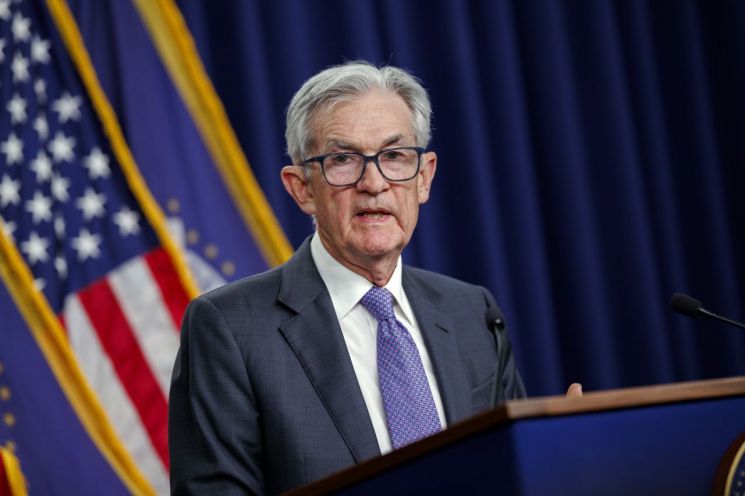
'Three Consecutive Rate Cuts' by the US Fed... Only One Cut Expected Next Year
On December 10 (local time), following its regular Federal Open Market Committee (FOMC) meeting, the Fed announced it would lower the federal funds rate by 0.25 percentage points to a range of 3.5% to 3.75% per annum. This marks the third consecutive cut after those in September and October. The interest rate gap between South Korea and the United States has narrowed from 1.5 percentage points to 1.25 percentage points at the upper bound.
At a press conference, Chairman Powell stated, "There are significant downside risks in the labor market," and assessed, "The current economy is not in a situation where overheated employment is pushing up prices." Regarding inflation, he said, "Excluding tariff factors, the inflation rate is in the low 2% range," and projected, "Tariff-driven inflation will peak in the first quarter of 2026 and weaken in the second half of the year."
The Fed's policy statement supported these views. The statement noted, "Since the beginning of this year, job growth has slowed and the unemployment rate has risen slightly through September," adding, "Recent data also support this trend."
During this decision, three of the twelve FOMC members with voting rights voted against the move, revealing internal disagreements. Jeffrey Schmidt, President of the Federal Reserve Bank of Kansas City, and Austan Goolsbee, President of the Federal Reserve Bank of Chicago, favored holding rates steady, while Fed Governor Stephen Miran advocated for a 0.5 percentage point cut, the so-called "big cut." This was the first time since September 2019 that three dissenting votes were cast, highlighting significant differences in policy priorities within the Fed as employment slows and inflation remains high.
In their outlook for future rates, FOMC members projected only one additional cut each in 2026 and 2027. According to the new dot plot, the median federal funds rate is expected to be 3.4% at the end of 2026 and 3.1% at the end of 2027, unchanged from the September forecast. This suggests that the pace of monetary easing may slow further starting next year. The rate forecast for the end of 2028 remains at 3.1%, indicating no further cuts are expected.
Powell Delivers Unexpectedly Dovish Remarks... Wall Street Sees "Possibility of Two or More Cuts Next Year"
Although the Fed’s projection of only one rate cut next year was seen as a hawkish move, Chairman Powell’s subsequent remarks were interpreted as a dovish signal by the market.
Chairman Powell stated, "We are in a good position to observe how the economy unfolds going forward." He also said that the current rate level is close to "neutral," meaning it neither stimulates nor restrains the economy, and emphasized, "For now, a rate hike is not anyone's base scenario," drawing a line against further tightening. These comments immediately eased market concerns about a potential halt to rate cuts.
The new Summary of Economic Projections (SEP) also indicated expectations for easing inflationary pressures. The Fed projected this year’s core Personal Consumption Expenditures (PCE) inflation rate at 3.0%, expecting it to fall to 2.5% by 2026. The growth forecast for 2026 was significantly raised from 1.8% to 2.3%. The unemployment rate at the end of next year was maintained at 4.4%. Additionally, the Fed’s decision to end quantitative tightening (QT) and resume short-term Treasury purchases earlier than initially expected also served as an easing signal to the market.
Wall Street is anticipating a more accommodative monetary policy than the Fed’s projection of just one cut next year. According to CME FedWatch, the current interest rate futures market reflects a 70.6% probability that rates will fall by more than 0.5 percentage points by the end of next year. All three major New York stock indexes rose, with the Dow Jones up 1.05%, the S&P 500 up 0.67%, and the Nasdaq up 0.33%.
Anna Wong, an economist at Bloomberg Economics (BE), analyzed, "Considering the slowdown in job growth and the outlook for lower inflation, the Fed is expected to cut rates four times next year."
Next Year's Rate Path Remains 'Foggy'... New Chair Nomination and Internal Divisions Add Uncertainty
Despite this optimism on Wall Street, many analysts point out that the path for next year’s rates remains highly uncertain. Several FOMC members continue to advocate for holding rates steady, and there are significant differences in priorities among members regarding responses to employment and inflation.
The nomination of a successor to Chairman Powell, whose term expires in May 2026, is another variable. Kevin Hassett, Chairman of the White House National Economic Council (NEC) and a close associate of President Donald Trump, who has called for substantial rate cuts, is considered a leading candidate for the next Fed chair. Depending on whether he is appointed, the direction of future monetary policy could change significantly, potentially causing further conflict and confusion within the FOMC.
Rick Rieder, Chief Investment Officer (CIO) of Fixed Income at BlackRock, stated, "Given the lack of consensus within the committee, delays in the release of economic data, and the possibility of a new Fed chair being nominated, the Fed is likely to keep rates on hold for the time being."
Kristina Hooper, Chief Market Strategist at Man Group, predicted, "There are wide differences of opinion within the FOMC, and some members have different priorities. It is clear that debates will intensify going forward."
© The Asia Business Daily(www.asiae.co.kr). All rights reserved.

















